
Key takeaways
- Map each zone, run, fitting or track section to a measurable location and intended task.
- Record voltage, driver position, control method, cable route, isolation point and access limits.
- Separate observed conditions from measurements, drawings and supplier-confirmed facts.
- Ask suppliers to identify assumptions, exclusions, proposed model references and open evidence.
- Freeze the survey revision before comparing quotations or approving a sample.
1. What should a commercial LED lighting site survey capture?
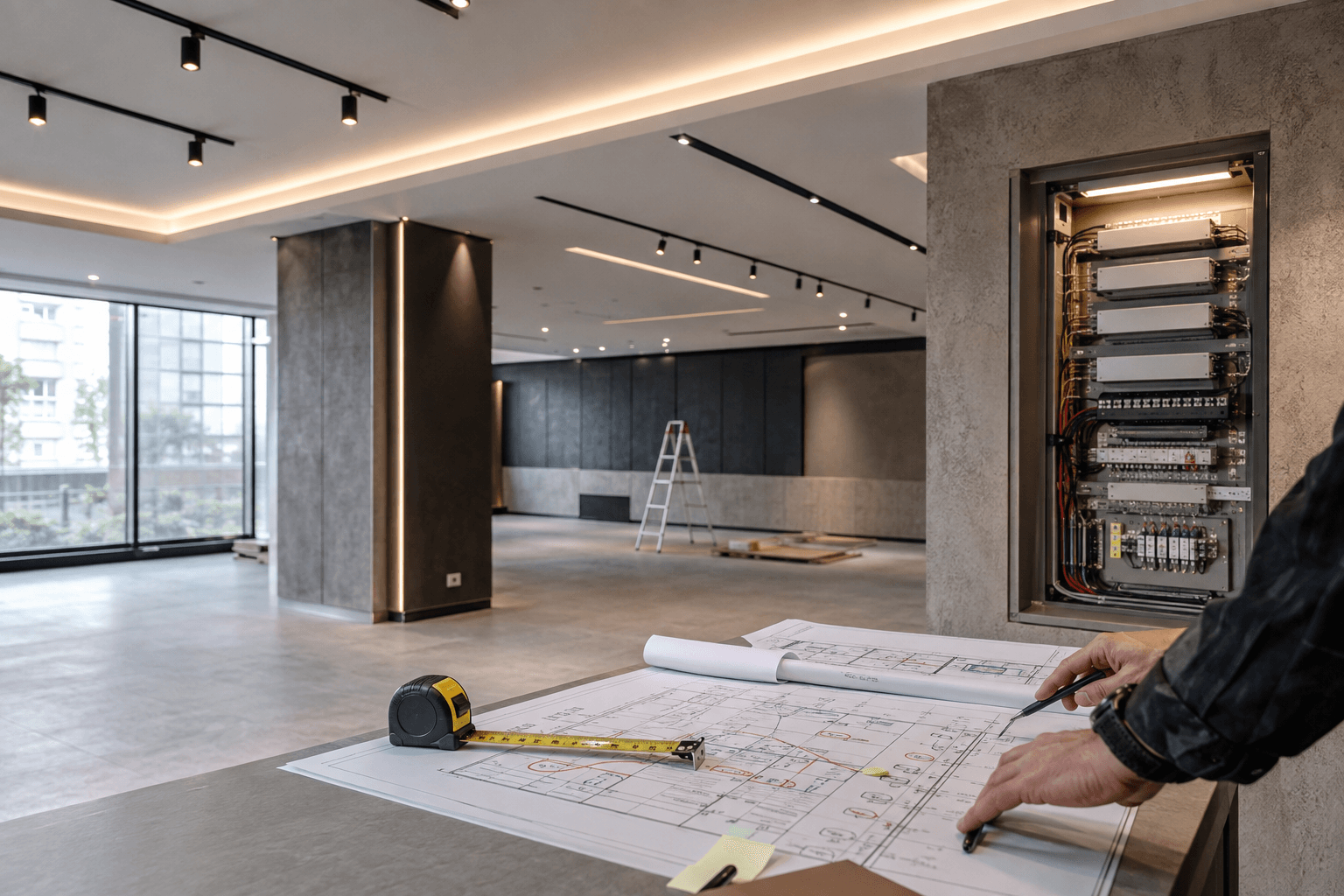
Before requesting a commercial LED lighting quotation, record the application, dimensions, installed interfaces, electrical supply, controls, access, environment, destination market and required documents. A site survey should expose unknowns and approval boundaries; it should not turn assumptions into product specifications.
| Survey area | Record | Boundary |
|---|---|---|
| Application | Retail, hospitality, office, signage, joinery or other use | Intended visual task must be stated |
| Geometry | Lengths, heights, recesses, cut-outs, bends and obstructions | Do not infer dimensions from a photo |
| Electrical | Supply, driver location, cable route, isolation and load basis | Final design requires exact product data |
| Controls | Dimming, zones, protocol, sensors and scene expectations | Compatibility is configuration-specific |
| Environment | Indoor/outdoor boundary, moisture, heat, dust and access | Do not transfer an IP assumption between models |
| Evidence | Drawings, samples, documents and market requirements | Generic brochures may leave gaps |
2. Map the installed or proposed interfaces
For LED strips, note profile, diffuser, feed points, joints, end treatment, bend direction and service access. For magnetic systems, note track sections, feeds, modules, drivers and control zones. For spotlights, note cut-out, adapter, optic, finish, driver and mounting interface. Record what is observed, what is measured and what still needs supplier confirmation.
- Use one reference for each zone or assembly
- Record approved substitutions and revisions
- Link labels and drawings to the installed location
- Keep survey records with the quotation pack
3. Check power, controls and service access
Record the available supply and proposed driver or power-supply location, but do not invent a load calculation before the exact model and connected length are known. Mark cable routes, practical access, isolation points and areas that cannot be opened without disrupting finishes. A larger driver is not a universal remedy for voltage drop, wiring or control mismatch.
4. Create a supplier-ready survey pack
Send the survey revision, application drawings, dimensions, photos, quantity basis, destination market, preferred or approved references, control requirements and requested evidence. Ask each supplier to return the exact proposed model and revision, inclusions, exclusions, assumptions, deviations, documentation scope and open questions.
- Application and destination market
- Dimensions, run lengths and quantities
- Driver, controller and feed locations
- Profile, mounting and environment
- Model-specific documents and sample expectations
5. Define approval and change boundaries
Use statuses such as observed, measured, supplier-confirmed, pending, approved or superseded. Changes affecting electrical, optical, mechanical, environmental, control or compliance performance require review before quotation acceptance, sample approval or production release. Price, MOQ, stock, lead time, capacity and delivery remain current written supplier confirmations.
| Status | Meaning | Buyer action |
|---|---|---|
| Observed | Condition seen on site | Record source and date |
| Measured | Dimension or value captured | Keep method and location |
| Supplier-confirmed | Written product or commercial response | Check exact scope |
| Pending | Evidence or decision incomplete | Do not treat as approval |
| Approved | Defined scope accepted | Freeze revision and approver |
Frequently asked questions
Questions buyers ask
Is a site photograph enough for an LED lighting quotation?
No. Photos help explain context, but suppliers also need dimensions, quantities, electrical conditions, controls, installation interfaces and destination market.
Should a survey specify the final LED model?
Not always. It should define the application and interfaces precisely enough for comparable proposals, while the exact model and revision remain supplier-confirmed and approval-controlled.
Does a site survey prove compliance or performance?
No. It records conditions and requirements. Product-specific technical and market evidence, calculations, samples or tests may still be required.
What should buyers ask suppliers to disclose?
Request the exact model and revision, included components, assumptions, exclusions, proposed driver or controls, evidence scope, deviations and open questions.
When should the survey be updated?
Update it when dimensions, layout, supply, controls, environment, access, product identity or project requirements change. Keep superseded revisions for traceability.
Talk to the product team
Planning an OEM or commercial lighting order?
Send your application, specification and destination market. We will help narrow the product and sample options.
Discuss on WhatsApp