
Key takeaways
- 0-10V is simple and cheap but analog and one-way; DALI is digital, addressable and two-way but costs more.
- TRIAC is for retrofit into existing wall dimmers; it needs the right driver and load, or you get flicker.
- PWM is best for color-tuning and high-frequency control inside fixtures, not for long wire runs.
- Choose the protocol by control system, not by driver price — swapping protocols later means rewiring, not just swapping drivers.
1. Why the dimming protocol matters more than the dimmer
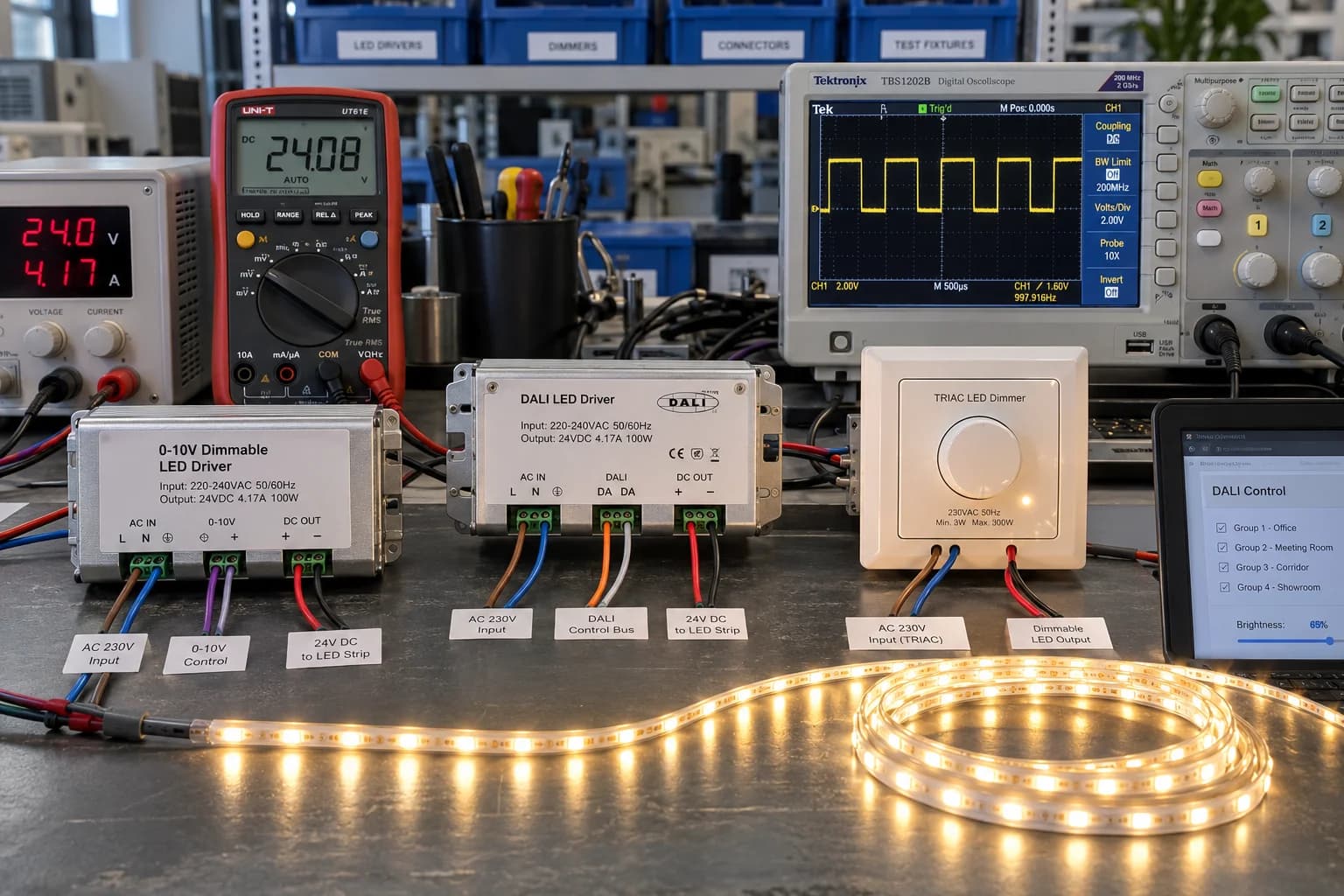
A dimming system has three parts: the control signal, the driver, and the dimmer or controller that generates the signal. When buyers pick a dimming protocol, they often focus on the dimmer in the showroom and forget that the driver must speak the same language.
Put a 0-10V dimmer on a DALI driver and nothing happens. Put a TRIAC dimmer on a 0-10V driver and the driver may dim erratically or not at all. The protocol is a contract between all three devices.
That is why retrofits and spec changes fail on site: the luminaires arrive with the wrong protocol, and rewiring or swapping drivers mid-project costs more than the fixtures themselves.
This guide compares the four common protocols so you can specify the right one before you order.
2. 0-10V: the workhorse that never goes away
0-10V uses a low-voltage analog signal (0 to 10V DC) to set brightness. 10V is full brightness, 0V is the lowest level, and many drivers switch off below a set threshold like 1V.
It is the cheapest and most widely understood dimming method in commercial lighting. Two extra wires run from the controller to the driver, and most electricians can install it without special training.
The limits: it is one-way (the driver cannot report status), it is not addressable (all drivers on the same circuit dim together), and long wire runs can pick up interference that causes visible flicker. For offices, hotels and retail where a simple group dimming is enough, 0-10V is usually the right call.
Wiring note: 0-10V dimming wires should run separately from mains cables, and the total loop length matters. Beyond about 50 meters, signal drop becomes noticeable.
3. DALI: addressable control for larger buildings
DALI (Digital Addressable Lighting Interface) is a digital two-way protocol. Each driver has an address, so a controller can dim, switch, read status and reconfigure individual fixtures over the same two control wires.
This changes what the building can do: scene setting per room, occupancy-linked dimming, daylight harvesting, and maintenance alerts (a driver can report a lamp failure). For offices with meeting rooms, hotels with corridor scenes, or retail with display zones, DALI justifies its higher cost.
The cost is real: DALI drivers cost more, the controller and commissioning software add expense, and a qualified person must program the system. A common mistake is buying DALI fixtures but skipping commissioning—the system then behaves like expensive non-DALI lighting.
DALI-2 is the current standard and is backward compatible for most basic use. If your project needs grouping and scenes, specify DALI-2 drivers and a DALI-2 controller from the same compatibility list.
4. TRIAC: the retrofit option that needs care
TRIAC dimming (also called leading-edge or phase-cut) is designed to work with the wall dimmers people already have. The dimmer chops the AC waveform, and the driver reads the phase angle to set brightness.
Its big advantage is retrofit: replace the lamp or driver, keep the wall dimmer, and dimming works. That makes it popular for residential and hospitality refurbishments.
The traps: not every LED driver is TRIAC-dimmable, and not every dimmer works with every driver. Pairing a cheap dimmer with a cheap driver often produces flicker, a minimum brightness that is too high, or a dead zone at the bottom of the range.
A practical rule for buyers: if the project is a retrofit on existing wall dimmers, specify TRIAC dimmable drivers and test the exact dimmer-driver pair before bulk ordering. If you are designing the control system from scratch, 0-10V or DALI gives more reliable results for little extra cost.
5. PWM: precision control inside the fixture
PWM (pulse-width modulation) dims by switching the LED on and off very rapidly; brightness depends on the ratio of on-time to off-time. At high frequencies (1 kHz and above) the switching is invisible to the eye.
PWM is the standard inside LED drivers and controllers for color tuning, and for applications that need precise, repeatable levels. It is also how most tunable-white and RGB control works.
Where it struggles: as a long-distance control signal, because high-frequency pulses attenuate and distort over cable runs, and because the switching can interfere with other equipment if not filtered. For most building projects, PWM is an internal technique rather than the chosen building control protocol.
Buyers should check that a PWM-controlled driver matches the controller's frequency and signal level; mixing 5V and 12V PWM signals on one circuit is a classic wiring error.
6. A practical selection framework
Ask three questions in order:
1. Is there an existing control system? If a BMS or smart-building system is already specified, it decides the protocol—do not fight it.
2. How many zones and scenes do you need? A few groups dimmed together: 0-10V. Individual addressing, scenes and status: DALI. Retrofit with existing wall dimmers: TRIAC.
3. Who installs and maintains it? 0-10V and TRIAC can be handled by general electricians. DALI needs commissioning, and the commissioning documents must be handed over, or the system's value is lost.
One more consideration: sensor compatibility. Daylight sensors and occupancy sensors come in 0-10V or DALI versions; if your design uses sensors, confirm they speak the same protocol as the drivers.
7. Buying checklist: questions to put in the PO
When you order dimmable LED products, put these in writing:
1. State the protocol explicitly: '0-10V dimmable driver, 1-10V control range' is different from 'TRIAC dimmable'.
2. Ask for the dimming range (e.g. 5%-100%) and the minimum load or minimum brightness level.
3. For TRIAC, ask which dimmer models the driver was tested with, and request the test report.
4. For DALI, confirm the DALI version, the number of drivers per controller, and whether commissioning is included in the quote.
5. Ask for the wiring diagram and the maximum control-cable length for the chosen protocol.
These five lines in the PO prevent most on-site dimming failures and the change orders that follow them.
Frequently asked questions
Questions buyers ask
Can I use a 0-10V dimmer with a DALI driver?
No. 0-10V and DALI use different signaling and are not compatible. You would need a protocol converter, which adds cost and complexity. Choose one protocol for the whole system, or convert at the control level, never at the driver level.
Is TRIAC dimming the same as PWM dimming?
No. TRIAC is a phase-cut method on the AC mains side that the driver interprets; PWM is a high-frequency on-off switching signal usually generated inside the driver or controller. They are different signal types and need different driver designs.
Which dimming protocol is best for an office building?
For simple group dimming with a small budget, 0-10V is cost-effective and reliable. For meeting rooms, scenes, daylight harvesting and per-fixture control, DALI is the better choice despite the higher cost. Base the decision on how the space will be controlled, not on driver price alone.
Why do my TRIAC dimmed LEDs flicker at low levels?
Flicker at low levels usually comes from a dimmer-driver mismatch, a dimmer minimum load that is too high, or a driver that is not truly TRIAC-dimmable. Test the exact dimmer-driver pair before bulk ordering, and avoid mixing dimmer brands across one circuit.
Talk to the product team
Planning an OEM or commercial lighting order?
Send your application, specification and destination market. We will help narrow the product and sample options.
Discuss on WhatsApp