
Key takeaways
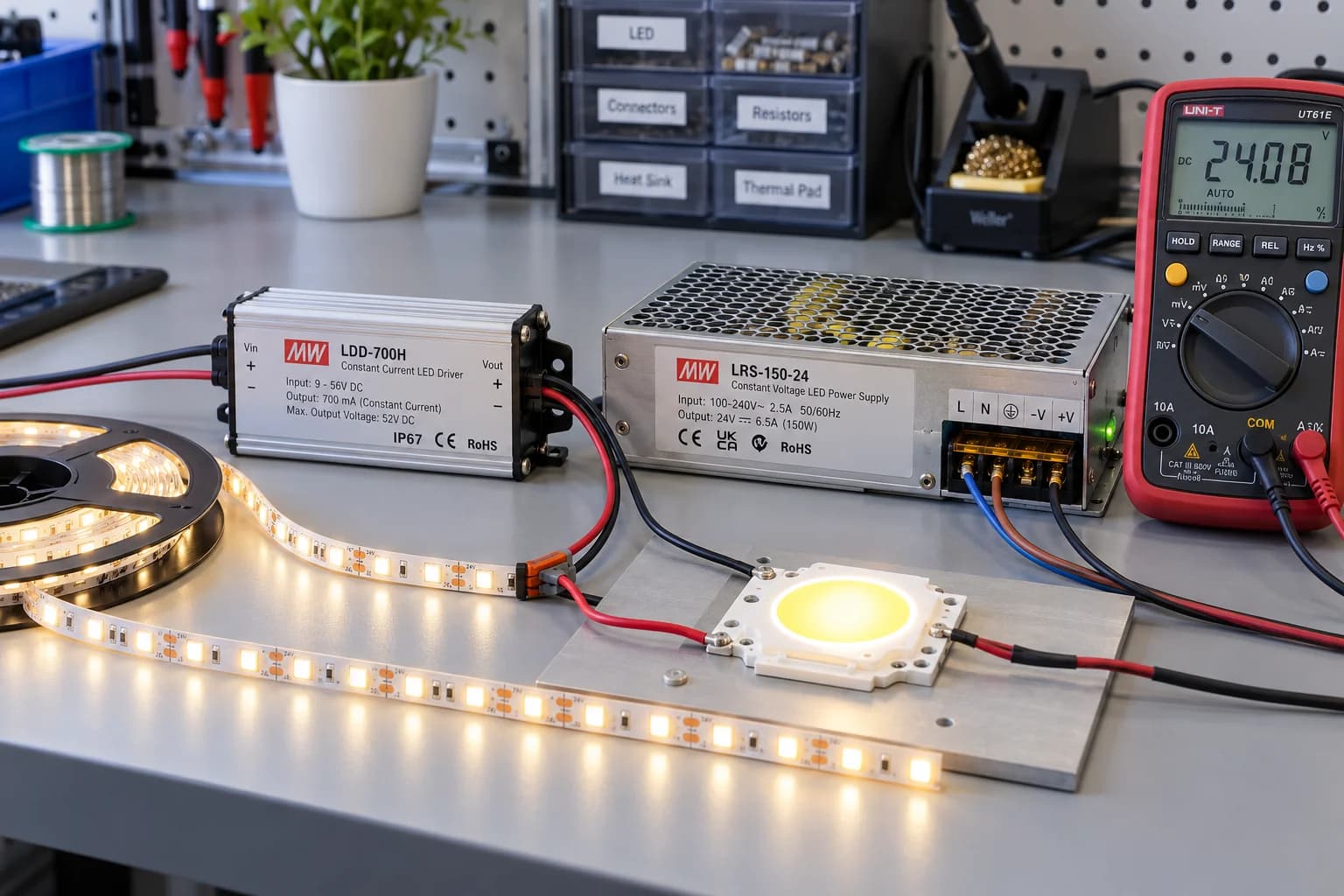
- Constant-current drivers regulate current and are for LED modules and luminaires; constant-voltage drivers regulate voltage and are for LED strips with resistors.
- Wattage alone never tells you which driver type you need—check the LED product's required input.
- LED strips run on constant voltage (12V or 24V); LED modules, downlights, and panels almost always run on constant current.
- The cheapest quote often pairs the wrong driver type with your product. Confirm output type in writing before you order.
1. The one-paragraph difference
A constant-current (CC) driver keeps the current flowing to the LED at a fixed level, while the voltage drifts within a range as the LED heats up. A constant-voltage (CV) driver keeps the output voltage fixed at 12V or 24V and lets the connected strips draw whatever current their circuits demand.
Why does this matter? LEDs are current-driven devices—the amount of light they emit and the heat they produce is governed by the current, not the voltage. Give an LED slightly too much current and it overheats; give it slightly too little and it dims unevenly.
So CC drivers protect the LED by holding current steady. CV drivers assume the load has its own current limiting (the resistors on every LED strip), and just deliver a stable voltage.
2. Which LED products use which type
The rule of thumb is simple: if the product is designed for a fixed voltage input, it uses a CV driver. If the product contains bare LED chips with no built-in resistors, it uses a CC driver.
Constant voltage: LED strip lights (12V or 24V), LED modules with resistors, some signage and lightbox products, and any product that says 'input 12V' or 'input 24V' on the label.
Constant current: downlights, spotlights, LED panels, most high-power COB modules, and any product whose label gives a current range (e.g. 350mA, 700mA, 1050mA) instead of a voltage.
The dangerous gray zone: magnetic track systems with replaceable modules. The track runs on a driver that may be CC or CV depending on the module design. Always match the replacement module to the track's driver type—mixing them is the fastest way to fry a module.
3. Why wattage is not enough
The most common buyer mistake is matching drivers by wattage alone. 'My strip is 60W, so I need a 60W driver' sounds logical, but it skips the two questions that actually matter:
First: does your product need a regulated voltage or a regulated current? A 60W 12V strip needs a 60W CV 12V driver. A 60W panel with four COB modules might need a 15W CC driver per module, or one 60W CC driver at a specific current.
Second: what is the exact output value? A CV driver must match the strip voltage exactly (12V vs 24V is not interchangeable). A CC driver must match the module's rated current and stay within its voltage window—using a 700mA driver on a 350mA module will overdrive it and shorten its life dramatically.
Get the datasheet of the LED product, find the required input type and value, and only then compare drivers.
4. How to read a driver label in 30 seconds
Driver labels tell you which type it is, but only if you know where to look:
Look for 'output: 12V' or 'output: 24V' with a fixed number—that is a constant-voltage driver. The current rating (e.g. 5A) is just the maximum the driver can deliver, and you must not exceed it with the total strip load.
Look for 'output: 350mA' or '700mA' plus a voltage range like '18-36V'—that is a constant-current driver. The voltage range is not adjustable; it is the window within which the driver keeps the current stable. Your LED module must fall inside that window.
If the label shows a current with a range of currents and voltages (e.g. '200-700mA, 6-42V'), it is a multi-current adjustable driver. Fine for flexible inventory, but you must set the correct current for your module before install.
5. The selection checklist buyers should use
Before you place the order, answer these five questions:
1. What is the LED product's required input type? (Voltage value, or current value?)
2. For CV: what is the exact voltage (12V or 24V) and the total wattage of the strip at 100% brightness? Add 20% headroom.
3. For CC: what is the module's rated current and its voltage window at that current?
4. Is dimming required? If yes, confirm the driver supports the dimming protocol (TRIAC, 0-10V, DALI, PWM) that your control system uses.
5. What is the operating environment? Outdoor and high-temperature sites need drivers with the right IP rating and a higher temperature rating—a CV 24V driver that works in an office may derate badly in a signage box in summer.
6. The cost and warranty angle
Constant-current drivers are usually more expensive than constant-voltage supplies of similar wattage, because the current regulation circuitry is more complex. A CC driver for a panel costs more than a CV supply for a strip.
That does not mean you can swap a CV supply into a CC application to save money. The LED modules will not regulate their own current; without a CC driver they will draw whatever the voltage allows, overheat, and fail—often within weeks, sometimes within hours.
When comparing quotes, ask the supplier to state the output type in the PO. A '24V LED driver' and a '700mA LED driver' are not substitutes for the same application, and the lowest quote is only a bargain if the driver actually fits your product.
Frequently asked questions
Questions buyers ask
Can I use a constant voltage power supply for LED strips?
Yes—LED strips are designed for constant-voltage input (12V or 24V) because they have built-in resistors that limit current. This is the standard setup. Just match the voltage exactly and keep the total wattage below 80% of the supply's rating.
What happens if I use a constant current driver on LED strips?
LED strips are not built for constant current. A CC driver will push a fixed current that the strip's resistors were not designed for, causing uneven brightness, overheating, and early failure. Always use a CV supply for strips.
How do I know if my LED module needs constant current?
Check the product label or datasheet. If it specifies a current like 350mA or 700mA with a voltage range, it needs a CC driver. If it specifies a fixed input voltage like 12V or 24V, it needs a CV driver. Never guess from wattage alone.
Why are constant current drivers more expensive?
CC drivers contain more complex regulation circuitry to keep current stable across temperature and voltage changes. CV supplies are simpler and cheaper to build. The price difference is usually 20-40% at the same wattage, but the two types are not interchangeable.
Talk to the product team
Planning an OEM or commercial lighting order?
Send your application, specification and destination market. We will help narrow the product and sample options.
Discuss on WhatsApp