
Key takeaways
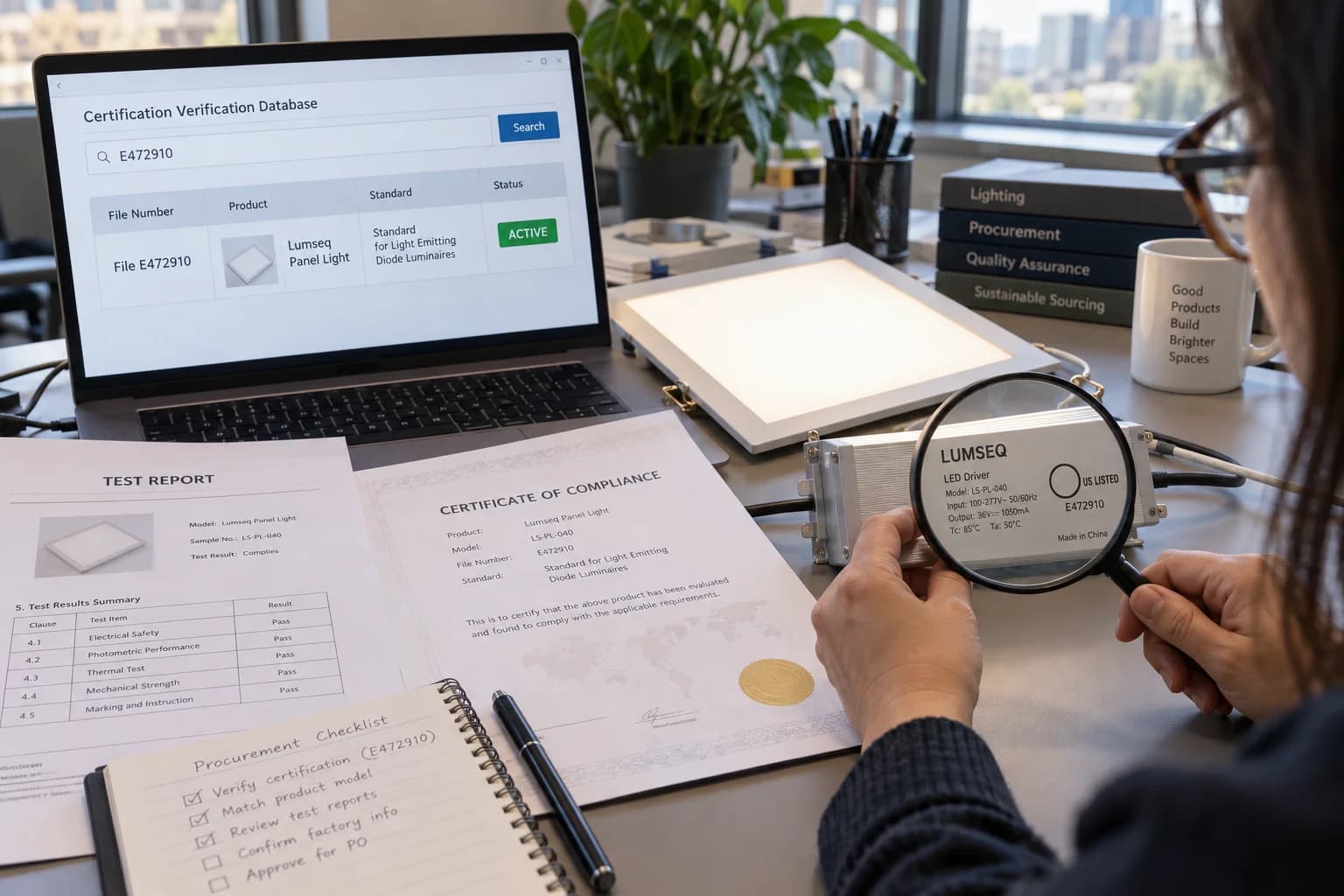
- A certificate PDF or photo is not proof - only a current, public listing in the certification body's own database is. Verify UL/ETL file numbers, DLC product IDs and ENERGY STAR entries against the exact model before buying.
- In the US, UL and ETL are both OSHA-recognized NRTLs testing the same standards (UL 1598 for luminaires, UL 8750 for LED equipment), plus FCC Part 15; CE is a self-declaration and carries no weight with US authorities.
- DLC and ENERGY STAR are efficiency labels, not safety marks. The DLC QPL is the gateway to commercial utility rebates, and products can be delisted, so confirm the exact model is currently listed rather than merely listed at some point.
- In the EU, CE is the manufacturer's declaration backed by technical documentation and an EU DoC covering LVD, EMC, RoHS and ErP (RED for wireless); ENEC adds independent third-party assurance. Require LM-79 and TM-21 reports from an accredited laboratory.
1. The certificate file is not proof - the listing is
A supplier emails a certificate with a colored logo, a file number and a signature, and it looks official. It is also trivial to reproduce or alter in image software. The single most important habit in LED sourcing is to stop treating a certificate as the deliverable.
Safety certification is not a document. It is a live, public record: the specific product, under the specific manufacturer, is listed in the certification body's own database against the correct standard, and that listing is currently active. A paper certificate can be faked; a database record cannot be invented by the factory.
So the verification question changes. Instead of 'send me the certificate', ask for the file number, control number or product ID, then open the certifier's public database and confirm four things: the model matches, the manufacturer matches, the standard matches, and the status is active. The rest of this guide explains what each label means and exactly where to look.
2. What 'safe' actually means in the US market
The United States runs an NRTL system: Nationally Recognized Testing Laboratories that OSHA recognizes under 29 CFR 1910.7. UL and ETL (issued by Intertek) are two of the better-known NRTLs; CSA is another. They test to the same published standards, so an ETL listing and a UL listing carry equal legal weight.
The two standards that matter most for LED are:
1. UL 1598, the safety standard for luminaires in non-hazardous locations on branch circuits of 600 V or less.
2. UL 8750, the safety standard for LED equipment used inside lighting products, covering the light engine, driver and related components.
For retrofit conversion kits the relevant standard is UL 1598C, and for horticultural luminaires it is UL 8800. On top of safety, the electronic driver and any wireless module must meet FCC Part 15 for electromagnetic emissions - that is a regulatory requirement, not a voluntary mark.
The UL versus ETL choice is mostly commercial: both are accepted by the electrical inspector (the authority having jurisdiction), under the National Electrical Code, and by insurers, who may refuse a claim tied to an uncertified electrical product. ETL certification is often cheaper and faster to obtain. What is not accepted in the US is CE marking: it is a self-declaration and has no standing with an NRTL or an electrical inspector.
3. Efficiency labels: DLC and ENERGY STAR
DLC and ENERGY STAR say nothing about electrical safety; they are efficiency programs, and they matter because they control access to rebates and approved-product lists.
DLC, the DesignLights Consortium, publishes the Qualified Products List (QPL) that has become the practical gateway for commercial lighting: utility rebate programs almost only pay for products on the QPL. It has Standard and Premium tiers and requires performance data such as an LM-79 report, a TM-21 lifetime projection and, for some categories, in-situ testing. DLC audits listings and removes products that fail or drift, so a model can be delisted.
ENERGY STAR is a US EPA program that uses an EPA-recognized laboratory and an independent certification body, and it is strongest in residential and consumer products. It also maintains a public certified product list.
The verification trap is assuming a model is covered because it was listed once. The model you are buying must appear on the current QPL or ENERGY STAR list under its exact product ID, with the correct tier, on the day you order. A listing that was removed last month no longer qualifies for a rebate.
4. What the EU requires: CE is a claim, not a certificate
In the European Economic Area, CE marking is mandatory for most LED products, but for ordinary luminaires it is largely a self-declaration rather than a document issued by a certification body. The manufacturer, or the importer, must be able to back the mark with two things: a technical documentation file and a signed EU Declaration of Conformity (DoC).
The main legal instruments a LED luminaire must satisfy are:
1. Low Voltage Directive LVD 2014/35/EU for electrical safety.
2. EMC Directive 2014/30/EU for electromagnetic compatibility.
3. RoHS Directive 2011/65/EU restricting hazardous substances.
4. Ecodesign Directive ErP 2009/125/EC for energy performance.
5. Radio Equipment Directive RED 2014/53/EU for products with a wireless link.
Under the LVD, ordinary luminaires generally do not require a notified body; the manufacturer carries out the conformity assessment. The DoC and technical documentation must be kept available for market surveillance, and the importer carries explicit duties to verify the file, the mark and the labeling. For tenders that want more than self-declaration, ENEC is an independent pan-European mark issued by bodies such as TÜV, and its certificates can be checked in public databases such as TÜV Certipedia.
A practical warning: many suppliers offer a 'CE certificate' sold by a commercial testing house. CE marking does not require such a certificate, and a piece of paper does not replace the technical file and the DoC. Ask for the DoC and the underlying reports instead.
5. The test reports behind the labels: LM-79, LM-80, TM-21
Certifications rest on test reports, and three documents cover most LED performance questions:
1. LM-79 measures the finished luminaire's electrical and photometric performance under steady-state conditions: total lumens, power, CCT, CRI and the luminous intensity distribution.
2. LM-80 measures the luminous flux maintenance of the LED package, array or module over time at several operating temperatures, for a long test period that runs to thousands of hours.
3. TM-21 provides the method for projecting the LM-80 data forward to estimate lumen maintenance life, such as the L70 point.
When checking reports, look for the laboratory name and accreditation, the tested model, the date and the test conditions. Common problems include a report dated before the product existed, a model number that does not match the order, and a laboratory without recognized accreditation. For efficiency programs, the laboratory must meet the scheme's specific accreditation requirements, so an accredited-laboratory mark (for example ILAC, A2LA or CNAS) matters.
6. How to verify a certificate in ten minutes
This is the operational routine to run on every new supplier and every significant model:
1. Collect the identifiers: UL file number (often in the E###### format), ETL control number, DLC product ID, ENERGY STAR listing, and the test report numbers.
2. UL: open UL Product iQ and search the file number or company, then confirm the model, manufacturer, standard and status.
3. ETL: use the Intertek verification directory to check the control number and listing.
4. DLC: open the QPL on the DesignLights Consortium site and search the model or product ID; confirm the tier and that it is currently listed.
5. ENERGY STAR: check the certified product list on the ENERGY STAR site.
6. EU: request the signed EU DoC and the technical documentation, including the test reports; for ENEC or TÜV marks, verify in Certipedia.
7. Cross-check consistency: the manufacturer, model, electrical ratings and standard version in the database must match the proforma invoice and the goods, with an active status.
8. On receipt: verify the mark on the product nameplate and confirm its model and file number match the listing.
If the database cannot find the record, the model differs, or the status is inactive, the product is not certified regardless of what the printed certificate shows.
7. Specification clauses that protect the buyer
These clauses turn certification into an enforceable requirement rather than a marketing claim.
Safety: all luminaires shall be listed by an OSHA-recognized NRTL (UL or ETL) to UL 1598 and UL 8750 for the US market, and shall comply with FCC Part 15; the supplier shall provide the file number and a current listing.
Efficiency: products shall be listed on the current DLC QPL at the specified Standard or Premium tier, and/or be ENERGY STAR certified, with the product ID; the supplier shall notify the buyer of any delisting.
EU: products shall be CE-marked with a signed EU Declaration of Conformity covering LVD, EMC, RoHS and ErP, plus RED for wireless, supported by technical documentation; ENEC shall be provided where specified.
Test data: an LM-79 report and a TM-21 projection from an accredited laboratory, with the model and date matching the product.
Verification and remedy: the supplier shall provide file and control numbers and authorize the buyer to confirm listings; any unit not matching the listing may be rejected at the supplier's cost.
Suppliers who can hand over a file number and a database screenshot without hesitation are certified. Suppliers who only provide a certificate photograph, whose record cannot be found, or whose model does not match are almost always selling an uncertified product.
Frequently asked questions
Questions buyers ask
Is UL better than ETL?
No. UL and ETL are both OSHA-recognized NRTLs that test to the same standards, carry equal legal weight, and are accepted by electrical inspectors and under the National Electrical Code. The difference is the issuing body, cost and schedule; ETL is often cheaper and faster. Judge a product by whether its listing is current and matches the model, not by which NRTL mark appears.
Can I sell a CE-marked LED light in the United States?
Not for a compliant commercial installation. CE marking is a self-declaration used in the European Economic Area and is not recognized by US authorities. The US market requires an NRTL listing such as UL or ETL to the applicable standards, plus FCC Part 15 compliance for emissions. CE cannot replace those.
What is the difference between DLC and ENERGY STAR?
Both are efficiency labels rather than safety marks. DLC is the commercial-lighting gateway for utility rebates, with a public Qualified Products List and Standard and Premium tiers. ENERGY STAR is an EPA program with independent certification and is stronger in residential and consumer products. Under either scheme, the exact model must be on the current list.
What happens if a DLC-listed product is delisted after I buy it?
A delisted product no longer qualifies for rebates and may fall outside an approved-product specification. Confirm the model is currently listed before ordering, include a clause requiring the supplier to notify you of any delisting and to take responsibility for it, and re-check the QPL on large or repeated shipments.
Talk to the product team
Planning an OEM or commercial lighting order?
Send your application, specification and destination market. We will help narrow the product and sample options.
Discuss on WhatsApp