
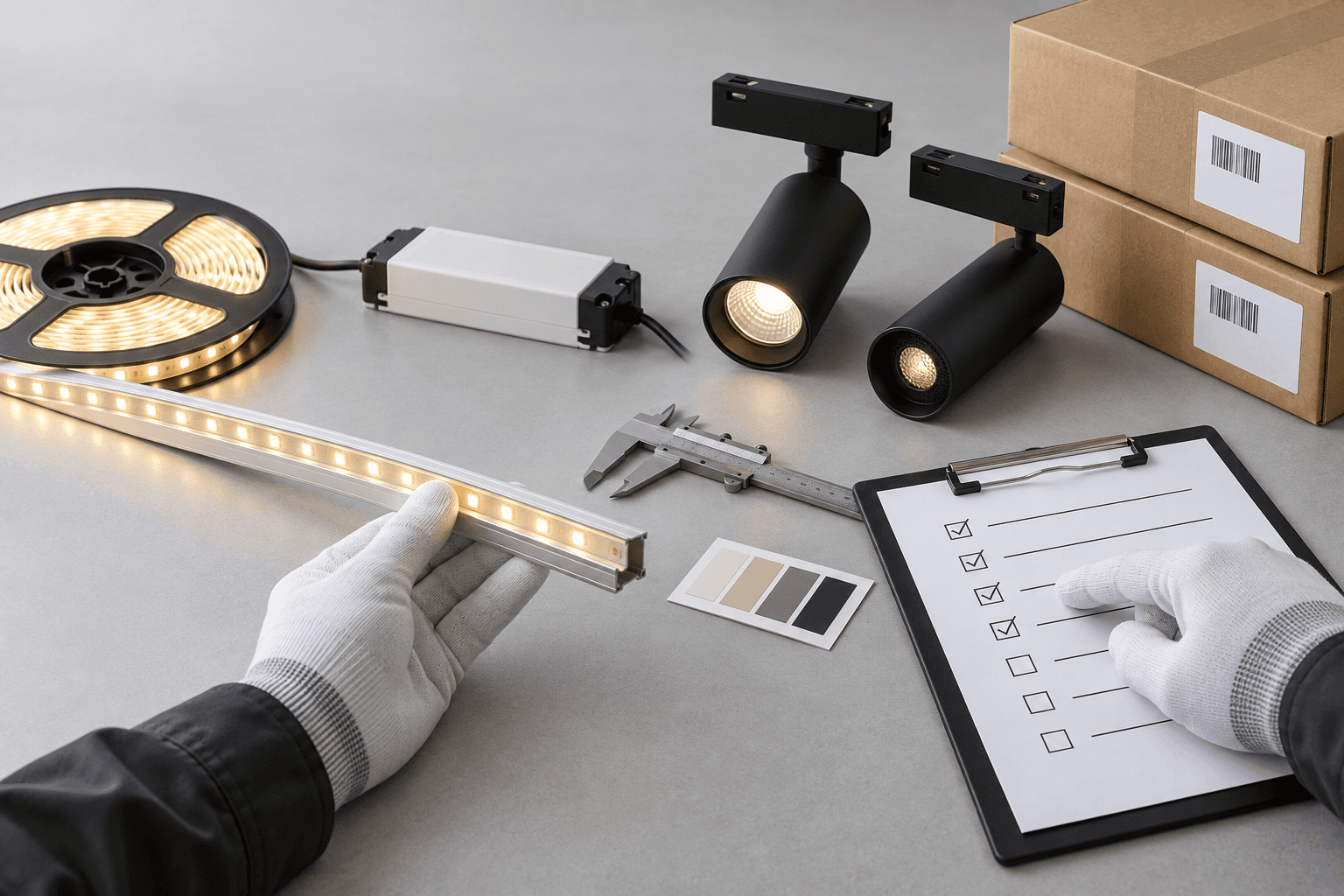
Key takeaways
- Freeze the exact model, revision, configuration and acceptance conditions before the pilot run.
- Inspect representative units under the same driver, profile, diffuser, control state and viewing conditions used for approval.
- Reconcile labels, packaging, accessories and documents before releasing mass production.
- Record every deviation with an owner, evidence request and disposition.
- Keep the approved pilot record linked to the purchase order and future repeat-order baseline.
1. What is a pilot-run approval?
A pilot run is a controlled production quantity made after the product and order conditions have been defined but before the full quantity is released. It gives the buyer a practical checkpoint between a laboratory or hand-built sample and mass production.
Pilot approval is not a universal certification, factory audit or guarantee that every future batch will be identical. It is a documented decision about a defined model, revision, configuration, quantity and acceptance method. The exact scope should be written on the approval record.
2. Freeze the approved baseline first
Use one controlled baseline before inspecting the pilot. Link the quotation, purchase order, technical submittal, approved sample, drawings, packaging artwork and change records. Record the fields that can change fit, appearance, performance or interchangeability.
Do not approve a family name while the sample, quotation and drawing describe different configurations. Mark supplier-stated, buyer-observed, measured, pending and superseded information clearly.
| Baseline area | Record before the pilot | Why it matters |
|---|---|---|
| Product identity | Model, revision, supplier code and market version | Prevents a family name from hiding a different configuration |
| Electrical | Voltage, power basis, driver, control method and operating condition | A visual check under a different setup may be misleading |
| Optical | CCT, CRI, density, optic, beam and diffuser where relevant | Appearance depends on the complete optical stack |
| Mechanical | Dimensions, mounting, connectors, track interface or cut rule | Similar-looking parts may not fit or connect |
| Packaging | Carton marks, labels, barcode, artwork and quantity basis | Packaging supports identification during receiving and resale |
| Documents | Data, wiring, installation and applicable evidence revisions | The document set must describe the exact approved item |
3. Select representative pilot units
Define how many units, reels, cartons or assemblies represent the pilot and how they will be selected. Include units from the beginning, middle and end of the run when the process or packaging sequence could affect the result. Keep the selection rule visible; do not hand-pick only the best-looking pieces.
For LED strips, identify reel or lot references and inspect the strip with the intended profile, diffuser, driver and control state. For magnetic systems, include the track section, feed, module, adapter and control combination the order uses. For spotlights, include the luminaire, optic, driver, finish and mounting interface.
4. Check the pilot under defined conditions
Separate what the buyer observed from what the supplier stated. Record the inspection condition beside the result: input, operating time, control level, ambient condition, mounting arrangement, target surface and viewing position where relevant.
A power-on check does not prove long-term reliability, electrical safety, thermal performance, photometric compliance or every destination-market requirement. Request the model-specific evidence required for the application and market, and keep the limitation visible in the approval record.
- Model, revision and label match
- Dimensions, finish, connectors and accessories
- Power-up, normal operation and intended control response
- CCT, CRI or appearance review against the approved reference
- Profile, diffuser, track or mounting fit
- Visible joints, housing, cable and end-treatment condition
- Packaging, quantity, carton marks and private-label artwork
- Documents and revision numbers supplied with the batch
5. Compare the pilot with the approved reference
Use the same comparison conditions for the approved sample and pilot. For color or appearance, keep the profile, diffuser, driver, dimming state, mounting distance and viewing environment consistent. Photographs can support traceability, but camera exposure and white balance can change apparent brightness or color.
For mechanical or system checks, compare the actual interface rather than only the product name. A similar track, connector, driver, profile or module is not automatically compatible. Record measured or observed differences separately from proposed explanations.
6. Control deviations before mass production
Do not silently accept a change because the pilot still powers on. Open a deviation record for any difference in product identity, electrical input, optical output, fit, finish, control behavior, packaging, documentation or compliance scope.
Each record should state the original baseline, observed difference, affected quantity or lot, evidence requested, responsible owner, temporary containment, approval decision and effective order. Keep the item pending until the responsible buyer, engineer or project owner accepts it.
7. Release or hold the mass-production order
Release mass production only when the pilot scope is clear, required checks are complete, open deviations have an owner and the approved revision is written into the purchase and production records. If evidence is missing or a change affects fit, safety, control, environmental use or destination-market compliance, hold the affected scope and request the appropriate review.
The final approval should identify the approved model and revision, pilot quantity or lot, inspection date, conditions, documents reviewed, deviations, approver and any limits. A pilot approval is a controlled purchasing decision, not a promise that all future production is unchanged.
8. Keep the record for repeat orders
Archive the approved pilot report with the purchase order, sample record, packaging version, photographs, inspection notes and approved documents. For repeat orders, ask the supplier to confirm the same model, revision, configuration and production checks before shipment. If any field changes, route it through the change-order or re-approval process.
For a pilot-run review, send the application, destination market, exact product or system, quantity, approved sample or drawing, operating conditions and the evidence you need to close before mass production.
Frequently asked questions
Questions buyers ask
Is a pilot-run approval the same as a sample approval?
No. Sample approval normally establishes the intended product and application condition. Pilot-run approval checks whether a controlled production quantity matches that approved baseline before mass production or a wider release.
How many units should be inspected?
There is no universal number. Define a representative selection based on the product, quantity, process and risk. Record the selection method and do not present it as statistical proof unless a qualified inspection plan supports that conclusion.
Can photographs replace a pilot inspection?
No. Photographs support identity and traceability, but they do not replace the defined electrical, optical, mechanical, packaging or document checks required for the product and application.
What happens when the pilot differs from the approved sample?
Record the exact difference, affected scope and evidence needed. Keep mass production or the affected line pending until the responsible approver accepts the change or the supplier returns to the approved baseline.
Does pilot approval prove certification or compliance?
No. Certification and compliance evidence must be checked for the exact product and destination-market scope. A pilot record can show what was inspected; it does not extend the scope of a certificate or test report.
Talk to the product team
Planning an OEM or commercial lighting order?
Send your application, specification and destination market. We will help narrow the product and sample options.
Discuss on WhatsApp