
Key takeaways
- Power factor above 0.9 is required for most commercial projects; below 0.95 usually fails building code inspections.
- THD below 20% is the industry benchmark; cheap drivers often run 30-50% and cause flickering, breaker noise, and overheating.
- Active PFC drivers cost 15-25% more upfront but save you from failed inspections and callback work.
- Always ask for the test report, not just the nameplate number—many budget drivers exaggerate their PF and THD specs.
1. Why buyers ignore THD and power factor—and why that's a mistake
When specifying LED lighting, most buyers compare lumens, CCT, CRI, and price. Power factor and THD usually get a quick glance at the spec sheet—or skipped entirely. That's fine for a 10W under-cabinet strip in a home.
It's not fine for a commercial project with 500 drivers on the same circuit. A 5% THD difference doesn't matter on one fixture. It matters on a 3-phase 100A lighting circuit, where harmonic currents add up and overheat the neutral wire. We've walked into retail projects where the electrician had to re-run the entire neutral cable because the cheap LED drivers were injecting 40% THD.
This guide breaks down what these two specs actually mean, what numbers you should specify, and how to spot a driver that's exaggerating its numbers on the nameplate.
2. Power factor explained: what the number actually means
Power factor (PF) is the ratio of real power (watts) that does useful work, to apparent power (volt-amperes) drawn from the grid. A perfect power factor is 1.0. A typical incandescent bulb is ~0.98. A cheap LED driver without power factor correction might be 0.55-0.65.
What that means in practice: a 100W LED strip running off a 0.6 PF driver doesn't draw 100W from the wall. It draws 167VA. The utility meter only bills you for the 100W of real power, but the wire, breaker, and transformer have to carry the full 167VA of current. The extra current shows up as wasted capacity and heat.
Most commercial building codes require PF >= 0.9 for lighting loads above 50W per fixture. Many cities push it to 0.95 for projects over 10kW. If your drivers don't meet that, the electrical inspector will fail the job—and you'll be paying for replacement drivers out of your own pocket.
3. THD explained: why harmonic distortion matters
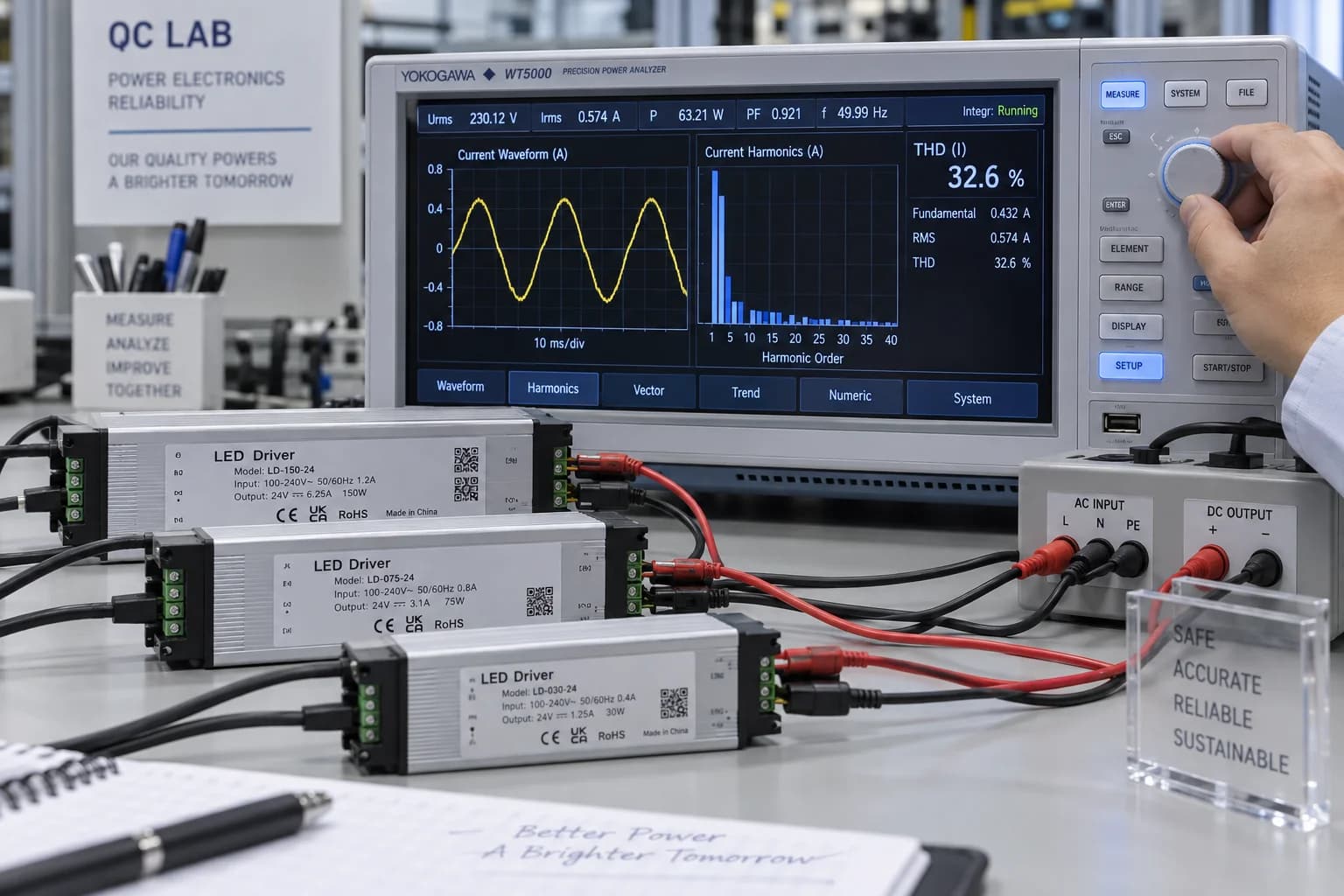
THD (total harmonic distortion) measures how much the current waveform is distorted from a pure sine wave. LED drivers are switching power supplies—they draw current in short pulses rather than smoothly. Those pulses create harmonics at 3x, 5x, 7x the line frequency.
Low THD (under 20%) is invisible. High THD (30-50%) causes real problems: neutral wire overheating (triplen harmonics add up on the neutral), transformer buzzing, interference with audio systems, and even random breaker trips that are almost impossible to debug.
The cheap drivers you find on Alibaba often advertise PF 0.99 and THD under 15% on the spec sheet. We've tested samples that measured 0.62 PF and 42% THD when put on a power analyzer. The nameplate is aspirational; the test report is real.
4. PFC topology: the three types you'll encounter
Driver manufacturers use three approaches to achieve good PF and low THD. They have very different cost, performance, and reliability profiles:
Passive PFC: uses passive components (inductors, capacitors) to correct power factor. Achieves PF 0.85-0.90 and THD 30-40%. Cheapest solution, but fails most commercial inspection requirements. Fine for residential, risky for commercial.
Valley-fill PFC: a halfway solution using a diode/capacitor network. PF reaches 0.92-0.95, THD around 25%. Used in mid-range drivers. Decent for small projects, but still shows up on harmonic measurements.
Active PFC (APFC): uses a dedicated boost converter IC to actively shape the input current waveform. PF 0.95-0.99, THD under 15%. This is the technology that meets commercial and industrial code requirements. Costs 15-25% more than passive, but it's the only option that passes inspection reliably.
5. What to specify on your purchase order
Don't just write high power factor driver. Be specific. Vague specs get you vague (read: bad) product.
- Power factor >= 0.95 at full load (not just at 110V—specify at both 120V and 230V)
- THD <= 20% at rated input voltage and full load
- Active PFC topology (not passive, not valley-fill)
- Compliance with IEC 61000-3-2 (Class C for lighting equipment)
- Ask for the power analyzer test report for the exact model you're buying—not a generic brochure number
6. How to verify the spec before bulk order
You don't need a $5,000 power analyzer to check a sample. Here's a practical test: measure the input current with a clamp meter at full load. Then calculate apparent power: V x A. Divide the rated output wattage by that apparent power. If you get 0.9+, the PF is real. If you get 0.6-0.7, the nameplate is lying.
For THD, ask the supplier for the test report. If they hesitate, make excuses, or send you a report from a different model, walk away. Reputable driver manufacturers test every model and have the data on hand.
This is one of those specs where the 15% price premium for a proper active PFC driver saves you 200% of the driver cost in replacement labor, inspection delays, and client dissatisfaction. Don't be the buyer who skips it and regrets it during the inspection.
Frequently asked questions
Questions buyers ask
What is a good power factor for LED lighting?
For commercial projects, specify >= 0.95. Anything below 0.9 will likely fail electrical inspection in most cities. Residential projects can tolerate 0.9, but higher is always better—it reduces wiring and transformer costs.
Does higher power factor save electricity bills?
Not directly for you—residential and small commercial customers are billed on real power (kWh), not apparent power (kVA). But it reduces load on the building's wiring and transformer, which allows more fixtures on the same circuit. For large projects (100kW+), the utility may charge a penalty for low PF, making it directly cost-relevant.
Can I fix bad THD after installation?
Not easily. Passive harmonic filters can be added at the distribution panel, but they're expensive and bulky. It's far cheaper to spec drivers with active PFC from the start than to retroactively fix a harmonic problem.
Is Mean Well's power factor rating accurate?
Yes—Mean Well, Inventronics, and other Tier-1 driver manufacturers publish verified PF and THD numbers with third-party test reports. The exaggeration problem is almost exclusively with no-name budget drivers. If a spec sounds too good to be true from an unknown brand, it probably is.
Talk to the product team
Planning an OEM or commercial lighting order?
Send your application, specification and destination market. We will help narrow the product and sample options.
Discuss on WhatsApp