
Key takeaways
- Emergency lighting is a life-safety system, not a backup lamp: it has to be listed, installed on the right circuits, and tested on a schedule.
- The code defines performance, not just hardware: at least 1 foot-candle at the start, no less than 0.6 foot-candle after 90 minutes, and transfer within seconds.
- Choose self-contained fixtures for small premises and central battery systems for large, high-ceiling or high-fixture-count sites; the break-even is roughly 50 fixtures.
- A battery pack cannot be retrofitted onto an existing LED fixture in the field; the complete emergency luminaire has to be evaluated and listed as a unit.
- The 30-second monthly test and the 90-minute annual test, with written records, are what prove compliance; an untested fixture is treated as non-compliant.
1. Emergency lighting is a life-safety system, not a backup lamp
Most buyers treat emergency lighting as the box of twin-head lamps that sits in the stairwell and is never looked at. That is a misunderstanding of what it is. Emergency and exit lighting is part of the means of egress, the protected route that lets occupants leave a building when the normal power fails, smoke reduces visibility, or a normal circuit is opened. It is a life-safety system with a defined performance standard, installation rules, and a mandatory testing regime.
The reason this matters for purchasing is that compliance is not achieved by buying a bright fixture. It is achieved by buying listed equipment, installing it on the correct circuits, spacing it to meet illuminance requirements, and proving it works on a schedule. A cheap unlisted lamp pointed at the corridor does none of these, and the authority having jurisdiction will not accept it.
2. The standards that define the system
Several documents work together. In North America the product standard is UL 924, Emergency Lighting and Power Equipment, which covers equipment intended for connection to branch circuits of 600 V or less. The installation and performance requirements come from NFPA 101, the Life Safety Code, and the electrical system rules come from NFPA 70, the National Electrical Code, primarily Article 700 for emergency systems and Article 701 for legally required standby systems.
Outside North America the equivalent product standard is IEC/EN 60598-2-22 for emergency luminaires, EN 1838 covers emergency lighting applications, EN 50171 covers central battery systems, and the testing standard is EN 50172 (BS 5266-8). The technical logic is the same even where the numbers differ: defined illuminance, a minimum rated duration, automatic transfer, and scheduled testing.
| Region | Product standard | System / installation | Testing standard |
|---|---|---|---|
| North America | UL 924 | NFPA 101; NEC (NFPA 70) Art. 700/701 | NFPA 101 testing requirements |
| Europe / IEC | EN 60598-2-22 | EN 1838; EN 50171 | EN 50172 (BS 5266-8) |
| UK | BS EN 60598-2-22 | BS 5266-1 | BS EN 50172 / BS 5266-8 |
| China | GB 17945 | GB 51309; GB 50016 | GB 51309 testing |
3. What the code requires: illuminance, duration, and transfer
NFPA 101 sets a minimum average illuminance of 1 foot-candle (about 10 lux) along the walking surface of the egress route at the start of the emergency, declining to no less than 0.6 foot-candle averaged over the route at the end of the rated duration. The minimum point illuminance is 0.1 foot-candle, so the light cannot simply average out while leaving a dark patch at a stair landing.
The system must illuminate automatically for at least 90 minutes after the loss of normal power, whether the cause is a utility outage, a tripped breaker, or a switch being opened. Under UL 924 the transfer to emergency mode must occur within 10 seconds of the power loss. Special environments, such as hospital operating rooms, may require durations beyond 90 minutes. Under IEC/EN standards, rated durations of 1 hour or 3 hours are common.
- At least 1 foot-candle average at the start of the emergency
- No less than 0.6 foot-candle average after 90 minutes
- Minimum 0.1 foot-candle at any single point
- Automatic transfer within 10 seconds (UL 924)
- At least 90 minutes rated duration in North America; 1 or 3 hours common under IEC/EN
4. Where emergency and exit lighting is required
NFPA 101 requires emergency lighting in designated stairs, aisles, corridors, ramps, and passageways leading to an exit, across assembly, educational, hotel, mercantile, business, and similar occupancies. Exit signs mark the exits themselves and the route to them. The requirement covers the whole path, not just the final door: an occupant should be able to read the next sign and see the floor under their feet at every point on the way out.
Spacing is driven by visibility. As a reference, illuminated directional signs are typically spaced no more than about 20 m along a corridor, roughly half that in a dead-end or blind section, and much closer at a turn. Exact spacing follows the photometric layout and the local code.
5. Self-contained vs central battery: choosing the architecture
There are two mainstream architectures. A self-contained emergency luminaire carries its own rechargeable battery, charger, and control circuit inside the fixture; the mains keeps the battery charged, and the battery powers the lamp when the mains fails. A central battery system uses one battery cabinet or inverter feeding multiple remote emergency heads from a dedicated circuit.
Self-contained units are simple to install and test and have a low upfront cost, which makes them the default for small and medium premises. Their limitation is that every fixture has a battery ageing on its own schedule that has to be replaced, typically within 4 to 8 years. Central battery systems put all the batteries in one maintained location, often with a 10 to 20 year battery life, and are preferred in high-ceiling plants, airports, and large sites where the fixture count is roughly 50 or more and servicing individual heads is impractical. Their installed cost is higher because they need dedicated circuits and often conduit.
| Factor | Self-contained | Central battery |
|---|---|---|
| Battery location | Inside each fixture | One central cabinet / inverter |
| Installed cost | Low to moderate | High (dedicated circuits, conduit) |
| Battery life | Roughly 4-8 years | Roughly 10-20 years |
| Maintenance | Per-fixture testing and replacement | Centralized testing and battery service |
| Best fit | Small / medium premises | Large, high-ceiling, 50+ fixtures |
| Typical feed | Integral lamp(s) | Low-voltage DC or 120 V AC (region dependent) |
6. Exit signs: selecting the sign itself
Exit signs are a separate product from the emergency luminaires that light the floor. They are selected by their face size, which is set by the maximum viewing distance, their contrast, and their backup. A sign that is correct above a small door is too small to read across a large open trading floor, so the sign size is matched to the viewing distance rather than bought in one size for the whole building.
LED signs give a uniform, high-contrast face and low power draw. Photoluminescent (glow-in-the-dark) signs are sometimes proposed as a no-wiring alternative, but they do not replace a listed electrical emergency sign in most jurisdictions and are not accepted as a substitute for powered emergency signs in a number of codes; they depend on being charged by the ambient light that has usually failed during an emergency. Confirm acceptance with the local authority before using them.
- Match the face size to the maximum viewing distance
- Require high contrast and a uniform face (LED)
- Use battery backup where the sign is required to stay lit
- Do not assume photoluminescent signs are accepted; confirm with the AHJ
7. Why a battery pack cannot be retrofitted onto an existing LED fixture
A common cost-saving idea is to keep the existing LED fixtures and add an emergency battery pack to them. This does not work the way it did for fluorescent fittings. Fluorescent inverter packs could be wired into a previously installed fluorescent luminaire because the lamp and ballast interface was standardized. There is no equivalent standard interface between an LED driver and its array, so adding an LED emergency battery pack to a previously installed LED luminaire is not a recognized path.
The complete emergency luminaire, the driver, battery, control, and LED array, has to be evaluated and listed to UL 924 or EN 60598-2-22 as a unit. A field-assembled combination is not a listed emergency fixture and will not be accepted. The practical implication is to buy emergency fixtures as complete listed products rather than planning to convert ordinary fixtures on site.
Where an emergency luminaire is also controlled by a normal lighting control system, a dimmer, occupancy sensor, or schedule, it must be a directly controlled type that automatically overrides any dim or off setting and establishes the required emergency output when the normal power fails. UL 924 was revised in May 2018 to clarify how these fixtures are tested. A fixture that stays off because its normal control was off is a failure, regardless of its battery.
8. Testing and maintenance: the part that proves compliance
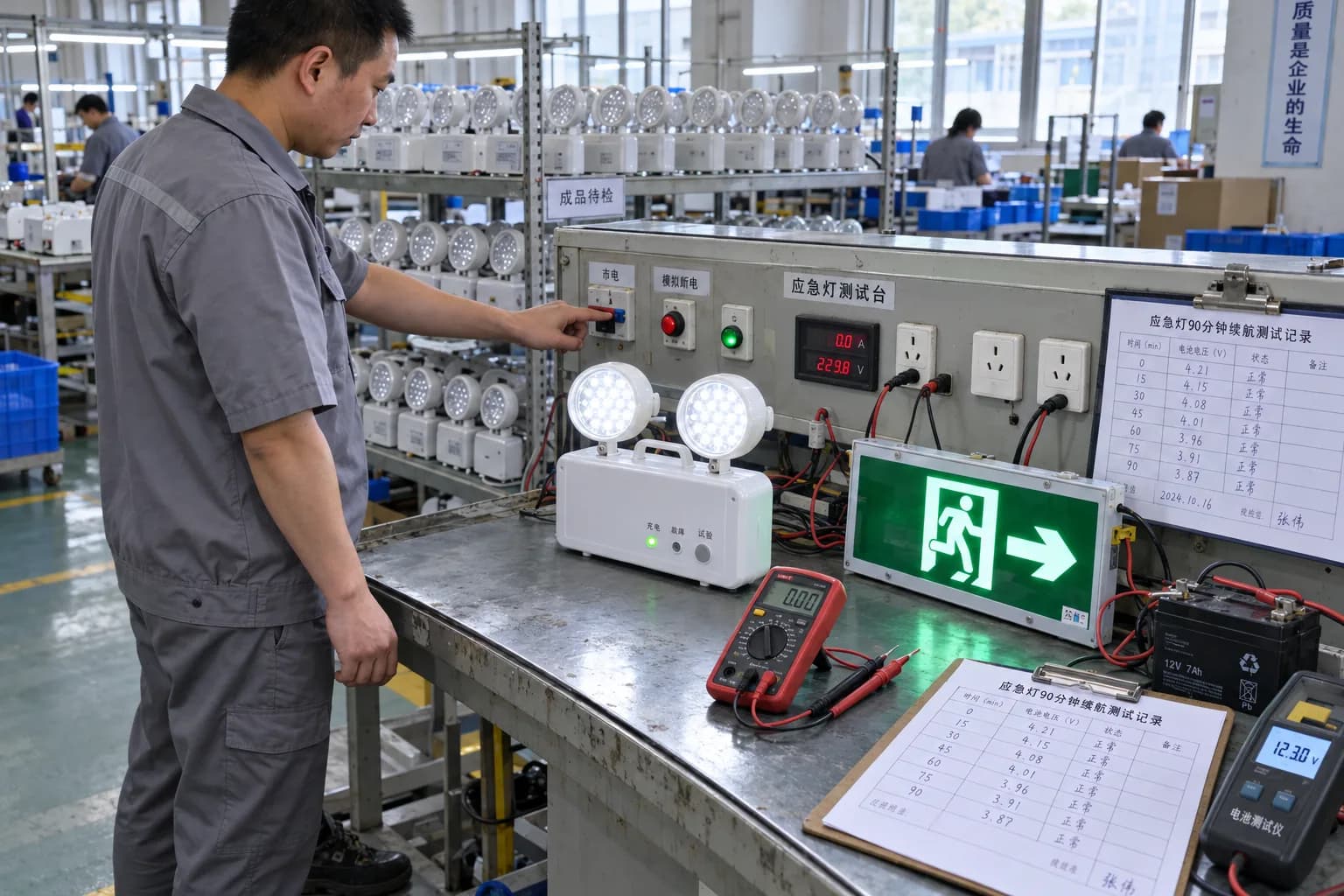
An emergency fixture is only compliant while it is demonstrated to work. NFPA 101 requires a functional test of at least 30 seconds at intervals not exceeding 30 days, and a full-duration test of 90 minutes once a year, during which the lighting must hold for the entire period. Any unit that fails to maintain the required illumination for the full duration has to be repaired or replaced. Written records of the inspections and tests are kept by the owner and are what the AHJ asks to see.
There are three accepted methods: manual testing, self-testing fixtures, and computer-based monitoring. Self-testing/self-diagnostic equipment runs its own tests and signals a fault with an indicator, removing the need for the manual monthly and annual routine, though it still has to be kept operational and checked. Whichever method is used, the annual full-duration test and the records are not optional.
| Equipment | Monthly | Annual |
|---|---|---|
| Battery emergency lights | Functional test, at least 30 seconds | Full-duration test, 90 minutes |
| Battery exit signs | Functional test, at least 30 seconds | Full-duration test, 90 minutes |
| Self-test / self-diagnostic | Automatic | Automatic; verify fault indicators |
9. What to require from the supplier
When you source emergency and exit lighting, the purchase is judged on documentation as much as on the fixture. Require the listing to the correct standard for the destination market, UL 924 in North America or EN 60598-2-22 in Europe and IEC markets, along with the rated duration, the battery type and expected life, and whether the unit is self-testing. The voltage and frequency must match the destination: 120 V/60 Hz for North America and 220-240 V/50 Hz across much of Europe, the Middle East, Africa, and Latin America.
- Listing/certificate to UL 924 or EN 60598-2-22 for the exact model
- Rated duration (90 minutes North America; 1 or 3 hours common under IEC/EN)
- Battery type, capacity, and expected replacement life
- Self-test / self-diagnostic option and fault indicator
- Correct voltage and frequency for the destination market
- Photometric or layout support for spacing and illuminance
Related Lumseq products
Frequently asked questions
Questions buyers ask
What is the difference between UL 924 and NFPA 101?
UL 924 is the product standard that emergency lighting and power equipment is listed to; it defines how the equipment is built and tested. NFPA 101, the Life Safety Code, defines where emergency lighting is required and the performance it must achieve in the building, including illuminance and the 90-minute duration. NEC Article 700 then covers the electrical circuits. A compliant installation needs all three.
How long does emergency lighting have to stay on?
In North America, at least 90 minutes after the normal power fails, with the route averaging no less than 0.6 foot-candle at the end of that period. Under IEC/EN standards, rated durations of 1 hour or 3 hours are common, and some occupancies or jurisdictions require longer. The duration for the specific project follows the local code.
Can I add an emergency battery pack to an existing LED fixture?
Generally no. Unlike fluorescent fittings, there is no standardized LED driver-to-array interface, so the complete emergency luminaire, the driver, battery, control, and LED array, has to be evaluated and listed as a unit. A field-assembled conversion is not a listed fixture and will not be accepted.
What is the difference between self-contained and central battery emergency lighting?
A self-contained fixture has its own battery inside and is simple to install, with each battery replaced on its own 4-8 year cycle. A central battery system feeds multiple heads from one cabinet, with longer-lived batteries and centralized maintenance, but a higher installed cost; it is favored for large or high-ceiling sites with roughly 50 or more fixtures.
Are photoluminescent exit signs acceptable?
Not as a blanket replacement for powered signs. Photoluminescent signs rely on being charged by ambient light, which is usually what has failed in an emergency, and many codes do not accept them as a substitute for listed electrical emergency signs. Confirm acceptance with the local authority having jurisdiction before specifying them.
How often does emergency lighting have to be tested?
A functional test of at least 30 seconds every 30 days, and a full 90-minute test once a year, with written records kept by the owner. Self-testing fixtures run these checks automatically and indicate faults, but they still have to be kept operational.
What illuminance is required on the egress route?
At least 1 foot-candle (about 10 lux) average at the start of the emergency, no less than 0.6 foot-candle average at the end of 90 minutes, and no less than 0.1 foot-candle at any single point, so coverage cannot hide a dark spot behind a high average.
What does a directly controlled emergency luminaire do?
It automatically overrides any normal control setting, dim, sensor-off, or scheduled-off, and brings the lamp to the required emergency output when normal power fails. A fixture that remains off because its everyday control was off does not meet the requirement.
Sources and references
UL Solutions Code Authorities, Emergency Lighting: Performance Expectations, Retrofit Implications and LEDsNFPA, NFPA 101 Life Safety CodeConsulting-Specifying Engineer, Emergency egress and illumination systemsUL Solutions, Code-Compliant Control of Emergency LuminairesInspect Point, Emergency lighting and exit sign testing under NFPA 101IEC 60598-2-22:2021, Luminaires for emergency lightingTalk to the product team
Planning an OEM or commercial lighting order?
Send your application, specification and destination market. We will help narrow the product and sample options.
Discuss on WhatsApp