
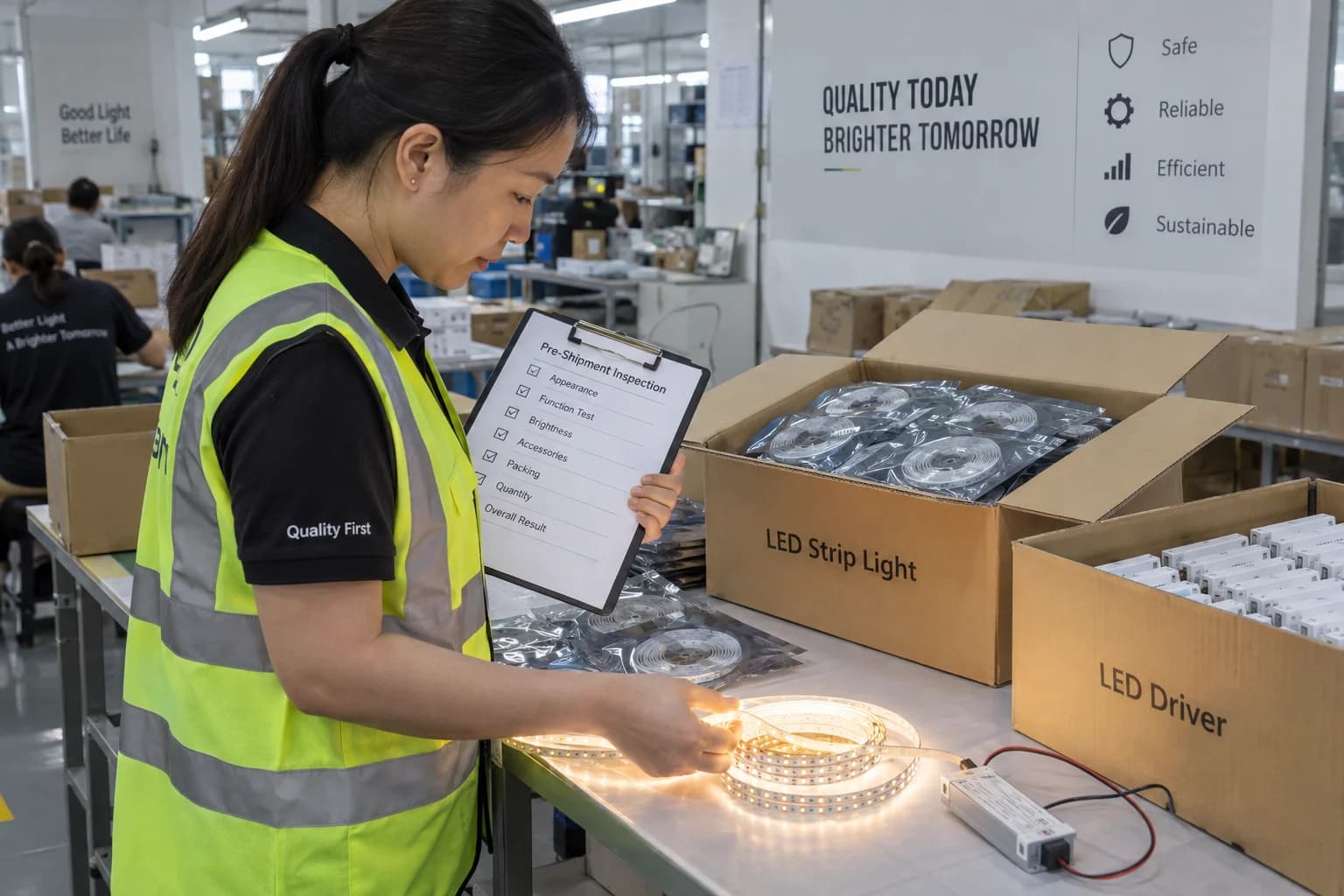
Key takeaways
- A PSI costs a few hundred dollars and catches problems that warranty claims and air freight never will.
- AQL 2.5 for major defects is the industry standard—understand it before you approve the inspection report.
- Inspect against the approved sample and technical datasheet, not against what the factory 'usually does.'
- Take photos of defects and get the inspector to mark cartons. Evidence before shipment beats arguments after arrival.
1. Why you need a PSI even with a trusted supplier
Every buyer has heard the story: the factory is great for six orders, then the seventh order ships with mixed batches, wrong labels, or boxes of dead drivers. You do not find out until the container arrives.
A pre-shipment inspection (PSI) is a physical check of your actual production batch before it leaves the factory. A third-party inspector (SGS, Bureau Veritas, Intertek, or an independent QA agency) goes to the factory, inspects against your requirements, and issues a report before you release payment and shipment.
Even with a long-term supplier, the PSI is your only independent checkpoint between production and the ocean. It is not about distrust—it is about catching the 2% of batches that go wrong, before they become your problem.
Cost: roughly USD 250-500 per inspection day depending on location and scope. Compare that to a rejected container: freight both ways, customs delays, months of disputes, and a customer who stops answering your emails.
2. What a proper PSI covers
A serious PSI is not a quick look at a few boxes. It covers four areas:
Quantity check: verify the carton count and piece count against the packing list. Confirm no short shipment and no over shipment without authorization.
Visual and workmanship check: inspect finish, color consistency, printing, labels, barcode readability, and packaging condition. LED lighting is sold on appearance—paint runs, scratches, and crooked printing are rejectable.
Functional check: power on a sample of fixtures and verify they light, dim, and operate correctly. For LED strips, this includes brightness, color temperature, and flicker checks.
Specification check: compare the actual product against the approved sample and technical datasheet—driver ratings, CRI, CCT, IP rating marks, wattage, and certifications. This is where batch substitutions get caught.
3. Sampling rules: what AQL actually means
The inspector does not check every unit—that would take weeks. They use a statistical sampling standard called AQL (Acceptable Quality Limit), usually AQL 2.5 for major defects and AQL 4.0 for minor defects, with an inspection level of II.
Here is what that means in practice:
For a batch of 5,001-10,000 pieces, the sample size is 200 units. Under AQL 2.5, the batch is accepted if 7 or fewer units in that sample have major defects, and rejected if 8 or more do.
If the batch is rejected, you have three options: request a full sort (factory re-inspects 100% and fixes defects), negotiate a discount for the defect level, or reject and rework before shipment.
One warning: AQL 2.5 is a reasonable commercial standard, but if your product is critical (emergency lighting, safety-certified fixtures), push for AQL 1.0 or 100% inspection on the key checks.
4. What to check on the factory floor during PSI
The official report covers the sample inspection. Smart buyers also ask the inspector to check these four things that are easy to fake:
Batch integrity: ask to see the actual burn-in room and the burn-in log for your PO. Confirmed the units tested are from the same batch as the ones being shipped.
Label and certification marks: verify that CE, RoHS, UL, or other marks on the product match the certificates the factory sent you. Mismatched or expired certs are a common silent substitution.
Packaging and loading: check carton markings, loading plan, and whether the cartons are properly reinforced for sea freight. Check for correct shipping marks and handling instructions.
Wet cartons or repacked boxes: if some cartons look re-glued or water-stained, the inspector should flag it. These are the cartons that arrive crushed or with water damage claims.
5. How to write a PSI inspection checklist
Give the inspector a written checklist before they go. A generic 'inspect the goods' instruction produces a generic report. Your checklist should include:
1. Product references: approved sample photo, technical datasheet, and the specific PO number.
2. Key specifications to verify: wattage, CCT, CRI, IP rating, driver brand/model if specified, and dimming protocol.
3. Packaging requirements: carton size, inner packaging, label content, barcode numbers, and shipping marks.
4. AQL level and defect definitions: state AQL 2.5 majors / 4.0 minors, and what counts as major (non-functional, wrong spec) vs minor (cosmetic, packaging).
5. Photo requirements: ask for photos of the sample being tested, the batch, any defects, and the container loading if applicable.
Send this checklist 3-5 days before the inspection date so the inspector can prepare.
6. After the report: what to do next
The PSI report usually arrives as a PDF within 24-48 hours after the inspection. Read it before you release the balance payment:
If accepted: release payment and proceed with shipment. Keep the report on file—it is your evidence if problems appear later.
If conditionally accepted: address the listed issues. Usually this means the factory fixes specific defects and the inspector re-checks only those units.
If rejected: do not release payment. Demand a rework and full re-inspection, or negotiate a solution. Never accept a rejected batch on verbal promises—the next time you see those lights, they will be in your warehouse.
A note on photos: if the report does not include photos of the actual test, ask for them. Photos are the difference between a real inspection and a rubber-stamped document.
Frequently asked questions
Questions buyers ask
How much does a pre-shipment inspection cost for LED lighting?
Typically USD 250-500 per inspector day, plus travel costs for remote factories. The price depends on location, product complexity, and inspection scope. Compared to the cost of a rejected container, it is negligible.
What is the difference between PSI and receiving inspection?
PSI happens at the factory before shipment, while receiving inspection happens when goods arrive at your warehouse. PSI catches problems while the factory can still fix them cheaply. Receiving inspection only tells you what you already lost.
Can I do the PSI myself instead of hiring a third party?
You can, but it is not recommended. A third-party inspector is independent, understands AQL sampling, and gives you an unbiased report. If you inspect your own order at your own supplier, you have no independent evidence if a dispute arises.
What happens if my goods fail PSI?
You hold the balance payment and require the factory to rework or re-sort the batch, then re-inspect. If the defects are systemic, reject the batch entirely. The PSI gives you the leverage to do this—without it, you pay first and discover problems later.
Talk to the product team
Planning an OEM or commercial lighting order?
Send your application, specification and destination market. We will help narrow the product and sample options.
Discuss on WhatsApp