
Key takeaways
- Most LED 'sudden death' failures are surge-related, not component quality issues.
- A MOV varistor alone is not enough—you need a proper surge protective device (SPD) or driver with integrated protection.
- Lightning doesn't have to strike your building to damage your lights. A strike 1km away can induce a surge on your mains.
- Specifying SPDs costs a few dollars per fixture. Replacing failed drivers costs hundreds in labor—plus the customer call you don't want.
1. Why LED lighting is more vulnerable than old lighting
Traditional metal-halide and fluorescent lights could survive surges that instantly kill LED drivers. There are two reasons:
First, LED drivers are full of semiconductors—MOSFETs, control ICs, and capacitors—all rated for a specific voltage window. A surge pushes voltage past that window and the semiconductor breaks down permanently. Old magnetic ballasts were mostly coils and transformers, which absorb spikes far better.
Second, LED fixtures are usually more compact, which means smaller capacitors and tighter PCB layouts. They have less energy-absorbing mass than the big ballast cans of the past. One surge that an old fixture shrugs off can destroy a modern LED driver in milliseconds.
The result: LED lighting is more efficient and lasts longer in normal operation, but it needs surge protection that older technologies never required.
2. Where surges actually come from
Surges are short voltage spikes, usually lasting microseconds, that push mains voltage far above its nominal level. Three sources matter for LED installations:
Lightning strikes: a direct strike near your building induces a surge into nearby power lines. You do not need a direct hit—a strike a few hundred meters away can couple enough energy into the grid to damage connected equipment.
Grid switching: when the utility switches loads, or when big motors and air conditioners on the same feeder turn on and off, they create voltage transients that travel down the line.
On-site equipment: within a building, elevators, HVAC compressors, and welding equipment are notorious generators of internal surges. These are smaller than lightning surges but far more frequent.
3. How surge protection actually works
Surge protection works by clamping: when voltage rises above a threshold, the protective component starts conducting and shunts the excess energy to ground before it reaches the driver.
The most common protection components:
MOV (Metal Oxide Varistor): the basic building block. Clamps voltage spikes but degrades with every surge it absorbs. After repeated hits, it silently stops protecting.
GDT (Gas Discharge Tube): handles very large surges, responds slower than an MOV, and is often paired with an MOV for two-stage protection.
TVS (Transient Voltage Suppressor): a diode that clamps fast but handles less energy. Usually sits at the input of the driver as the last line of defense.
A proper SPD combines these in stages: GDT or MOV at the incoming supply, TVS at the sensitive electronics. That staged approach is what separates a real SPD from a single cheap varistor soldered on a PCB.
4. What to spec for your project
For commercial LED projects, this is the practical spec checklist:
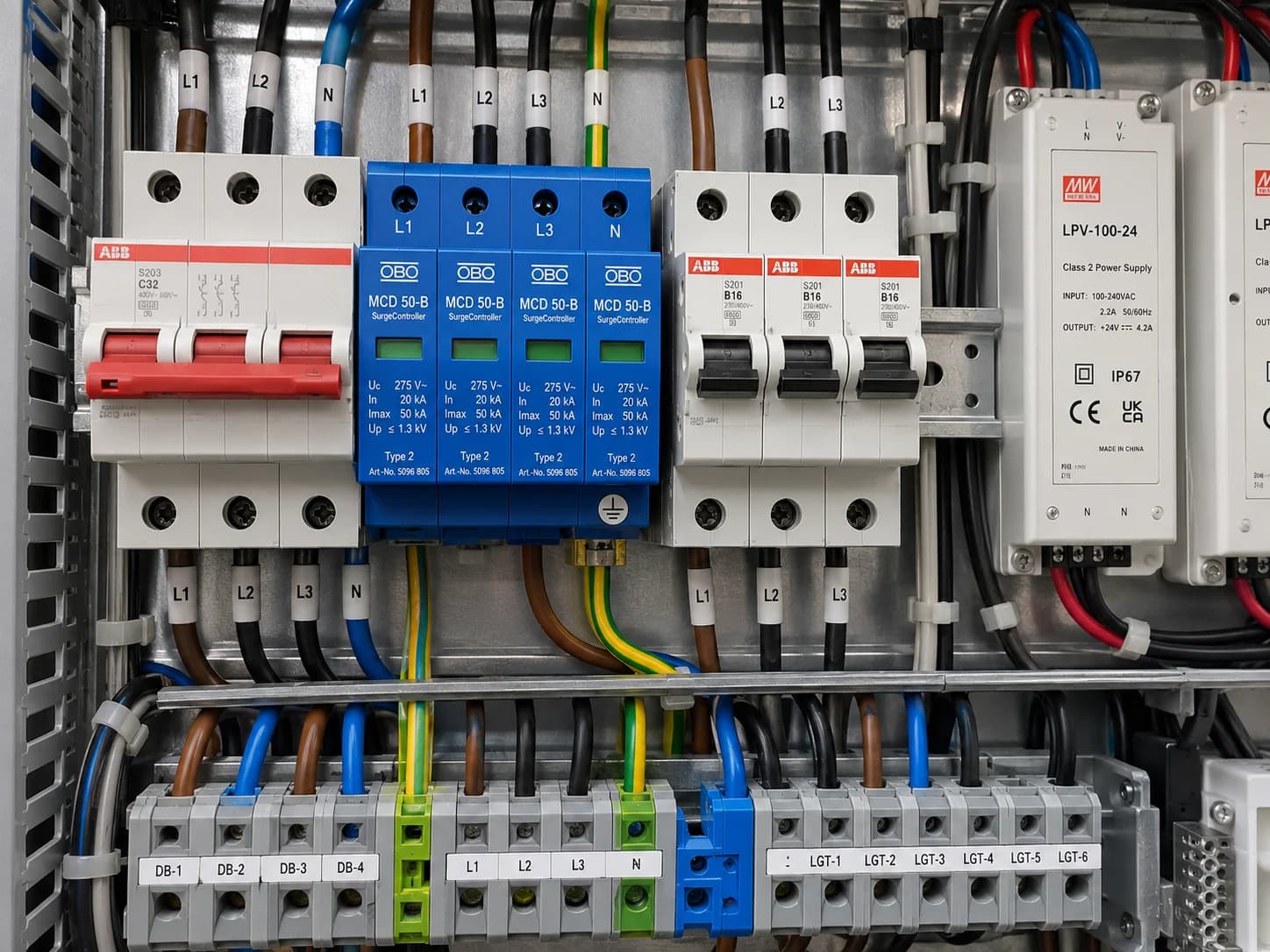
Incoming supply: install a Type 2 SPD at the distribution board. This catches grid and lightning-induced surges before they reach your lighting circuits. Cost: tens of dollars. This one device protects every fixture on the circuit.
Fixture level: choose LED drivers with built-in surge immunity of at least 2kV (IEC 61547) for standard commercial use, or 4kV for outdoor, signage, and industrial applications. Many quality drivers now include a 6kV option—spec it if your site is lightning-prone.
Outdoor and signage: always add fixture-level protection. Outdoor fixtures are directly exposed to lightning paths and are the most expensive to replace.
Warranty language: ask your supplier to state the surge-withstand rating in the technical datasheet. If the datasheet is silent on surge immunity, the driver probably has none worth mentioning.
5. The cost math buyers miss
Buyers save money on drivers without surge protection, then pay for it twice.
One failed driver: the part costs USD 8-25. Replacing it at an install site costs 1-3 hours of a licensed electrician's time, travel, and ladder work: USD 100-300. If the fixture is at 6 meters in a retail hall or on a building facade, multiply that by the crane or lift rental.
A 10-year commercial lighting installation will typically see 2-4 grid surge events significant enough to stress unprotected drivers. With 200 fixtures, that is 400-800 potential premature failures over the decade. The premium for surge-protected drivers is about 5-8% of the driver price.
That is the cheapest insurance in the whole lighting budget. Do the math on your own project before you chase the lowest driver quote.
6. How to verify your supplier's surge claim
Surge claims are frequently overstated. Three ways to verify:
Ask for the test report: a real surge immunity claim (IEC 61000-4-5 / IEC 61547) comes with a test report from an accredited lab. If the sales rep cannot produce one, treat the claim as marketing.
Ask what happens after the test: some drivers survive the 2kV test but with degraded components that will fail a year later. A good datasheet states 'no damage' after testing, not just 'no immediate failure'.
Ask for the protection schematic: any honest manufacturer will describe the MOV/GDT/TVS stages in their driver. If the engineer cannot name the protection components, there is only a cheap varistor inside.
Frequently asked questions
Questions buyers ask
Why did my LED lights die after a storm?
Almost certainly a surge. Lightning near your building, or grid switching during the storm, pushed a voltage spike through the mains that exceeded the driver's input rating. The driver's semiconductors broke down instantly. This is the most common 'sudden death' failure mode in LED lighting.
Do LED lights need surge protection?
Yes, especially commercial, outdoor, and signage installations. LED drivers are semiconductor-based and far more surge-sensitive than old magnetic ballasts. A Type 2 SPD at the distribution board plus drivers with 2-4kV surge immunity covers most projects.
What is the difference between MOV and SPD?
An MOV is a single protective component. An SPD (surge protective device) is an assembly that usually combines an MOV with a GDT and/or TVS, sized and coordinated to handle large surges and fail safely. A cheap driver with one MOV is not the same as a proper SPD.
How much does LED surge protection cost?
At driver level, surge-protected drivers cost roughly 5-8% more than unprotected ones. A Type 2 SPD for a distribution board costs tens of dollars and protects every connected circuit. Compared with the labor cost of replacing failed fixtures, protection is by far the cheaper option.
Talk to the product team
Planning an OEM or commercial lighting order?
Send your application, specification and destination market. We will help narrow the product and sample options.
Discuss on WhatsApp