
Key takeaways
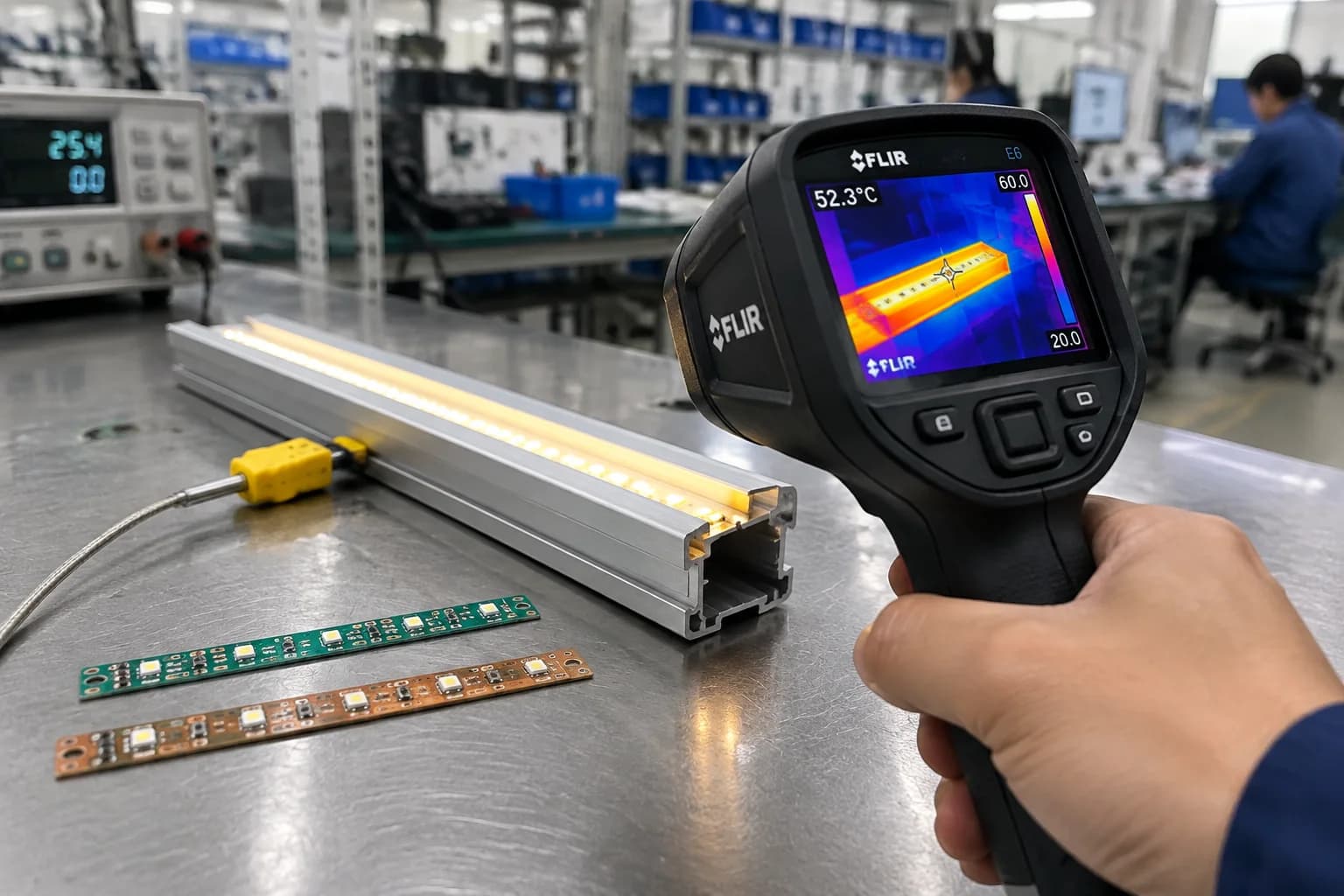
- Every 10°C rise in LED junction temperature cuts rated lifespan roughly in half. Thermal management is not optional — it is the single biggest factor in real-world LED strip longevity.
- PCB copper weight matters: 1oz vs 2oz copper on the same LED strip can make a 15-25°C difference under full load. Thinner copper means hotter LEDs, faster lumen decay and earlier failure.
- Aluminum profiles are not just for aesthetics. A properly sized extruded aluminum channel dissipates 2-3x more heat than bare adhesive mounting on drywall.
- High-density LED strips (120 LEDs/m and above) without an aluminum profile run 30-40°C hotter than specified. The LED chip may not fail immediately, but lumen maintenance drops sharply after 6-12 months.
- Specify thermal management upfront: tell your supplier the copper weight, aluminum model and installation environment — don't assume it is included in the standard spec sheet.
1. Why does heat kill LED strips?
LED strips do not burn out like incandescent bulbs. They fail gradually: output drops, color shifts, and at some point the customer stops using them because it no longer looks right.
The root cause is almost always excessive junction temperature. The LED chip itself can last 50,000+ hours if kept at 85°C junction temperature. Every 10°C above that cuts the rated lifespan roughly in half. At 105°C, you are looking at 10,000-15,000 hours — and that is if nothing else fails first.
Most buyers look at lumens per meter and price. They rarely ask what happens after 8 hours of full-load operation in a closed ceiling cavity. That is where the difference between a 3-year strip and a 1-year strip shows up.
2. What are the three factors that control heat?
Heat moves through three steps: LED junction → PCB → ambient air. Each step has a bottleneck, and the worst bottleneck determines the actual temperature.
- PCB copper weight: thicker copper spreads heat across more area and reduces the hottest point
- Aluminum profile / heat sink: the aluminum channel is the primary heat dissipation path into the air
- Installation environment: enclosed vs ventilated, surface material, ambient temperature
3. How much does PCB copper weight actually matter?
This is the first thing to check on a spec sheet — and the thing most buyers never ask about.
A 1oz copper PCB (35µm) is the standard for cheap strips. A 2oz copper PCB (70µm) spreads heat roughly twice as well. On a high-density strip (120 LEDs/m, 14.4W/m), the difference under full load can be 15-25°C at the LED junction.
Practically: 1oz copper on a 14.4W/m strip mounted in an enclosed channel might run at 95-100°C. The same strip on 2oz copper might run at 75-80°C. That is the difference between 20,000 hours and 50,000 hours of rated life.
4. Aluminum profiles: not just for looks
Many buyers see aluminum profiles as an aesthetic choice — they want the strip to look neat and recessed. That is a side benefit. The main job of an aluminum channel is thermal management.
A 16mm wide extruded aluminum profile with a flat back can dissipate 2-3x more heat than the same strip mounted bare on drywall or wood. The key variables: cross-section area, wall thickness, and whether the strip is in direct contact with the aluminum (thermal paste or air gap matters).
| Installation type | Typical junction temp (14.4W/m strip) | Estimated lifespan | Best application |
|---|---|---|---|
| Bare strip on drywall, no profile | 95-110°C | 10,000-15,000 hours | Short-term decorative, low-budget |
| In aluminum profile, enclosed ceiling | 80-90°C | 20,000-30,000 hours | Residential, intermittent use |
| In aluminum profile, ventilated | 65-75°C | 40,000-50,000 hours | Commercial, 24/7 operation |
| 2oz copper + aluminum profile + active ventilation | 55-65°C | 50,000+ hours | High-end commercial, museum, gallery |
5. What about high-density strips?
High-density strips (120 LEDs/m, 180 LEDs/m, 240 LEDs/m) pack more power into the same length. More power means more heat per centimeter. This is where thermal management goes wrong fastest.
A 180 LED/m strip at 18W/m without an aluminum profile will run at 100°C+ even at room temperature. In a closed ceiling with 35°C ambient, it can hit 115°C+ — and the warranty is already void at that point.
Rule of thumb: any strip above 12W/m must be mounted in an aluminum profile. Any strip above 15W/m should use 2oz minimum copper. Any strip above 18W/m needs both 2oz copper and a properly sized aluminum channel with ventilation.
6. Common mistakes buyers make
Most thermal problems are not caused by bad LEDs — they are caused by buyers not asking the right questions during specification. Here are the four mistakes we see most often.
- Only looking at lumens per meter: a strip with the same lumens can have wildly different thermal performance depending on copper weight and LED bin
- Assuming the aluminum profile comes standard: many suppliers quote the strip price without the channel. Ask separately.
- Not specifying the installation environment: a strip that runs fine in a residential living room will overheat in a closed retail display case.
- Trusting the spec sheet lifespan number: 50,000 hours is measured at 25°C ambient with ideal mounting. Real-world numbers are 50-70% of that.
7. Practical checklist for your next purchase
Use this checklist when you send your RFQ. Thermal management is easy to get right if you specify it upfront — it is much harder to fix after installation.
- Ask the supplier for the actual copper weight (1oz, 2oz, or 3oz) — not just the wattage per meter
- Specify the aluminum profile model you will use — or ask the supplier to recommend one for the power per meter
- Tell them the installation environment: enclosed vs ventilated, ambient temperature, daily operating hours
- Request a thermal test report or LM-80 data if the project is commercial or 24/7
- For high-density strips (180 LEDs/m and above), pay extra for 2oz copper — it costs a few percent more but doubles the real-world lifespan
Frequently asked questions
Questions buyers ask
Does LED strip brightness drop over time?
Yes — and it drops faster when the strip runs hot. A strip at 85°C junction temperature can maintain 70% of initial output for 50,000 hours. The same strip at 105°C may only maintain 70% for 15,000-20,000 hours.
Is 1oz copper enough for LED strips?
It depends on power per meter. For low-power strips (4.8W/m and below), 1oz copper is fine. For 9.6W/m and above, 2oz copper is recommended. For 14.4W/m and higher, 2oz is minimum.
Do I really need an aluminum profile?
If the strip is 9.6W/m or higher, yes. Without an aluminum profile, the strip runs 30-40°C hotter and lifespan drops by 50% or more. Aluminum profiles are not just for looks — they are the primary heat dissipation path.
How hot is too hot for LED strips?
Junction temperature above 90°C starts to significantly reduce lifespan. Above 105°C, you are looking at 10,000-15,000 hours of useful life. The goal is to keep junction temperature below 85°C for rated lifespan.
Does ambient temperature affect LED strip life?
Yes. A strip rated for 25°C ambient will run 10-15°C hotter in a 35°C closed ceiling. Always specify the installation environment when ordering — residential living room vs closed retail display case makes a big difference.
Talk to the product team
Planning an OEM or commercial lighting order?
Send your application, specification and destination market. We will help narrow the product and sample options.
Discuss on WhatsApp