
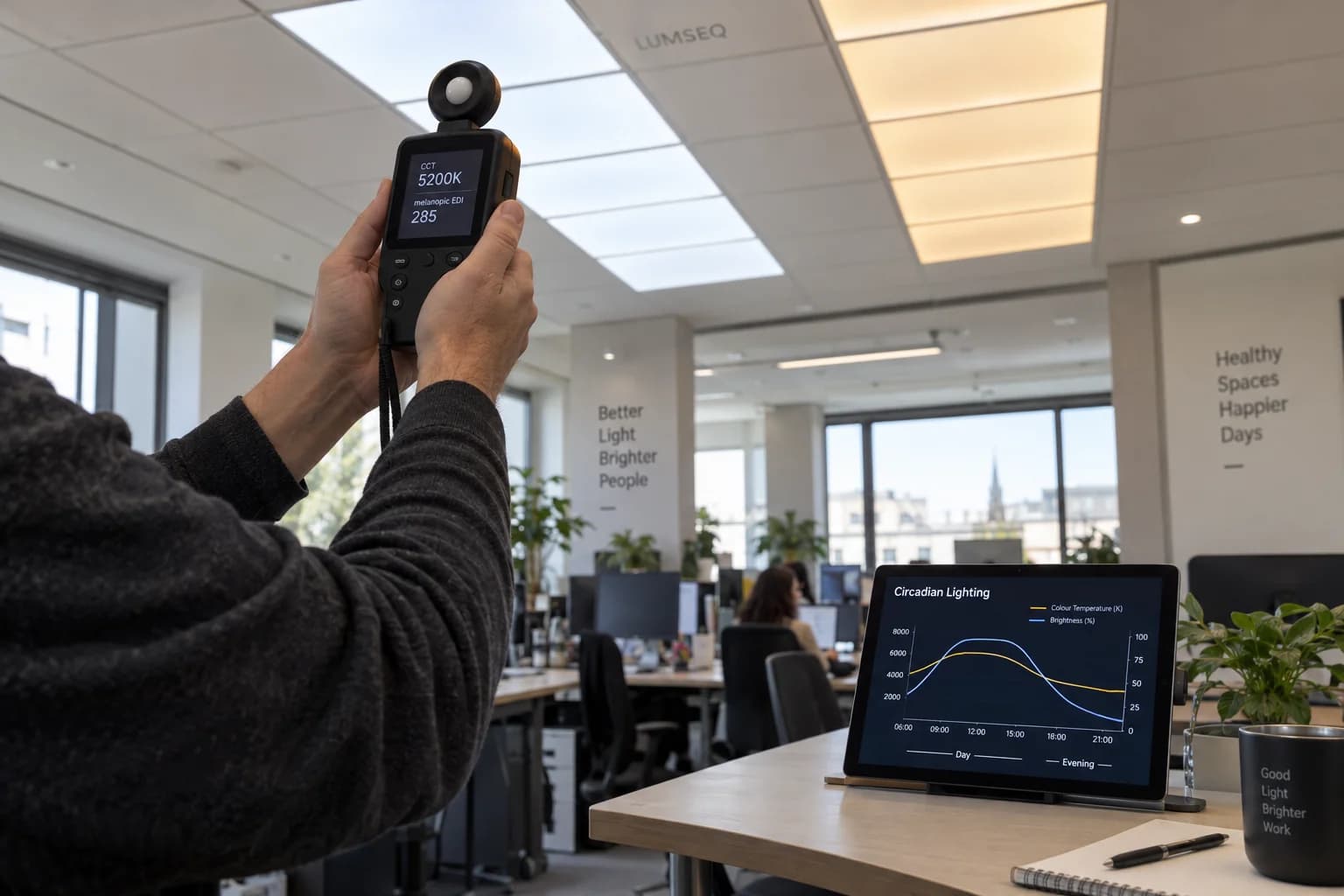
Key takeaways
- Tunable white is a hardware capability; circadian lighting is a verified outcome. A fixture that changes colour temperature is not automatically a circadian system - it also needs an automatic schedule and a melanopic target met at eye level.
- The metric that matters is melanopic EDI (CIE S 026:2018), measured vertically at eye level: at least 250 melanopic lux in daytime, below 10 in the 1-3 hours before bed, and near zero while sleeping. Desk lux and CCT alone do not tell you this.
- A tunable-white fixture mixes warm and cool LED channels, and output, CRI and colour consistency can collapse at the CCT extremes. Specify CRI, TM-30 and SDCM across the whole range, not at one nominal colour temperature.
- DALI-2 DT8 drives brightness and CCT from one address while DT6 uses two; DT8 saves addresses and commissioning time but says nothing about dimming depth, flicker or colour quality, which must be specified separately.
1. Adjustable white is not the same as circadian lighting
Walk a lighting trade show and almost every second fixture claims to support wellbeing. In practice the labels are used loosely, and buyers end up paying for three very different things as if they were one.
The first layer is tunable white: the fixture can change its correlated colour temperature (CCT) between a warm and a cool endpoint. That is a hardware capability - two LED channels and a control input, nothing more.
The second layer adds an automated schedule: a controller shifts colour temperature and brightness through the day to track daylight, instead of waiting for someone to turn a knob.
The third layer is a verified circadian or human-centric lighting (HCL) result: the installation actually delivers a defined light dose to the eye at the right time of day, measured in a standard metric. A lot of quotations sell the first layer packaged as the third. The question to ask is not whether the fixture is tunable, but whether the supplier can show that the eye-level light dose meets a daytime and a night-time target.
2. Why lux measured on the desk is the wrong number
For decades lighting was specified for vision: enough photopic lux on the working plane to see the task. The eye, however, also contains intrinsically photosensitive retinal ganglion cells (ipRGCs) that have almost nothing to do with forming an image. They feed the body clock, alertness and melatonin suppression, and they are most sensitive to short-wavelength, blue-cyan light around 490 nm.
Two light sources can deliver the same 500 lux on a desk and produce very different biological effects. A cool, full-spectrum source stimulates the ipRGCs far more strongly than a warm source at the same visual lux, because the spectral content differs.
CIE S 026:2018 formalised this with melanopic Equivalent Daylight Illuminance (melanopic EDI): the illuminance of standard daylight (D65) that would give the same melanopic stimulus as the light being measured. It is calculated from the source's spectral power distribution, weighted against the melanopsin sensitivity curve.
The second detail buyers miss is the measurement plane. The biological signal depends on light reaching the eyes, so melanopic EDI is assessed vertically at eye level (roughly 1.2 m in a seated workplace), not horizontally on the table. A bright desk with dark walls and indirect fixtures can look well-lit on paper while under-dosing the people in the room.
3. The numbers that actually define day and night
The expert consensus behind CIE S 026 (summarised by the IES and by Brown and colleagues) gives practical targets for melanopic EDI at eye level:
1. Daytime: maintain at least 250 melanopic EDI during scheduled waking and working hours, to send a clear 'day' signal that supports alertness and a stable circadian rhythm.
2. Evening: keep below 10 melanopic EDI in the one to three hours before bedtime, so melatonin suppression does not delay sleep.
3. Night-time: stay near 1 melanopic EDI during sleep; if a visual task genuinely requires light, up to about 10 is the working ceiling.
Rating schemes have turned these into compliance language. WELL historically used Equivalent Melanopic Lux (EML) with a daytime value around 250 and a much lower evening value; its newer lighting language references melanopic EDI directly. The exact unit on a tender is less important than the principle: the specification should demand a time-based melanopic dose at eye level, not a colour temperature.
This is also why simply fitting 6500 K panels does not solve the problem. Cool light has a higher melanopic ratio, but melanopic EDI is spectrum multiplied by the light that actually reaches the eye. An under-powered, heavily indirect or glare-producing cool installation can still miss 250 while making the room unpleasant to sit in.
4. The hardware: two channels, and where cheap tunable white fails
A tunable-white fixture contains two LED strings - one warm white and one cool white - that are mixed to produce the CCT in between. Near the middle of the range both strings run at full output, which is where the fixture is brightest and usually best specified. At either endpoint only one string carries the load.
That physics creates the most common quality trap. Low-end tunable products lose a noticeable amount of light at the warm and cool extremes, and their colour rendering drops there too, because the single remaining string was never the premium bin. A data sheet that quotes CRI 90 at a single nominal CCT tells you nothing about the endpoints.
For a commercial project, hold the supplier to the whole range:
1. Colour rendering: CRI Ra of at least 90 across the full tuning range, and ideally IES TM-30 with Rf of at least 85 and Rg between 90 and 110, which captures fidelity and saturation that CRI misses.
2. Consistency: chromaticity tolerance within SDCM 3 at every CCT, so fixtures do not look different from one another at the same setting.
3. Endpoint output: a stated minimum lumen output at the warmest and coolest settings, not only at the peak in the middle.
4. Evidence: a spectral power distribution and test report for several CCT points (for example 2700 K, 4000 K and 6500 K), rather than one certificate at the best-looking point.
On range, offices and schools commonly specify 2700 K to 6500 K (or 3000 K to 6500 K); healthcare, aged care and hospitality often prefer a warmer floor around 2200 K for night-time calm.
5. The control layer: DALI DT6, DT8 and D4i
Tunable white needs two control channels, and there are several ways to deliver them.
A dual-channel 0-10 V system works, but it requires two control runs per fixture type, offers no individual addressing, and quickly becomes unwieldy beyond a small room.
DALI is where most commercial tunable-white projects land, and two device types do the same job differently:
1. DALI DT6 treats each output as an ordinary dimmable channel. A tunable-white fixture therefore consumes two DALI short addresses - one for warm, one for cool - and the controller sends two commands and works out the mixing logic itself. On a 64-address bus this halves the number of tunable fixtures you can place.
2. DALI DT8 (defined in IEC 62386-209) controls both intensity and colour temperature from a single short address. The driver coordinates the warm and cool channels internally against the black-body line (the Tc method), so commissioning a thousand-fixture office or hospital needs half the addresses and far less per-fixture setup.
DALI-2 certification from the DALI Alliance (DiiA) is what makes devices from different manufacturers interoperable; for a tunable tender, look for DALI-2 certification of the DT8 Tc method on both the drivers and the controller. D4i is the DALI-2 extension for in-luminaire intelligence, bus power and data - useful when fixtures must report energy use or carry sensors as nodes in an IoT system.
One caution: DT8 describes a control method, not a quality level. A DT8 label guarantees nothing about dimming depth, flicker, or colour rendering at the extremes. Both sides of the link must support the same DT8 Tc mode, and the visual-performance requirements still have to be specified separately.
6. What a real circadian system must include
Putting the pieces together, a genuine circadian or HCL installation has three components, and removing any one leaves you with plain tunable white:
1. Capable fixtures: a wide enough CCT range, sufficient output and a high melanopic ratio to reach the daytime target at eye level, without sacrificing CRI or producing glare.
2. An automated schedule: a controller that runs a daylight-tracking profile of colour temperature and level through the day and a warm, dim profile for evening, selectable by scene. Manual adjustment alone delivers almost no circadian benefit, because people do not retune the ceiling all day and usually get the setting wrong.
3. Verification: an eye-level melanopic EDI calculation from the photometric files and room surface reflectances, or a measurement with a spectral metre at a representative workstation, showing the daytime and evening targets are met.
Whether the investment is justified depends on the space. It pays back where the same people stay for long hours on a regular schedule - open offices, classrooms, aged-care facilities and hospital wards. It is less compelling in short-stay circulation, retail aisles or corridors, where a high-quality fixed-CCT or a simple tunable-white installation is often the more honest choice than paying an HCL premium the occupants cannot benefit from.
7. What to put in the specification
These clauses separate a real circadian deliverable from a tunable fixture with a wellness label. Adapt the numbers to the application.
Tunable range and quality: continuously tunable from 2700 K to 6500 K; CRI Ra of at least 90, TM-30 Rf of at least 85 and Rg between 90 and 110, and SDCM within 3 at every CCT; endpoint lumen output to be stated and not to fall below an agreed percentage of the peak.
Control: DALI-2 certified DT8 (Tc, IEC 62386-209) drivers with a compatible DT8 controller; D4i where per-fixture energy data or sensors are required; dimming down to 1% with no visible flicker, cross-referenced to the project flicker specification.
Circadian performance: maintained average of at least 250 melanopic EDI (CIE S 026:2018, vertical at 1.2 m eye level) during the scheduled daytime profile, and below 10 melanopic EDI in the one to three hours before bedtime; the supplier shall provide the spectral power distribution and melanopic ratio at each CCT, plus an eye-level calculation or on-site measurement for a typical room.
Automation: the controller shall deliver an automatic daylight-tracking colour-temperature and brightness profile with selectable scenes, without requiring manual adjustment through the day.
Suppliers who can hand over spectral data at several colour temperatures and an eye-level calculation have actually engineered the circadian outcome. Suppliers who only repeat that the light is 'tunable and human-centric' are usually selling the first layer at the price of the third.
Frequently asked questions
Questions buyers ask
What is the difference between tunable white and circadian (HCL) lighting?
Tunable white is a hardware capability: the fixture can vary its colour temperature. Circadian or human-centric lighting is a verified outcome: an automated schedule changes the light through the day and the installation meets defined melanopic EDI targets at eye level. Tunable white is necessary for circadian lighting but not sufficient on its own - a fixture someone has to retune manually is not delivering a circadian programme.
Is cooler, higher-CCT light always better in the daytime?
No. Cool light has a higher melanopic ratio, but the biological stimulus is melanopic EDI at the eye, which is spectrum multiplied by the light that actually reaches people. An under-powered, heavily indirect or glaring 6500 K installation can still miss the 250 melanopic EDI daytime target while being uncomfortable. Specify the eye-level dose and visual comfort, not just a high colour temperature.
Should I choose DALI DT8 or DT6 for tunable white?
For new projects with many fixtures, DT8 is usually the better choice because one address controls both brightness and CCT, halving address use and simplifying commissioning; both controllers and drivers must support the DALI-2 certified DT8 Tc method. Use DT6 when you are extending an existing DT6 system or need the two channels fully independent. DT8 is only a control method and does not guarantee colour quality, dimming depth or flicker performance.
Is circadian lighting worth specifying without a WELL certification?
It can be. Where the same occupants spend long hours on a regular schedule - open offices, schools, aged care and hospital wards - designing to melanopic EDI targets has practical value even if the project is not certified; certification mainly documents and verifies the same requirements. For short-stay spaces such as corridors and retail aisles, a good fixed-CCT or basic tunable-white installation is usually more cost-effective than paying for a full HCL system.
Talk to the product team
Planning an OEM or commercial lighting order?
Send your application, specification and destination market. We will help narrow the product and sample options.
Discuss on WhatsApp