
Key takeaways
- Keep total LED load at 80% or below the driver's continuous output rating to maximize lifespan.
- Ask for the inrush current (I²t) rating and recommended breaker/relay size before ordering.
- Get lifetime rated at your actual installation ambient temperature, not the 25°C lab number.
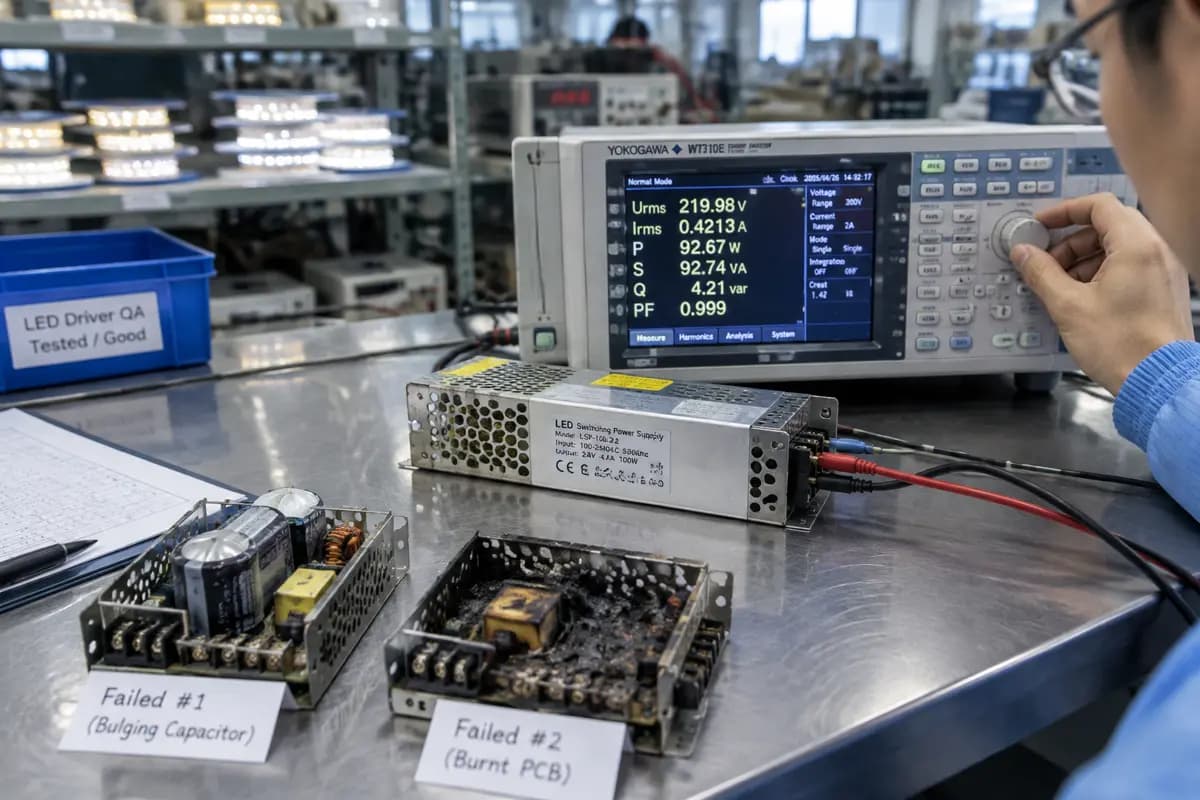
- Test a sample at 100% load for 72 hours and measure case temperature before bulk purchase.
1. Why do cheap LED drivers die within months?
A client told me last week: “We bought 200 LED drivers from a budget supplier. Half of them died within six months. The warranty says 3 years, but they won't respond to emails.” Sound familiar?
This isn't about bad luck. Driver failure in the first year almost always traces back to three predictable design shortcuts that only show up once the units are installed in the real world. Buyers who know what to look for can filter out the bad suppliers before placing the PO.
2. Mistake #1: Running the driver above 80% rated wattage
Most buyers size a driver by adding up the strip wattage and picking a driver with that exact rating. That “works” in the first week. But capacitors, semiconductors, and magnetics all age faster when pushed close to their limit.
The industry rule of thumb: keep total LED load at or below 80% of the driver's continuous output rating. So if your strip run draws 80W, use a 100W driver—not an 80W one. The extra 20% margin isn't wasted money; it's what buys you years of service life.
What suppliers won't tell you: many “100W” drivers on Alibaba are actually 80W units relabeled. Ask for the test report showing real output at 25°C ambient and 40°C ambient. If the rated output drops 15% at high temperature, that's normal. If it drops 30%, it's a chassis-sized driver with undersized internals.
3. Mistake #2: Ignoring inrush current at startup
When you flip the switch, the input capacitor inside the driver charges instantly. That inrush current can be 30 to 50 times the rated operating current—for a few milliseconds. It's harmless if the relay, circuit breaker, and wiring are sized for it. It's deadly if they aren't.
We've seen projects where every 12th driver blows the input fuse on power-up. The root cause wasn't the driver—it was a relay contact rated for 5A switching a load that draws 80A peak inrush. The contact welds shut after a few dozen cycles. Then the driver's input side goes.
Before ordering, ask the supplier: “What's the inrush current rating (I²t) of this driver? What's the minimum circuit breaker rating it's tested with?” If they can't answer in 10 seconds, move on. This is basic spec-sheet stuff, and any reputable manufacturer will have it on hand.
4. Mistake #3: Thermal design—the silent killer
Capacitor life halves for every 10°C rise in internal temperature. That's not a myth—it's how electrolytic capacitors work. A driver running at 85°C inside a sealed ceiling junction box won't last three years. It might last eight months.
The driver nameplate has an “ambient temperature rating” (Ta). That number is tested in free air, in a lab, at 25°C room temperature. If you install the same driver inside a closed enclosure or above a ceiling with no ventilation, the actual internal temperature jumps 15–25°C. The rated life drops in half, twice over.
What to ask for: the expected lifetime at your actual installation ambient temperature, not the lab-rated number. A driver rated 50,000 hours at 25°C might be rated only 15,000 hours at 60°C. That's the difference between a 5-year product and a 1.5-year product—and your client will blame you, not the supplier.
5. Buyer's checklist before placing the order
Use this list on every driver PO. It takes 10 minutes and saves you months of warranty claims.
- Load margin: total LED wattage ≤ 80% of driver continuous output rating
- Inrush rating: supplier provides I²t curve and recommended breaker/relay size
- Thermal rating: lifetime stated at your actual installation ambient, not lab conditions
- Capacitor brand: ask whether it's a name-brand (Rubycon, Nichicon, NCC) or generic
- Warranty terms: on-site replacement vs. R&D-only vs. “we'll see”
- Sample test: run the sample at 100% load for 72 hours and measure case temperature
6. Common misconception: “Mean Well is always safe”
Mean Well is a reputable brand, but even good drivers die if you overload them or box them into an airless enclosure. We've replaced Mean Well units that failed in 12 months—every single one was installed in a sealed recessed fixture with 90°C internal air temperature. The driver wasn't defective; it was mismatched to the application.
Brand is a starting point, not a guarantee. Spec the application first, then pick a driver that's rated for that real-world environment.
Frequently asked questions
Questions buyers ask
How long should an LED driver last?
A properly sized and cooled driver should run 50,000+ hours (about 5.7 years of 24/7 operation). If you're seeing failures inside 12 months, it's almost always load margin, inrush, or heat—not random defects.
Is it better to oversample or undersample LED drivers?
Oversample. Running at 60–70% of rated load costs a little more upfront, but the 2–3× longer life and near-zero failure rate makes it the cheapest option over the project's life cycle.
Do dimming circuits shorten driver life?
Poor dimming compatibility does. A mismatched dimmer can cause audible noise, flicker, or early failure of the driver's dimming IC. Test the dimmer–driver pair before bulk production, don't assume compatibility from brand names.
Talk to the product team
Planning an OEM or commercial lighting order?
Send your application, specification and destination market. We will help narrow the product and sample options.
Discuss on WhatsApp