
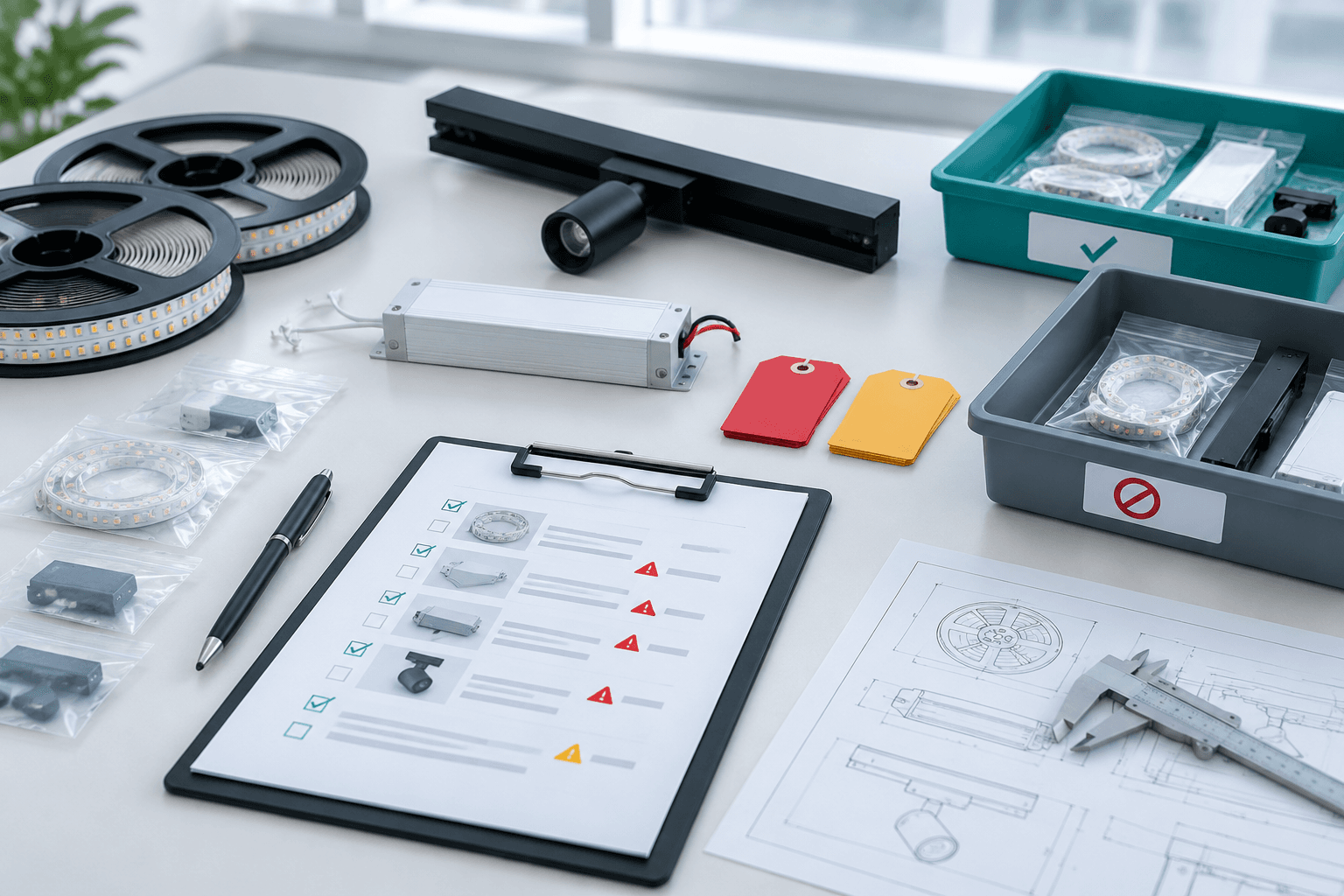
Key takeaways
- Identify the exact order line, model, revision, package and affected quantity before describing the finding.
- Record observable facts and evidence separately from suspected causes, supplier statements and unresolved assumptions.
- Contain the identified stock without automatically classifying the entire shipment as non-conforming.
- Give every disposition, corrective action and concession a named owner, approval status and due date.
- Close the report only after the agreed correction and affected scope have been verified against the acceptance requirement.
1. What is an LED lighting non-conformance report?
An LED lighting non-conformance report, often shortened to NCR, is a controlled record showing that a defined product, package, document or process result did not meet a stated requirement. It should identify the requirement, the observed condition, the affected scope, immediate containment, the disposition decision and the evidence used to close the finding.
An NCR supports control and traceability. It does not by itself prove a root cause, show that every unit in a shipment has the same condition or determine a legal or warranty outcome. Keep observation, investigation and decision as separate parts of the record.
| NCR element | What to record | Boundary |
|---|---|---|
| Requirement | Approved drawing, order field, sample, document or acceptance criterion | Use the exact current revision |
| Finding | Observable condition, location, quantity and evidence | Do not insert an unverified cause |
| Scope | Affected model, batch, package, zone or document | Do not assume the whole shipment is affected |
| Containment | Hold, segregation, identification and responsible owner | Containment is not final disposition |
| Closure | Correction evidence, verification result, approver and date | Closure does not erase the original record |
2. Record exact product, order and package identity
Start with the purchase order and line, exact model, configuration and revision. Add the shipment, carton, pallet, reel, unit, driver, accessory, batch or lot reference where supplied. Record the quantity inspected, quantity affected and quantity still awaiting review using the same unit basis.
For LED strips, include voltage, power basis, CCT, CRI, width, density, IP construction, reel or cut-length identity and related profile or driver where relevant. For magnetic lighting, power supplies and spotlights, capture the interfaces, optics, finishes, control options and package references that distinguish one configuration from another.
If identity is incomplete or a label is unreadable, record the gap and keep the affected material on hold for confirmation. Do not create a batch number or revision from a shipping date, carton colour or informal product name.
3. Describe the finding factually
State what was expected and what was observed under the same recorded condition. Reference the applicable drawing, approved sample, order field, packaging requirement, test instruction or acceptance criterion. Add the inspection date, location, method, equipment reference where applicable, responsible observer and photographs that show both detail and context.
Use descriptions such as label voltage differs from purchase order line, three cartons arrived wet, or one profile sample does not fit the approved diffuser. Avoid conclusions such as poor quality, factory error or total shipment failure unless a documented investigation supports them.
Separate supplier-provided information, buyer observations, measured results and suspected causes. A photograph can show visible condition and identity, but it cannot prove electrical performance, internal damage, certification scope or cause by itself.
- Exact requirement and revision
- Observed condition and inspection context
- Inspected and affected quantities in the same unit
- Photo, measurement or document references
- Observer, date and location
- Open questions and evidence still requested
4. Contain affected stock without overstating the scope
Identify and segregate the affected material so it cannot be shipped, installed, mixed or released unintentionally. Mark the hold status in the physical area and in the relevant receiving, warehouse or project record. Name the person responsible for controlling the hold and for authorizing any movement.
Contain the confirmed scope first. Expand sampling or hold boundaries when the product identity, package links or evidence shows that a wider group may be affected. A finding in one carton, reel, driver lot or installation zone should trigger review, not an unsupported statement that every unit is defective.
Where safety, electrical work or suspected internal damage is involved, stop unsafe handling and send the issue to the responsible qualified person. This checklist does not replace project-specific safety, regulatory or technical procedures.
5. Choose and approve the disposition
Disposition is the controlled decision for the identified material. Common outcomes include accept as supplied, accept under a documented concession, rework, repair where appropriate, replace, return, scrap, re-inspect or continue to hold. Use the terms defined by the buyer's quality system and contract.
Record who proposed the disposition, who has authority to approve it, which units or packages it covers and what evidence or re-inspection is required. Commercial credit, replacement timing, freight responsibility and warranty treatment require current written agreement; an NCR alone does not define those terms.
When a deviation is accepted, preserve the exact scope and conditions. A concession for one order, batch or application should not silently become a permanent product change or approval for repeat orders.
| Disposition | Record before release | Typical control |
|---|---|---|
| Accept | Reason the requirement is satisfied | Named approval and evidence reference |
| Concession | Exact deviation, scope, conditions and expiry | Authorized buyer or project approval |
| Rework or repair | Instruction, responsible party and re-inspection plan | Keep original and corrected evidence |
| Replace or return | Affected identity, quantity and logistics agreement | Prevent mixed or duplicate stock |
| Hold | Open questions, owner and next review date | No release until a recorded decision |
6. Request cause and corrective-action evidence
Ask the responsible supplier or project party to investigate the defined finding and return evidence at the level needed for the decision. The response may need a verified cause, correction for the affected material, action to prevent recurrence, responsible owner, completion date and evidence that the action was implemented.
Do not write the supplier's root cause before the investigation is complete. A suspected packing error, component change, process variation or installation condition remains a hypothesis until supported. Also distinguish correction from corrective action: replacing one affected unit corrects the immediate issue, while preventing recurrence may require a separate controlled action.
Tie every action to the affected product and requirement. A generic statement such as operator retrained or quality improved is incomplete unless the record shows what changed, where it applies and how completion will be verified.
7. Verify the correction and close the NCR
Before closure, confirm that the agreed disposition has been completed for the recorded scope. Re-inspect, review revised documents, reconcile replacement quantities or check the corrected assembly using the defined acceptance method. Record the result, evidence reference, verifier, date and any remaining limitation.
Close the NCR only when the responsible approver accepts the verification. If evidence remains incomplete, keep the item open or record a controlled conditional status. Do not delete the original photographs, finding description or rejected proposals after correction; they are part of the traceability record.
Link the closed report to receiving, shipment, warranty, change-order, supplier and repeat-order records where relevant. A closed NCR confirms completion of the agreed process for its scope; it is not a universal guarantee for other models, batches, projects or markets.
8. Buyer close-out checklist
Use this checklist before the responsible approver closes an LED lighting non-conformance report.
- NCR number, order line, model, revision and package identity are complete
- The exact requirement and observed condition are stated separately
- Inspected, affected, held and released quantities reconcile
- Evidence distinguishes observations, measurements, supplier statements and assumptions
- Containment protects the identified stock from unintended use
- Disposition has a named proposer, approver, scope and date
- Cause and corrective-action statements are supported or remain clearly open
- Correction or replacement was verified against the acceptance requirement
- Concessions and conditions are limited to their approved scope
- The closed record is linked to traceability, receiving, change and claim files
Frequently asked questions
Questions buyers ask
Does one inspection finding mean the whole LED shipment is defective?
No. Record the confirmed affected scope and contain it. Expand the review only when identity, sampling or investigation evidence supports a wider scope.
What is the difference between containment and disposition?
Containment prevents identified material from unintended use while the issue is reviewed. Disposition is the approved decision to accept, rework, replace, return, hold or otherwise control that material.
Should an NCR include the root cause?
Include a verified cause when the investigation supports it. Keep suspected causes clearly labelled as hypotheses and do not present them as established facts.
Can a buyer accept a non-conforming item under concession?
A responsible approver may accept a defined deviation when the buyer's process and contract allow it. Record the exact scope, conditions, evidence and order or batch limitation; do not treat it as permanent approval.
When can an LED lighting NCR be closed?
Close it when the agreed disposition is complete, the correction or replacement has been verified against the stated acceptance requirement, quantities reconcile and the named approver accepts the evidence.
Talk to the product team
Planning an OEM or commercial lighting order?
Send your application, specification and destination market. We will help narrow the product and sample options.
Discuss on WhatsApp