
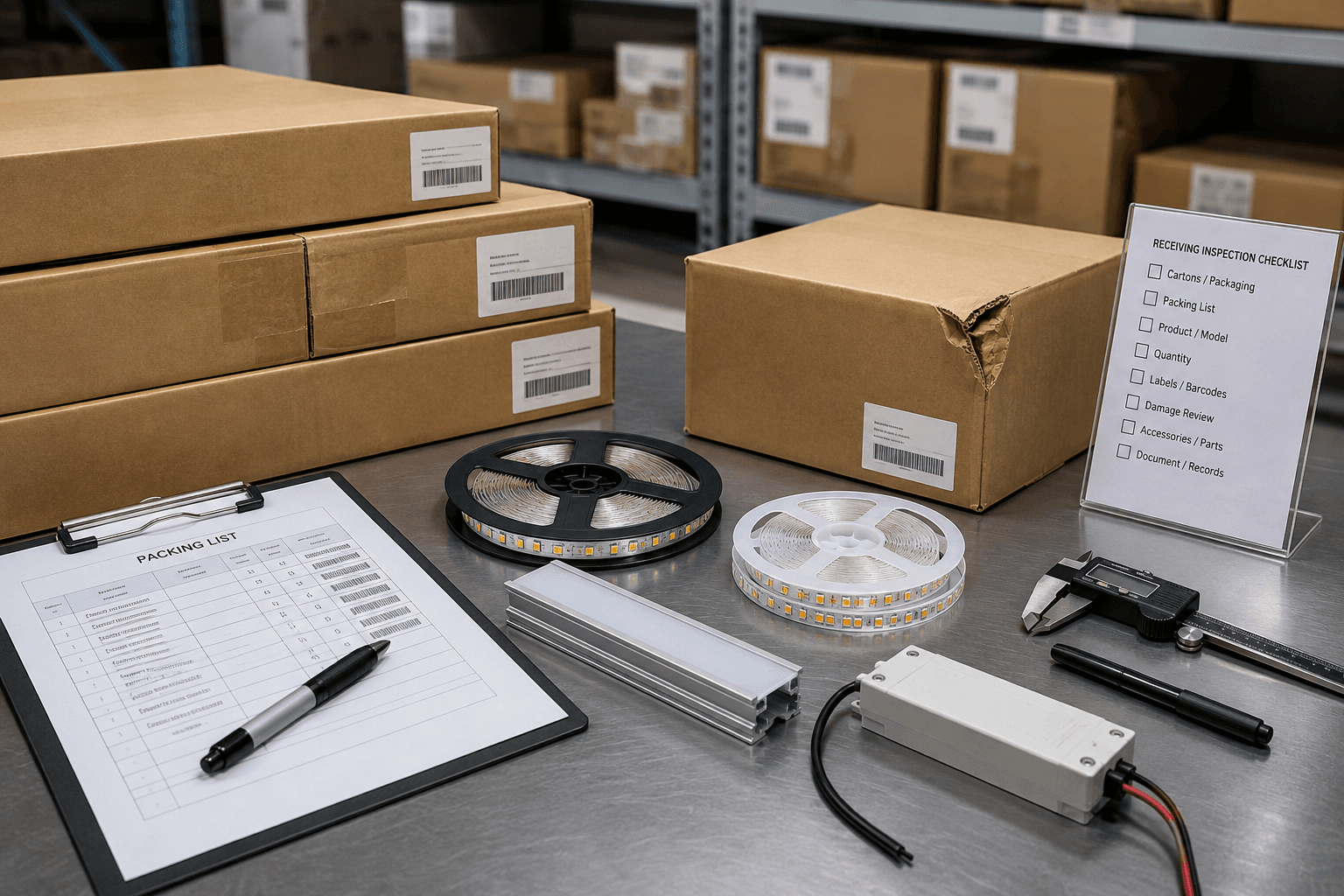
Key takeaways
- Preserve delivery evidence and isolate visible damage before cartons are opened or mixed into stock.
- Reconcile carton counts, labels, product identity and quantity units with the packing list and purchase order.
- Use the approved sample, technical schedule and change records as the receiving baseline.
- Record which samples were checked and apply only the acceptance rule agreed in the contract or quality plan.
- Close every discrepancy with a traceable accept, quarantine, reject or pending-review disposition.
1. What should buyers inspect when LED lighting arrives?
When LED lighting arrives, first preserve delivery evidence, compare carton counts and labels with the shipping documents, isolate visible damage, and verify the received model and quantity before stock is mixed or installation begins. Product checks should then follow the purchase order, approved sample, technical schedule and agreed inspection plan rather than a generic visual impression.
| Checkpoint | What to record | Hold condition |
|---|---|---|
| Delivery condition | Arrival time, carrier reference, pallet and carton condition | Wet, crushed, opened, punctured or missing packages |
| Carton count | Received cartons against packing list and transport record | Count does not reconcile |
| Identification | Carton, reel, product, driver and accessory labels | Model or revision cannot be traced to the order |
| Quantity | Units, metres, reels, modules, drivers, profiles and spares | Quantity basis differs from the purchase order |
| Visible condition | Housing, profile, reel, connector, cable, diffuser and finish | Damage, deformation, contamination or mixed finish |
| Disposition | Accept, accept with comment, quarantine, reject or pending review | Responsibility or next action is unclear |
2. Preserve evidence before opening cartons
Photograph the pallet or outer cartons as received, including visible damage, labels, seals and carrier references. Record shortages or external damage on the delivery record where the receiving process allows it. Do not discard packaging needed to trace or investigate a claim.
Keep facts separate from conclusions. A crushed carton is evidence of packaging damage, but it does not by itself prove that every product inside is damaged. Conversely, an intact carton does not prove that the contents match the order.
- Photograph the shipment before unpacking
- Record damaged, wet, opened or missing packages
- Keep carton and label references traceable
- Preserve packaging needed for investigation
3. Reconcile cartons, labels and quantity
Compare the delivery note and packing list with the purchase order and approved schedule. Confirm the quantity unit: a carton, reel, metre, module, driver, profile, accessory or complete set may represent different counting bases. Record partial deliveries and back-order lines separately when the supplier confirms them.
Check model references, revisions, CCT, voltage, power basis, finish, IP construction, length and other fields that appear on the approved record. Do not merge unidentified stock with accepted inventory.
4. Quarantine damage and inspect representative products
Move damaged, wet, opened, unlabelled, mixed or unmatched items into a clearly identified hold area. Prevent installation or resale until the buyer and supplier agree on disposition. A quarantine decision is not automatically a rejection; it preserves traceability while the parties determine the next action.
Use the purchase order, approved sample, technical submittal, drawing and change-order record as the comparison baseline. Depending on the product and agreed plan, inspect model identity, dimensions, finish, connectors, cable exits, profile fit, diffuser condition, reel or cut format, driver labels and included accessories.
Only perform powered or measured checks under a defined procedure with suitable equipment and responsible personnel. A brief power-on observation does not prove lifetime, compliance, thermal performance, ingress protection or compatibility with every driver and control system.
5. Record the sample, acceptance rule and disposition
Define which cartons or units were checked, how they were selected, which characteristics were inspected and what acceptance boundary was agreed. This guide does not prescribe an inspection level or statistical sampling plan; those decisions depend on the order, product risk, contract, market and responsible quality process.
Use a receiving report that links each discrepancy to photographs, affected quantities, supplier response, buyer decision and final disposition. Update stock status, replacement or credit records, project schedules and installation instructions as needed. Retain the accepted model and revision for repeat-order comparison.
| Status | Meaning | Next action |
|---|---|---|
| Accepted | Checked scope meets the agreed receiving criteria | Release identified quantity |
| Accepted with comment | A recorded issue does not block the defined use | Assign and close the comment |
| Quarantine | Evidence or disposition is incomplete | Prevent use until reviewed |
| Rejected | The responsible approver does not accept the affected quantity | Record supplier and logistics action |
| Pending review | Technical, commercial or evidence decision remains open | Name the owner and due action |
6. Receiving boundaries buyers should keep visible
Arrival inspection does not replace pre-shipment inspection or factory quality control. Packaging condition is not proof of product performance or certification, and compliance evidence must match the exact product and destination-market scope.
Price, replacement timing, freight responsibility, claim eligibility, stock and lead time require current written agreement. Sampling and acceptance rules must come from the applicable contract or quality plan, not an invented universal number.
- Do not treat an intact carton as proof that its contents match the order.
- Do not treat a similar-looking product as automatically compatible.
- Keep affected stock on hold while identity, damage or evidence questions remain open.
- Record one final disposition and one responsible approver for every discrepancy.
Frequently asked questions
Questions buyers ask
Should damaged cartons be rejected immediately?
Not automatically. Photograph and isolate them, inspect the affected contents under the agreed process, and record the final disposition. Carrier, insurance, contract and supplier requirements may affect the next step.
Is a packing list enough to accept an LED lighting delivery?
No. It supports the count, but acceptance should also reference the purchase order, approved product identity, quantity basis, visible condition, required documents and agreed sample checks.
Can received LED lighting be installed before discrepancies are closed?
Items affected by an identity, damage, quantity, compatibility, performance or evidence discrepancy should remain on hold until the responsible approver releases them.
Does a power-on check prove the product meets its specification?
No. It records operation only under that test condition. It does not by itself prove lifetime, output, colour, thermal performance, IP protection, control compatibility or compliance.
How many units should be inspected on arrival?
Use the sampling and acceptance rule agreed in the contract or quality plan. The appropriate level depends on order size, product risk, prior evidence, destination requirements and the buyer's quality process.
Talk to the product team
Planning an OEM or commercial lighting order?
Send your application, specification and destination market. We will help narrow the product and sample options.
Discuss on WhatsApp