
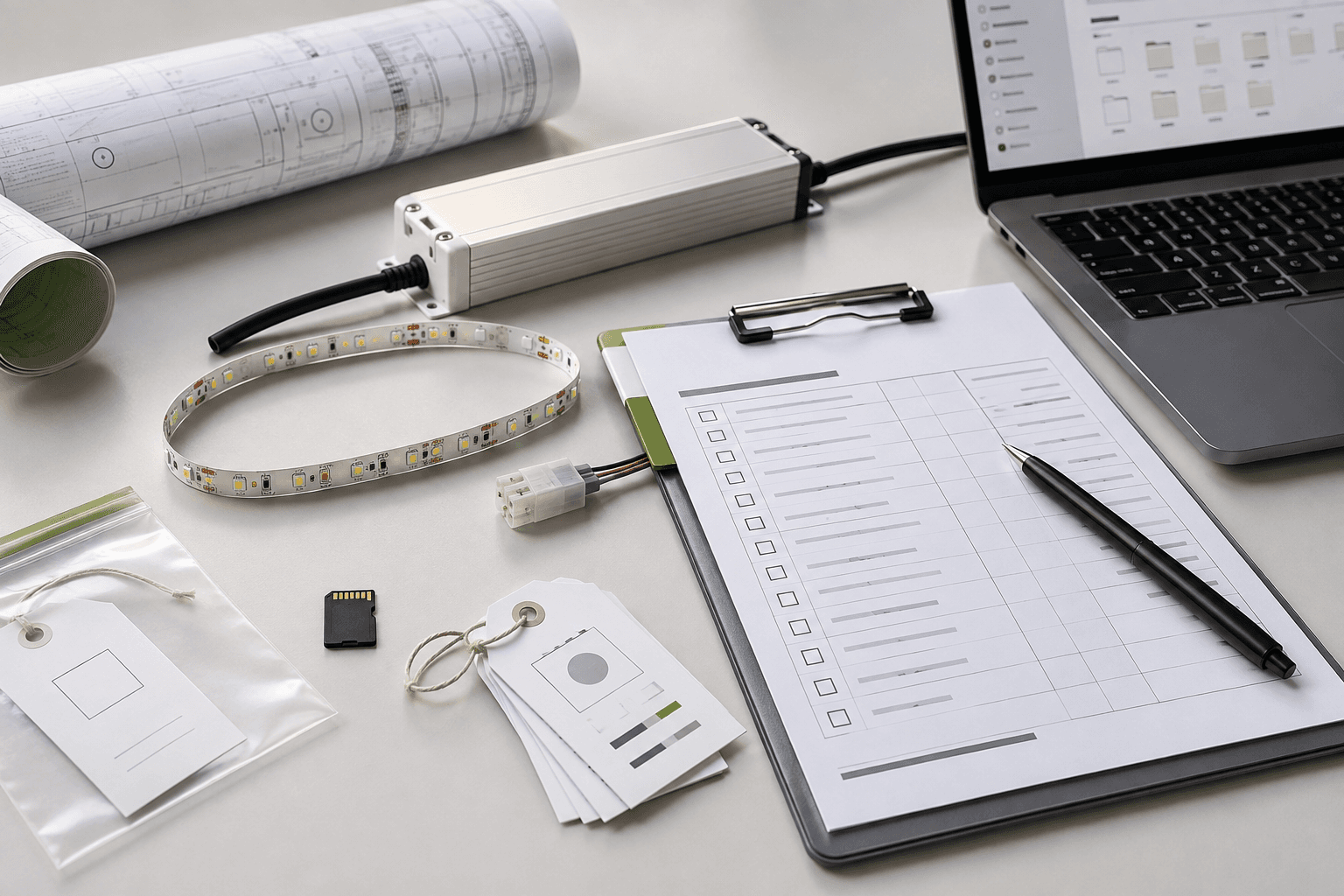
Key takeaways
- Identify the exact product, revision, order and affected quantity before discussing cause.
- Record the complete lighting system, including drivers, controls, wiring, profiles, connectors and environment.
- Separate observations from assumptions: describe what happened without declaring a failure cause.
- Stop testing when there is heat, smoke, exposed conductors, water ingress or another safety concern.
- Confirm claim eligibility, exclusions, return instructions, freight responsibility and remedy in current written terms.
1. What evidence should a buyer prepare for an LED lighting warranty claim?
Prepare a traceable evidence package that connects the affected item to the order and installed system: purchase and model references, label photographs, quantities, installation context, driver and control details, a dated description of the symptom, and non-destructive observations made under safe conditions. Preserve the product and packaging where practical, and ask the supplier for the current claim procedure before returning, opening or modifying anything.
This evidence supports an investigation; it does not by itself establish warranty eligibility, cause, liability or remedy. Keep confirmed facts separate from assumptions throughout the claim.
| Evidence group | What to record | Boundary |
|---|---|---|
| Purchase traceability | Purchase order, invoice or shipment reference, order date and delivery record | A photograph alone may not link the item to the transaction |
| Product identity | Exact model, revision, visible serial, batch or lot reference and label photographs | Do not infer identity from appearance or a family name |
| Affected quantity | Ordered, installed, affected and retained quantities with the counting basis | Do not present an estimate as a verified defect rate |
| System context | Driver, controls, wiring, connectors, profile or housing and installation method | The luminaire or strip is only one part of the system |
| Symptom record | First observation date, operating state, location, original photographs or video and repeatability | A symptom is not proof of root cause |
| Handling history | Receiving inspection, storage, installation, changes, repairs and prior communications | Unrecorded changes can prevent a reliable comparison |
2. Check the agreed claim route before acting
Start with the quotation, purchase order, warranty wording, product document and supplier correspondence that applied to the order. Identify the responsible contact, notice method, requested evidence, return authorization process and any instruction about retaining or isolating affected items. Use the exact terms agreed for that transaction rather than a generic statement from another product or market.
Do not assume a published warranty period applies to every product, order, destination or failure mode. Eligibility, exclusions, notice deadlines, remedy, labour, freight, removal, reinstallation and investigation costs require the current written agreement. Avoid returning goods without authorization because the supplier may need the installed context or a controlled sample for review.
3. Establish traceability and describe the symptom
Create one claim record and give it a stable reference. Link it to the purchase order, invoice or shipment, delivery date, receiving inspection, model schedule and approved sample or submittal. Photograph all visible labels before removing, cleaning or opening the product. Keep different models, batches and installation zones separate.
Write a factual timeline: when the system was installed, when it entered service, when the symptom was first noticed, whether it is continuous or intermittent, and what safe observations reproduce it. Descriptions such as does not illuminate, visible flicker, colour difference, partial output, control response issue, physical damage or moisture at a stated location are more useful than an unsupported cause.
Capture both context and detail: the full installation location, affected item, label, connections visible without unsafe disassembly, and any identified comparison item. Keep original files and dates rather than relying only on compressed screenshots.
- Use one stable claim reference
- Separate unlike models, zones and conditions
- Record quantities in the order's unit where possible
- Keep observations separate from conclusions
- Retain original image and video files
4. Record the complete system and operating boundary
For LED strips, document the strip model, voltage and power basis, connected length, feed arrangement, driver, controller, profile, diffuser, connectors, joints, sealing and mounting surface. For magnetic track lighting, record the track, feeds, modules, adapters, drivers, control zones and substitutions. For spotlights or luminaires, include the fitting, optic, driver, adapter, mounting and control interface.
Record the actual installation and environment rather than copying a design assumption. Note whether the item is indoors or outdoors, enclosed or ventilated, exposed to moisture or dust, accessible for service, and connected to other equipment. Electrical measurements must be made only by qualified project personnel using an appropriate method and documented test point; this article does not instruct live electrical work.
5. Preserve evidence and apply safety stop conditions
Isolate and label affected items in line with the project's safety process. Preserve packaging, labels, connectors, cut ends, drivers and related parts that may be needed to understand the assembly. Do not clean away deposits, reseal a joint, replace a component, open a driver or alter wiring before the supplier confirms the evidence required, unless immediate work is necessary for safety and is recorded.
| Stop condition | Immediate record | Next step |
|---|---|---|
| Smoke, burning smell, abnormal heat or visible deformation | Location, time, operating state and photographs from a safe position | Isolate through qualified personnel and escalate under the site safety process |
| Exposed conductor, damaged insulation or loose energized part | Exact location and visible condition | Prevent access and use qualified electrical personnel |
| Water inside an electrical boundary | Source or location observed and affected equipment | Isolate as required; do not re-energize merely to reproduce the symptom |
| Repeated protective-device operation | Circuit, connected equipment and sequence observed | Stop repeated resets and request qualified investigation |
| Structural or mounting damage | Affected fitting, support and surrounding area | Secure the area and obtain the responsible project review |
6. Submit a controlled evidence package
Send one indexed package rather than a stream of unrelated messages. Include a cover summary, order and model references, affected quantities, timeline, photographs or video, system diagram or annotated drawing, installation and environment record, safe observations, changes or repairs, and the requested next action. State which facts are confirmed, which remain unknown and which documents are attached.
Ask the supplier to acknowledge the case reference and identify missing evidence, sample selection, return authorization and the decision owner. If a physical sample is requested, agree how it will be selected, labelled, packaged and linked back to the installation. Keep a chain-of-custody record where the project requires it.
- Current terms for the exact transaction
- Order, shipment and receiving references
- Exact model, revision and visible labels
- Quantities with a clear counting basis
- System, environment and factual symptom records
- Supplier case reference and return authorization
7. Close the technical and commercial decisions separately
The technical investigation and commercial resolution are related but not identical. A technical record may identify a symptom or probable mechanism without deciding contractual responsibility. A commercial accommodation does not automatically establish a product-wide technical conclusion.
Record the supplier's written decision, evidence reviewed, affected scope, proposed action, responsibilities and conditions. Confirm whether the action applies only to the submitted units or to a wider identified population. Replacement compatibility, installation method, destination-market documents and acceptance checks must be reviewed for the exact replacement item.
This checklist does not determine warranty coverage. Price, credit, replacement timing, stock, labour, freight and other remedies require current written agreement. Certification and compliance evidence must match the exact replacement model and destination-market scope.
Frequently asked questions
Questions buyers ask
What should be included in an LED lighting warranty claim?
Include order and product identity, affected quantities, label photographs, a factual symptom timeline, installation and system details, environment and maintenance history, safe observations, and the requested resolution. Follow the supplier's current claim and return instructions.
Does a failed LED light automatically qualify for warranty replacement?
No. A reported symptom starts an evidence review; it does not establish eligibility, cause or remedy. Coverage depends on the exact product, transaction terms, application, evidence and supplier decision.
Should a buyer remove or open the affected LED product?
Not before checking safety requirements and the supplier's evidence instructions. Removal, opening, repair or rewiring can change the evidence and may introduce risk. Qualified personnel should handle electrical and site-safety work.
What photographs help an LED warranty investigation?
Capture the installation context, affected item, all visible labels, relevant connections that can be viewed safely, physical symptoms and an identified comparison where appropriate. Keep original files and dates and explain what each image shows.
Can several affected LED products be submitted as one claim?
They can share a case only when their order, model, batch or lot, system conditions and symptoms remain traceable. Separate different models, zones or conditions so the investigation does not treat unlike items as one population.
Talk to the product team
Planning an OEM or commercial lighting order?
Send your application, specification and destination market. We will help narrow the product and sample options.
Discuss on WhatsApp