
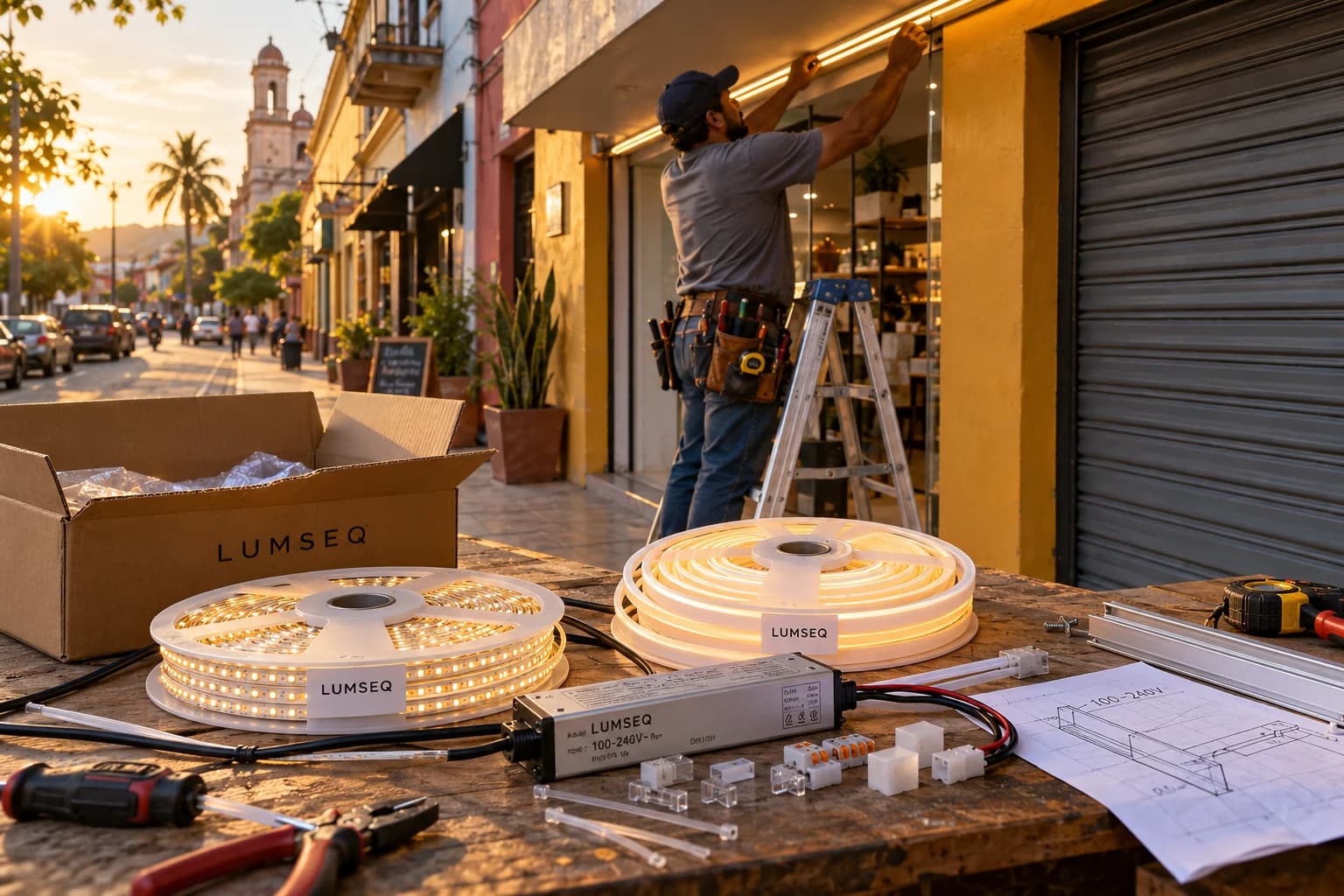
Key takeaways
- These are three markets, not one. Mexico runs on 127V at 60Hz, Colombia on 110V at 60Hz, and Brazil on 127V or 220V depending on the city and state, also at 60Hz. The frequency is 60Hz across all three, which differs from China's 50Hz. Buyers also use different words: tiras LED and mayoreo in Mexico, cintas LED and mayorista in Colombia, fita LED and atacado in Brazil. A quote that ignores those three electrical realities and the local quote unit will be wrong before a price is discussed.
- Brazil is the voltage trap. A roll of high-voltage strip that works in a 127V city can fail or underperform on a 220V circuit in another state, and a single project can span both. The strip itself is a 12V or 24V DC low-voltage component, so specifying wide-input 100-240V drivers and 12V/24V strip removes most of the argument; a hard-wired 220V board does not. Confirm the destination city before confirming the driver.
- Compliance is model-specific and led by the importer. Mexico requires NOM and does not accept CE, UL or ENERGY STAR as market access for controlled lighting; Brazil's INMETRO Portaria 231/2026 makes certified LED lamps and luminaires with a driver mandatory from May 2030, while extra-low-voltage (12V/24V) strip itself falls under the regulation's exception; Colombia applies RETIE and RETILAP and asks for a certificate of conformity before import. The factory supplies the reports, but the importer files and holds the registration.
- The quote unit is where Latin American sourcing quietly goes wrong. Local buyers think in metres, reels (5m is common), kits that include a driver and controller, or cartons, and retail prices show IVA included. A factory quote that only says a price per reel without saying how many metres, whether the driver is included, the MOQ, and the Incoterm forces the buyer to do the comparison alone - and that is how an apparently cheap FOB number turns into an expensive landed unit.
- Import duties and VAT vary by HS code and, in Brazil, by state. Brazil stacks import duty (II), industrial product tax (IPI), state ICMS and PIS/COFINS through SISCOMEX; Mexico adds IVA of 16 percent and tariff; Colombia adds IVA and arancel. Do not budget a fixed percentage from a freight forwarder's one-line estimate - have a local broker confirm the exact HS code and destination state before the deposit.
1. Three countries, three ways to buy
A sign maker in Mexico City needs five rolls of warm-white neon flex this week to finish a restaurant front. A retail chain buyer in Medellin is pricing cintas LED for 40 stores and needs the same colour temperature and width repeated over a year. A lighting importer in Sao Paulo is planning a container of fita LED and drivers for distribution across two states. They all need LED strip. They do not buy it the same way, and they do not even call it the same thing.
The vocabulary matters because it shows up in searches and on purchase orders. In Mexico, strip is tiras LED (the singular tira led is the most-searched form) and wholesale is mayoreo. In Colombia, local traders and electricians tend to say cintas LED (cinta led), and a wholesaler is a mayorista. In Brazil, the word is fita LED, and wholesale is atacado. Trend data is consistent: Mexican buyers search tira led, Brazilian buyers search fita led, Colombian buyers search cinta led, while the English phrase led strip draws comparatively little local volume in any of the three. This article is written in English because that is the common baseline for our technical documentation; the Spanish and Portuguese terms are explained here so they can be matched to the right English spec.
Local wholesale exists in all three markets for a reason. A mayoreo counter, a mayorista or an atacado dealer sells by the metre, by the reel, and in kits that may already include a driver and controller, prices with IVA included, and holds stock so the buyer can walk away with product the same day. That is the honest channel for small jobs, replacements, and a sign maker who cannot wait for a vessel. The price reflects the importing, warehousing, clearance and tax the dealer has already done.
Direct import is a different purchase. A factory sells full reels, cartons and project quantities against a fixed specification, supports OEM and project packaging, and keeps batches consistent across repeat orders. In exchange the buyer accepts a production lead time, a minimum order, and the freight, clearance and conformity work described later. The dividing line is specificity and volume, not price: small, urgent, open-specification orders belong at the local counter, and fixed-specification chains, projects and distribution volumes belong at the factory.
We are a China-based LED strip and magnetic-lighting manufacturer. We quote and ship from China under the agreed Incoterm, support project and OEM orders, and provide model-matched documentation before shipment. We do not run a warehouse in Mexico City, Medellin or Sao Paulo and we do not list products in pesos or reais with local free shipping, because that is not how a factory ships. Same-day local stock is real, but it is held by local importers and distributors, not by the factory.
2. The electrical baseline: 127V, 110V and 127-or-220V, all at 60Hz
The first technical question is the wall voltage, and it has three different answers. Mexico is nominally 127V at 60Hz on Type A and B sockets; equipment labelled 120V works there. Colombia is nominally 110V at 60Hz, also on Type A and B, with some cities running close to 120V. Brazil is the one buyers get wrong: it is 127V in some cities and states and 220V in others, at 60Hz, on Type C and N sockets. There is no single 'Brazil voltage' to specify against - the destination city decides, and it must be confirmed before the driver is ordered.
All three run at 60Hz, which is easy to miss because China, most of Europe and the Middle East run at 50Hz. A modern wide-range switching driver usually handles 50/60Hz without issue, but a hard-wired high-voltage strip, a magnetic or iron-core transformer, and some older dimmers are frequency-sensitive. Confirming 60Hz on the driver and control gear is a one-line check that prevents a hum, flicker or overheating problem that only appears after installation.
The LED strip itself is a low-voltage device. A 12V or 24V strip never sees the wall socket directly; a driver converts the mains to 12V or 24V DC, and that driver is the part that has to match the local voltage. In practice there are three systems on Latin American projects, and the first real decision is deciding which one the application belongs to.
1. AC high-voltage strip (127V or 220V). This board has rectifiers on it and connects straight to the mains, so a single feed can cover a long facade or sign run with fewer drivers and power points. It is the standard choice for building outlines, storefront signs and outdoor tracing. The catch is obvious here: the board must be made for the voltage of the destination, and Brazil's 127V/220V split means a single high-voltage board cannot serve both. A 50-metre reel is also a packaging length, not a promise of 50 metres from one end with no voltage drop; high-voltage runs still need feed points.
2. DC 12V or 24V low-voltage strip with an external driver. This is the interior workhorse for cove lighting, wardrobes, mirrors, kitchens, restaurants, retail shelving and dot-free high-density COB. It needs a driver for each run or zone, but it gives smooth dimming, a finer cut point and a touch-safe circuit. Pairing low-voltage strip with a wide-input 100-240V driver is the most forgiving specification for a region with three wall voltages, because the driver accepts 127V, 110V and 220V without ordering a different part for each city.
3. 48V magnetic track systems. The rail, magnetic fixtures and driver form one matched system that has to be specified together. They are common in flexible retail, gallery and hospitality accent lighting where fittings are repositioned, and a 48V rail from one maker cannot be assumed to accept another maker's fixture. Because the rail is supplied by a driver that can again be wide-input, the destination voltage is handled at the driver, not on the rail.
The recurring mistake is reaching for one voltage across a whole order to save a part number. For a project that ships into both 127V and 220V Brazil, low-voltage strip with wide-input drivers is the simple, repeatable answer; a hard-wired 220V high-voltage board only belongs on a run where the destination voltage is known and fixed.
3. NOM, INMETRO and RETIE: what is actually mandatory
Each market has its own conformity regime, and the single most important rule is the same in all three: certification is filed by the importer in the destination, model by model, and a CE or UL mark is not a substitute for the local scheme. A factory can carry the testing burden, but it cannot honestly claim every model on its website is already registered for all three countries.
Mexico applies NOM, the Normas Oficiales Mexicanas. Controlled lighting is assessed against Mexican NOM standards for safety and energy efficiency - the NOM-ENER series for general luminaires, integrated LED luminaires, and street and outdoor lighting are the relevant families - and must carry NOM conformity before it is placed on the market. The key point buyers from China ask about is blunt: CE, UL and ENERGY STAR marks are not recognised by Mexican authorities as market access for controlled products, and the importer of record is the responsible party. Confirm the exact NOM requirement for the specific model and HS code with the importer before production.
Brazil uses INMETRO. Portaria INMETRO n 231/2026, published in May 2026, requires LED lamps and luminaires placed on the Brazilian market to meet the performance, safety and compatibility requirements from 5 May 2030, with certification and registration and a local representative in the process. The scope detail matters for strip buyers. INMETRO's own guidance states that LED luminaires with a control gear (driver) - built-in, integrated or independent - must be certified and registered, with the certification covering the luminaire plus the specific driver model it is supplied with. By contrast, LED fita, hose and cord in extra-low-voltage (tensao extra de baixa seguranca, the 12V/24V SELV range) fall under an explicit exception regardless of power, as do Christmas and decorative lighting. In plain terms: low-voltage strip on its own is treated as a component, but the moment it is sold as part of a driver-equipped luminaire, that luminaire is regulated. Confirm the exact classification of the finished goods - bare strip, driver, or finished luminaire - with the importer.
Colombia applies RETIE, the technical regulation for electrical installations, together with RETILAP, the regulation for lighting and public lighting. Electrical products subject to RETIE must obtain a certificate of conformity issued by an ONAC-accredited body before importation, commercialisation or distribution; self-declaration has a narrower scope than buyers sometimes assume. A 2026 revision keeps the existing bans on incandescent and halogen sources and phases out mercury, metal-halide, fluorescent and sodium discharge products and their gear, though products made for export are not restricted. For an importer, that means the conformity file is a pre-import condition, not something arranged after the goods arrive.
The practical division of labour is consistent everywhere. The importer or local representative confirms the requirement for the destination and model, files and holds the registration, and initiates any per-shipment steps. The factory supplies the test reports, datasheets, IECEE/CB documentation where applicable, brand authorisation and samples. We provide the model-matched documents we actually hold for review before shipment; we do not promise blanket NOM, INMETRO or RETIE coverage for every product online. If a model is not yet documented for a destination, adding it carries time and cost and should be planned before the order is released.
4. Duties, and the unit that actually gets quoted
Two different problems get confused on Latin American orders. One is the tax stack on import, which is the importer's responsibility. The other is the unit the factory quotes, which is where most comparison errors start.
The tax stack is country-specific and changes with the HS code and, in Brazil, the destination state. Brazil clears through SISCOMEX and stacks import duty (II), industrial product tax (IPI), the state circulation tax (ICMS, which varies by state), and PIS/COFINS. Mexico applies tariff plus IVA of 16 percent and customs handling charges. Colombia applies arancel and IVA. The percentage for the same LED product can move between HS classifications for bare strip, drivers and finished luminaires, and Brazilian ICMS alone differs from one state to another. A freight forwarder's one-line estimate is not a budget; ask a local customs broker to confirm the exact HS code and the destination state or port before committing, and read the detailed landed-cost method rather than relying on a single duty figure.
The quote unit is the more common source of confusion. Local wholesale throughout the region prices by the metre (por metro), by the reel (rollo in Spanish, rolo in Portuguese, commonly 5m), by the kit (often the strip plus a driver and a controller), or by the carton (caja or caixa). A Brazilian retail listing or a Colombian mayorista quote usually shows IVA already included and assumes local payment methods and local fulfilment. A factory quote does none of that. It should state explicitly whether the price is per metre, per 5m reel or per carton, how many metres that carton contains, whether the driver and controller are included, the MOQ, and the Incoterm.
That distinction matters because a kit price and a bare-reel price are not comparable. A local fita kit priced per box may include a driver, clips and a controller, while a factory FOB price for the same 5m reel may include the strip and nothing else. Buyers who put the two numbers side by side without normalising the unit, the accessories and the tax end up believing the factory or the local dealer is far cheaper than it really is. Ask for the quote in metres with the accessory list and the MOQ stated separately, and the comparison becomes honest.
A factory also should not copy local retail terms it cannot meet. Same-day delivery, local free shipping, PIX, boleto or instalments, and IVA-included consumer pricing are what a Brazilian or Mexican retail checkout does, built on a local entity and local inventory. An FOB or CIF export quote from China is in USD, excludes destination duties and IVA, and moves on the agreed Incoterm. A vendor in China offering local free shipping and consumer instalments in reais is almost certainly a reseller or a middleman, not a factory.
5. Matching the strip to the job: an application short list
Most Latin American orders repeat the same handful of applications. This is the starting short list we quote against; exact wattage and lumen figures are confirmed per model and per length on the final schedule.
Storefront signs, lettering and facades: a large share of demand in the region is neon flex and high-density COB for letreros, restaurant fronts and retail signage. Outdoor and exposed runs use IP65/IP67 with sealed connectors, and long runs lean on high-voltage strip where the destination voltage is fixed - or on 24V neon flex with zone drivers where the city voltage is uncertain. The waterproofing has to extend to the connectors and end caps, not just the board.
Retail, showrooms and shopfitting: high-CRI 24V COB at CRI 90 or above for shelf and display washing, often 3000K or 4000K, plus a 48V magnetic track for movable spot and accent lighting. Total the wattage on the rail against the driver so the system is never overloaded, and confirm the wide-input drivers cover the local voltage.
Hotels, restaurants and interiors: 24V high-density COB for cove, headboard, mirror and wardrobe lighting, with TRIAC or 0-10V dimming where the room control calls for it, in a diffused aluminium channel. Touch-safe 24V is the natural interior choice across all three voltages because the wall voltage is handled at the driver.
Distribution and residential: smaller e-commerce and residential buyers in the region often want complete 5m kits (strip, driver, controller, clips) and standard white PCB in popular colour temperatures. These are the kind of fixed, repeatable SKUs that justify factory-direct volume, but the driver input voltage still has to be matched to the country.
Projects and tenders: government, hospitality and large commercial jobs lead with the specification and documentation, not the price. Confirm the NOM, INMETRO or RETIE scope for the named models and the destination city voltage before accepting a low FOB number; a container that cannot clear customs or cannot be installed on the local voltage cannot be saved by a cheap unit price.
6. What a project-ready RFQ from Mexico, Colombia or Brazil should contain
A quote request that reads 'fita LED, atacado, best price' forces every factory to guess. A project-ready RFQ removes the guesswork and makes the comparison like-for-like. In a three-voltage, three-scheme region, the destination detail is not optional.
1. Destination country and city - this sets the regime (NOM, INMETRO or RETIE) and, for Brazil, whether the circuit is 127V or 220V.
2. Application and mounting position - interior cove, retail display, storefront sign, outdoor facade, coastal or humid location, enclosed channel.
3. Voltage system - 127V/220V high-voltage direct, 12V/24V with external drivers, or a 48V magnetic track; the control protocol (non-dim, TRIAC, 0-10V, DALI) and colour control (single-colour, CCT-tunable, RGBW).
4. Optical and electrical specification - W/m, lm/m, LED density or COB, CCT, CRI, board width, cut length, and the required IP rating.
5. Quantities and run geometry - total metres, number of reels or runs, the length of each individual run, and the maximum distance from driver to strip.
6. Quote unit and accessories - price per metre, per 5m reel or per carton, whether drivers, controllers, profiles, connectors and clips are included, and the MOQ.
7. Certification and commercial terms - the specific NOM, INMETRO or RETIE requirement, packaging and carton marking, lead time, Incoterm, port of entry, and the HS code the importer plans to use.
A factory that comes back with a table against those fields is quoting the same product as its competitor. A factory that only returns a single reel price is asking the buyer to do the engineering, the tax calculation and the compliance risk for free.
7. Buying direct from China: the realistic path
For a project-sized or distribution order, the direct route runs the same way every time. A project-ready RFQ lands, the factory confirms the specification against the destination city voltage and produces a schedule, and a sample or small trial order is approved for colour, CRI and thermal behaviour. The model-specific NOM, INMETRO or RETIE documentation is settled on the importer's side using the factory's reports, production is released against a deposit, a pre-shipment inspection checks the batch against the approved sample, and the goods are packed and loaded for the agreed Incoterm. The importer then clears the consignment under the local regime and the correct HS code.
What a factory genuinely does is manufacture to the agreed spec, support OEM and project packaging, provide third-party test reports and the documentation the conformity assessment builds on, accept inspection, and ship FOB or CIF. What it does not do is hold same-day local stock, list products in pesos or reais with local free shipping and instalments, underwrite a local warranty network it has not built, or quietly hold an INMETRO or NOM certificate in the importer's name. Those obligations sit with the local partner, distributor or importer, and a vendor who blurs that line is usually a reseller marking up someone else's strip.
One language question comes up often. We publish this technical content in English because it is the stable baseline for our specifications and it can be quoted accurately into Spanish and Portuguese by the buyer and local distributor. We handle commercial and technical correspondence in English and provide datasheets that can be checked against the local terms - tiras, cintas and fita all map to the same physical products. A full native Spanish or Portuguese site is a separate project that requires native review and the ability to service enquiries in those languages; it should not be faked with machine-translated listings on a technical export site.
Direct import is not free of work. It asks the buyer to manage certification, freight and clearance, and to wait for production rather than walking out of a mayoreo counter. What it returns is the exact specification the project needs, consistent batches across repeat orders, OEM branding, and a price that has not been through a local warehouse. For a chain, a project or a distributor serving multiple cities, the three things that decide whether it lands cleanly are the destination voltage, the model-matched conformity file, and a quote unit that is fully spelled out.
If you are pricing an order for Mexico, Colombia or Brazil, send the destination city, the application, the run lengths and the quote unit you need, and we will return the matched strip, wide-input driver and magnetic options with the documentation that applies to those specific models - and a clear answer on which items are already documented and which would be added for your order.
Frequently asked questions
Questions buyers ask
Can I import LED strips directly from China to Mexico, Colombia or Brazil?
Yes. Chinese manufacturers ship FOB or CIF directly into all three markets and routinely supply project, OEM and distribution orders at specifications a local counter does not stock. The importer or local partner handles clearance and the destination compliance (NOM in Mexico, INMETRO in Brazil, RETIE and RETILAP in Colombia) using the factory's test reports, and pays the local duties and VAT. Direct import is the cheaper, more consistent route for project and distribution quantities with fixed specifications; local mayoreo, mayorista or atacado stock is the better choice for small, urgent, open-specification orders and replacements.
What voltage do LED strips need in Mexico, Colombia and Brazil?
The strip itself is a 12V or 24V DC low-voltage component, so it is the driver that must match the wall supply. Mexico is 127V at 60Hz, Colombia is 110V at 60Hz, and Brazil is 127V or 220V depending on the city and state, at 60Hz. Specifying 12V/24V strip with wide-input 100-240V drivers covers all three without a separate part number. Hard-wired high-voltage strip must be ordered for the exact destination voltage, which is especially important in Brazil because a single project can span 127V and 220V cities.
Do 12V/24V LED strips need INMETRO, NOM or RETIE certification?
It depends on how the product is sold and the destination. Under Brazil's INMETRO Portaria 231/2026, LED lamps and luminaires sold with a driver must be certified and registered (mandatory from May 2030), while extra-low-voltage (12V/24V) strip, hose and cord on its own falls under an explicit exception; the certification covers the luminaire plus its specific driver model. Mexico requires NOM conformity for controlled lighting and does not accept CE or UL as market access. Colombia requires an ONAC-accredited certificate of conformity under RETIE for controlled electrical products before import. In all three, the importer confirms and files for the exact model and HS code, and the factory supplies the test reports.
How do buyers in Latin America refer to LED strips?
Mexico uses tiras LED (tira led is the most searched form) and calls wholesale mayoreo. Colombia tends to use cintas LED (cinta led) and calls a wholesaler a mayorista. Brazil uses fita LED and calls wholesale atacado. A reel is a rollo or rolo, commonly 5m, and a bundle with driver and controller is a kit. When comparing prices, confirm whether the quote is per metre, per reel, per kit or per carton, and whether IVA is included - local retail listings show IVA included, while an FOB export quote from a Chinese factory does not.
Do Chinese LED strip factories hold stock in Mexico or Brazil?
Generally no. A China-based factory manufactures and ships from China, so the lead time follows the Incoterm and freight rather than offering same-day pickup, and it quotes in USD without local duties, IVA, PIX or instalments. Same-day local stock is held by local importers and distributors who have already cleared and warehoused the goods, which is reflected in their price. A vendor in China advertising local free shipping, local payment plans or stock in Mexico or Brazil at factory prices is usually a reseller; confirm where the goods are made and held before ordering.
Talk to the product team
Planning an OEM or commercial lighting order?
Send your application, specification and destination market. We will help narrow the product and sample options.
Discuss on WhatsApp