
Key takeaways
- Flicker is a periodic variation in light output. Your eye may not notice it, but a phone camera or a rotating machine will.
- Two metrics matter: percent flicker (depth of variation) and flicker index (depth weighted by waveform shape). Low percent flicker does not automatically mean low flicker index.
- IEEE 1789 defines risk bands by frequency: below 90 Hz is the highest risk zone, 90-1250 Hz is a risk area, above 1250 Hz flicker is considered imperceptible for most people.
- For procurement, specify percent flicker under 5% at 120 Hz and flicker index under 0.1 if the lighting is for offices, video, or industrial environments. Ask the driver topology before you order.
1. The light looks fine, but the phone shows a moving band
Almost every LED buyer has had this moment: the light looks perfectly steady, and the phone camera shows dark bands scrolling across the screen. The light is not broken — it is flickering at a frequency the eye cannot track but the camera shutter can.
Flicker happens because most LED drivers convert AC power by chopping it. Non-dimmed drivers typically flicker at 100 or 120 Hz (twice the mains frequency), which is too fast for the eye to see as blinking but fast enough to be captured by a camera or seen as strobing on moving machinery.
The difference between 'looks fine' and 'passes a spec' is exactly what this article covers: flicker is measurable, standardised, and preventable — if you specify it.
2. Percent flicker vs flicker index: the two numbers buyers need
Percent flicker measures the depth of the variation: (max - min) / (max + min) x 100%. A lamp that swings between 100 and 80% output has 11% percent flicker. It is simple and commonly quoted.
Flicker index goes further: it weights the shape of the waveform, not just the extremes. A brief sharp dip and a slow gentle dip can have the same percent flicker but very different flicker index values. Flicker index ranges from 0 (no variation) to 1 (extreme).
This distinction matters in practice. A driver can claim 'low flicker' because percent flicker is low, while the flicker index — the number that correlates better with visible stroboscopic effects — is still high. Ask for both numbers.
IEEE 1789 recommends that a statement of flicker include both the frequency and the percent flicker (or modulation depth), because risk depends on the combination, not on either alone.
3. Why flicker matters: headaches, cameras, and machinery
For most people, flicker above about 100 Hz is not consciously visible, but it still affects comfort. Studies linked to IEEE 1789 note that flicker in the 3-70 Hz range can trigger headaches and migraines in sensitive individuals, and that modulation in the 100-300 Hz range can be detected by peripheral vision even when it is not consciously seen.
The practical consequences for commercial lighting:
1. Offices and retail: occupants report eye strain and fatigue in spaces with high-flicker lighting, even without knowing why.
2. Video and photography: flicker creates rolling dark bands in footage, which is unacceptable in studios, conference halls, and museums.
3. Manufacturing: stroboscopic effect makes fast-rotating or vibrating machinery appear stationary or moving slowly — a genuine safety risk on lathes, drills, and assembly lines.
If your customer's application includes any of these, 'the light looks fine to me' is not a valid acceptance test.
4. IEEE 1789: how the standard organises risk
IEEE 1789 (2015) is the main reference for LED flicker, and it is easy to misread. It does not name one safe percent flicker. It draws a graph of modulation frequency against percent flicker with two boundary lines that slope upward - a stricter no-observable-effect level for sensitive populations and a low-risk level for the general population. The risk depends on where a product sits on that graph, not on any single number.
Two principles are enough for a first pass. Modulation below roughly 100 Hz is treated most seriously, and the modulation depth that is tolerated rises with frequency, so that above about 1250 Hz even full modulation is considered imperceptible for most people. Frequency matters as much as depth: a product with 30 percent flicker at a few kilohertz is less of a concern than one with 10 percent at 120 Hz. When a supplier says 'low flicker', ask at what frequency.
The exact boundary lines, the newer perception-based metrics PstLM and SVM, the European Ecodesign limits, and what to write into a specification are covered in our full IEEE 1789 LED flicker standard buyer guide. The article you are reading now stays with the two underlying metrics - percent flicker and flicker index - and how to catch bad products without a lab.
5. Which drivers flicker, and why
Flicker behaviour is mostly decided by the driver, not the LED chip. The main cases:
1. Cheap non-dimmed drivers with minimal filtering produce 100/120 Hz ripple directly on the LED current. Percent flicker can be 30-60%.
2. TRIAC-dimmable drivers cut the waveform at the leading or trailing edge. Near minimum dim level, the output can become very short pulses at 100/120 Hz — high flicker at exactly the settings where people notice it most.
3. PWM dimming inside a fixture switches at a fixed frequency. Good designs use 1-4 kHz (safe); bad designs use 200-500 Hz (visible and uncomfortable).
4. High-quality drivers use a switching frequency above 1.25 kHz with good output filtering, or deliver a filtered DC current — flicker index near zero.
When you compare quotes, the driver brand and topology tell you more about flicker than any fixture photo. A luminaire with a cheap driver will flicker regardless of how good the LED chip is.
6. What to put in your purchase specification
If flicker matters for your application, write the requirement into the spec so it is testable. The exact limits depend on the space and the market - offices, video studios and machinery do not share one number, and Europe and California use different rules. Our full IEEE 1789 buyer guide sets the values out by application and region. For the measurement side, five things are worth pinning down:
1. Both metrics, not one: percent flicker and flicker index together with the modulation frequency. A single number without the frequency is incomplete, and the two metrics answer different questions.
2. Test conditions: specify that the measurement is made on the optical output with the named driver and control protocol, not just read from a circuit, and state the surrounding temperature.
3. A dimming-range check: values measured at full, middle and minimum output, because flicker almost always worsens as the light is dimmed. A full-brightness number hides the worst point.
4. Driver and topology: name the driver brand, topology and switching frequency in the approval sample, so production units can be checked against the same driver rather than a lookalike.
5. Verification evidence: ask for a flicker test report from a photometric lab (LM-79 reports often include flicker), or agree that samples will be checked with a flicker meter before mass production.
Suppliers who can produce a flicker measurement on request have actually tested it. Suppliers who answer 'our lights don't flicker' have not — and the ones who have not are exactly the ones who do.
7. Verifying flicker without a lab
You do not need a full photometric lab to catch the bad cases:
1. Phone camera in normal mode: if you see scrolling bands, the light is modulating in the 100-120 Hz range — fail for most commercial specs.
2. Phone camera in slow-motion (240 fps): a stable light appears constant; a flickering light shows visible pulsing. This is a quick pass/fail screen for PWM dimming frequencies.
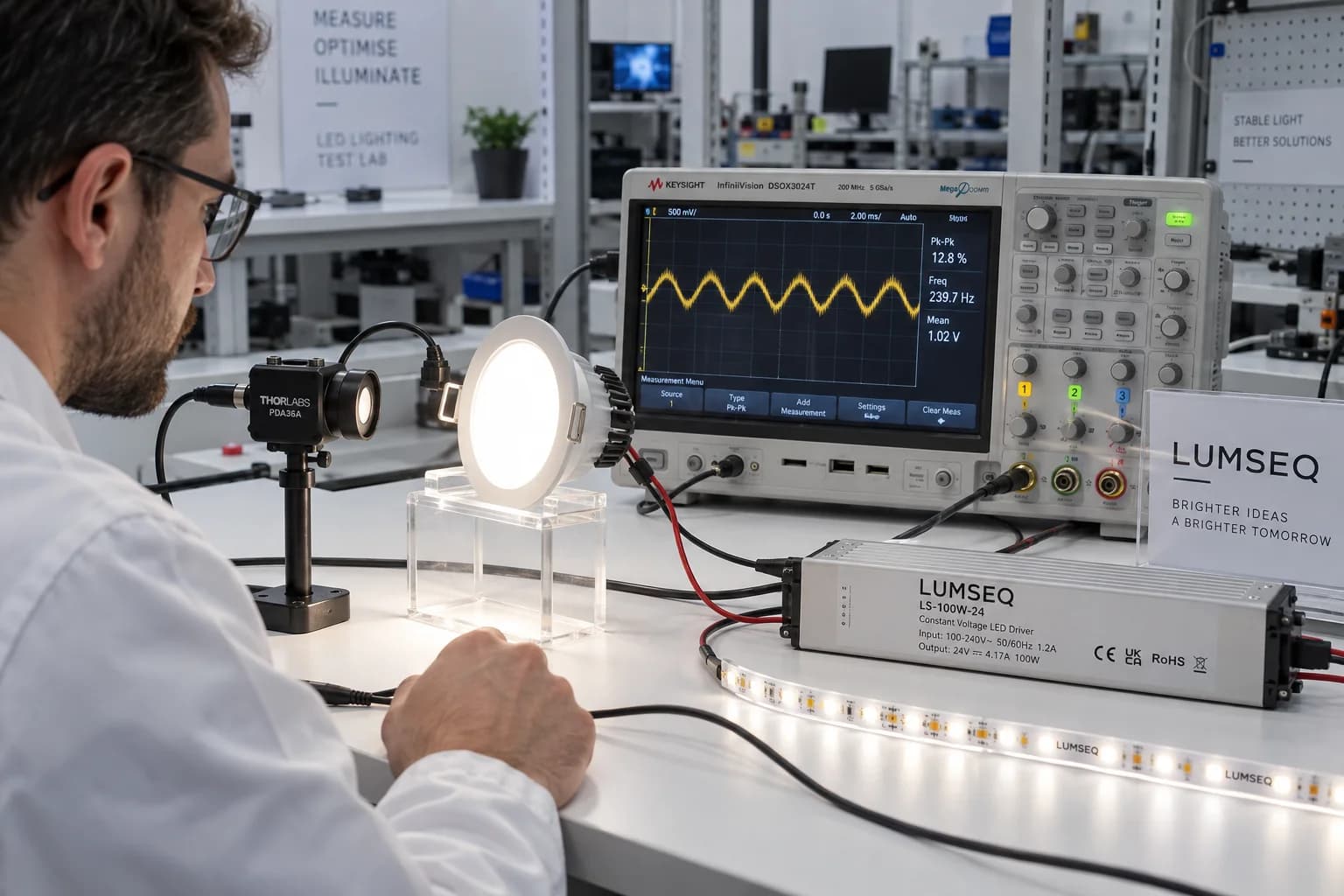
3. A photodiode and an oscilloscope: the rigorous method. Connect the photodiode to a resistor, point it at the light, and read the waveform frequency and ripple depth. If the ripple is at 100/120 Hz with high depth, the driver has no real output filtering.
None of these replace a proper flicker index measurement, but they let you reject the obvious offenders before they reach your customer.
Frequently asked questions
Questions buyers ask
Why does my phone show LED lights flickering when they look fine?
LED drivers chop the AC waveform and produce light output that varies at 100 or 120 Hz (twice the mains frequency). Your eye cannot track that speed, but a camera shutter samples it, so you see moving dark bands. The light is working, but it is flickering at a level many specs consider unacceptable.
What is the difference between percent flicker and flicker index?
Percent flicker measures the depth of variation between maximum and minimum light output. Flicker index weights the waveform shape, so it better captures brief sharp dips. Two lights with the same percent flicker can have different flicker index values. Ask your supplier for both, plus the frequency.
Is IEEE 1789 a mandatory requirement?
IEEE 1789 is a recommended practice, not a mandatory regulation. However, many commercial tenders and lighting specifications now reference it, and some customers require compliance as part of their procurement spec. Treat it as the de facto benchmark for flicker risk.
What flicker spec should I require for LED lighting?
There is no single number; it depends on the application and the market. General occupied spaces use a low-risk percent flicker at the line-frequency modulation, video studios and sites with moving machinery need tighter values, and the European Union sets binding PstLM and SVM figures. Our full IEEE 1789 buyer guide gives the values by application and region. The practical minimum in every case is to ask in writing for percent flicker, flicker index and the modulation frequency, measured on the optical output across the dimming range.
Talk to the product team
Planning an OEM or commercial lighting order?
Send your application, specification and destination market. We will help narrow the product and sample options.
Discuss on WhatsApp