
Key takeaways
- FOB is the price at the vessel rail, not the price you actually pay. The real number is landed cost - FOB plus origin fees, freight, insurance, duty, customs fees, destination drayage, compliance amortisation, defects and the cost of money.
- Duty is the single biggest and most volatile line, and it follows the HTS classification. LED lamps (8539.52) and finished LED luminaires (9405.11 / 9405.42) sit on different rates, and China-origin goods stack Section 301 on top of MFN, with additional IEEPA measures still changing in 2026. Never budget a duty figure from a freight agent's one-line estimate.
- Some fees are fixed and predictable. HMF is 0.125 percent on ocean cargo, MPF is 0.3464 percent with a cap, marine insurance runs about 0.2-0.3 percent, and an ISF miss is a 5,000 USD penalty. Know these and the quoted ocean freight becomes easy to check.
- The costs buyers underestimate are not on the shipping quote at all: UL/ETL/DLC certification at 5,000-30,000 USD per model, the defect and warranty reserve, and the cash tied up between deposit and sale. A cheap FOB price usually shows up here, not on the unit line.
1. The FOB unit price is not the price you pay
Two proforma invoices land on your desk. Same wattage, same lumen figure, same outer carton, almost the same photo. One factory quotes 24.00 USD FOB per LED panel, the other 22.20 USD. Most buyers take the lower number and feel they have done their job. Then the container lands, the customs invoice arrives, the trucker bills for drayage, and a few months later the warranty returns start - and the 22.20 USD panel turns out to be the expensive one.
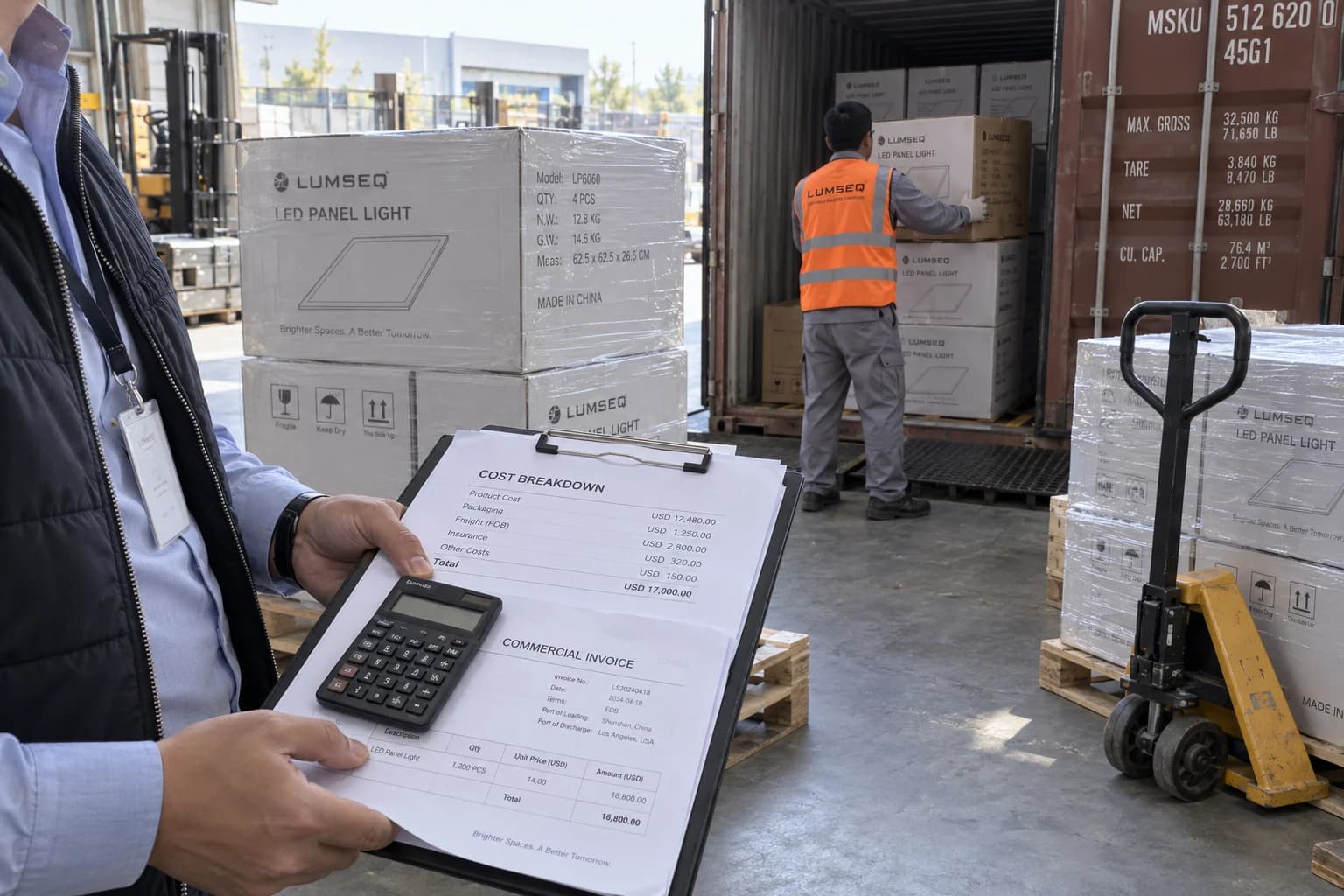
The mistake is treating FOB as the purchase price. FOB (Free On Board) only covers the goods up to the moment they are loaded onto the vessel at the named Chinese port. From that point to a saleable unit on your warehouse rack, money keeps leaving your account at almost every step.
Landed cost is the total of every one of those steps, expressed per unit. It is the number that decides your real margin, your minimum sell price, and which supplier is actually cheaper. Two FOB quotes that are 7 percent apart can easily reverse once you add the rest - especially when duty rates are high and one shipment is a full container and the other is a loosely packed LCL.
2. The landed cost stack: twelve cost lines
Strip an LED import to its invoices and the cost falls into roughly twelve lines. Some are percentages of the goods value, some are fixed per shipment, and a few are fixed per container - which is why load factor matters so much.
1. FOB value of the goods - the starting point, and what most quotes call the price.
2. Origin local charges - inland trucking to the port, export declaration, origin THC, documentation and telex release.
3. International freight - ocean (FCL or LCL) or air, including the base freight plus bunker and peak-season surcharges.
4. Marine insurance - typically 0.2-0.3 percent on 110 percent of cargo value for all-risk cover.
5. Customs duty - the MFN rate plus any trade-action duties (Section 301, IEEPA measures) tied to origin and classification.
6. MPF - the U.S. Merchandise Processing Fee, 0.3464 percent of value on formal entries, with a minimum and a statutory cap.
7. HMF - the Harbor Maintenance Fee, 0.125 percent of value, ocean shipments only, with no cap.
8. Brokerage, bond and ISF - the customs broker's entry fee, the customs bond (single or continuous), and the ISF 10+2 filing for sea freight.
9. Destination port and drayage - port terminal handling, chassis fees and the truck move from the port to your facility.
10. Compliance amortisation - the cost of UL/ETL, FCC, DLC and energy-efficiency registration, spread across the units shipped under each model.
11. Quality and failure cost - third-party inspection, the defect rate, replacements and the warranty reserve.
12. Cost of money - the deposit and balance tied up during production, transit and the 30-90 days before the goods are sold, plus currency exposure.
Lines 1-4 and 9 are mostly quoted per container or per shipment. Lines 5-7 are percentages of value. Lines 10-12 are invisible on a shipping quote, yet they are precisely where an under-engineered product takes its revenge.
3. Classify the light correctly before you trust any duty number
Duty is the largest variable in the stack and it is driven by the HTS classification, not by what the product is called on the invoice. LED lighting splits across several headings, and the rate differs between them:
1. 8539.52 - LED lamps, meaning bulbs and tubes and bare light sources that replace traditional lamps.
2. 9405.11 - ceiling and wall lighting fittings designed solely for LED light sources, of base metal (most recessed and surface LED panels and downlights land here).
3. 9405.42 - other electric luminaires designed for LED light sources, covering many fixtures that do not fit the ceiling/wall provision.
The importer extends these to a full ten-digit HTS number, and the description on the commercial invoice must match the actual product. A panel is not a lamp; forcing a finished luminaire into the bulb heading to chase a lower rate is misclassification, which is one of the fastest routes to an inspection, a penalty and an entry held at the port.
For U.S. imports from China, the duty is layered, not a single number. There is the normal MFN base rate - around 3.9 percent for most 9405 luminaires - then Section 301 action duties (the majority of finished LED fixtures sit on the 25 percent tier, while some lamp categories carry the lower 7.5 percent tier), and from 2025 onward additional IEEPA-based measures that were adjusted several times through 2026, including a backfill after one interim surcharge lapsed. As a planning range, China-origin finished LED fixtures in 2026 commonly land with an effective duty in the high-20s to 40 percent region, but that window genuinely moves - treat it as a figure to confirm, not a figure to lock a budget on.
Three practical rules follow from this. First, ask your customs broker for a classification opinion or, for a recurring product, a CBP binding ruling before the first shipment. Second, never under-state the invoice value or ship under a convenience code; duty is assessed on the transaction value, and undervaluation is a separate offence from classification. Third, transhipment is not a change of origin. China-built LED boards merely assembled in a third country without substantial transformation are still treated as Chinese-origin under the substantial-transformation test, and paper-only rerouting is a fraud risk, not a saving.
One technical point worth knowing: the U.S. generally dutiates on the export value of the goods (closer to FOB), so the international ocean freight and insurance to the U.S. are usually not part of the duty base - unlike the EU and many other markets, which dutiate on a CIF basis. MPF and HMF are still calculated on entered value. This is exactly the kind of detail a broker should confirm against your specific entry.
The figures in this section are a plain-language summary of the public regime as of October 2026 and are not customs advice. HTS codes, Section 301 tiers and IEEPA measures change; CBP and the Harmonized Tariff Schedule, applied by a licensed customs broker to your product at the time of entry, are the only authoritative source.
4. Freight: FCL versus LCL, and the fees that surround it
Ocean freight is the second-largest number and the one that swings most with the calendar. Rates are set by lane, by equipment and by season, and the gap between a full container and a partial one is not linear.
For full-container-load (FCL), the 2026 market has been elevated. Drewry's World Container Index in early September 2026 put a 40ft box from Shanghai to Los Angeles near 7,350 USD and to New York near 9,700 USD, with October 2026 quotes for a 40HQ to the U.S. broadly in the 7,500-9,300 USD range depending on coast; a 20ft box usually costs 60-70 percent of a 40ft. Rates rise with GRI and peak-season surcharges in the autumn run and drop in quieter months, so the exact number moves - the method of budgeting does not.
For less-than-container-load (LCL), forwarders quote by volume, roughly 80-180 USD per cubic meter in 2026, or around 2 USD per kilo for weight-driven cargo, with a minimum charge that catches very small shipments. Below roughly 10-15 cubic meters, LCL is often the sensible option; above that, a half-empty 20ft can become cheaper per unit because the fixed charges stop scaling with volume. LCL cargo is also handled multiple times at both ends, so damage and delay risk run higher for fragile panels and glass.
On top of the base rate, budget for: bunker and currency surcharges, origin port terminal handling, destination port charges, and drayage - the truck move from the port to your facility, which can run from around 1,000-1,500 USD for a short local haul to several thousand for an inland delivery. Marine insurance on top of all this is modest (about 0.2-0.3 percent to cover 110 percent of value) but the first item buyers regret dropping when a container is damaged.
The strategic lesson is load factor. Freight and the fixed per-shipment fees are divided by the number of units actually in the box. Two suppliers with the same FOB price can give you different landed costs purely because one's carton design and pallet plan load 9-12 percent more panels per container.
5. The entry fees that never appear on a factory quote
A factory's FOB price will not include the U.S. entry fees, and a surprising number of first-time importers meet them for the first time on the customs invoice. They are small individually, but they are certain.
1. HMF - 0.125 percent of cargo value, sea freight only, set by statute since 1986, with no minimum or maximum.
2. MPF - 0.3464 percent of entered value on formal entries (goods over 2,500 USD), with a minimum and a maximum cap that are adjusted each fiscal year. On a 150,000 USD shipment it is a few hundred dollars, not a negotiating point.
3. Customs broker entry fee - typically roughly 150-350 USD per formal entry, more for complicated or flagged entries.
4. ISF 10+2 - for ocean cargo the Importer Security Filing must be submitted at least 24 hours before the vessel loads. Late or missing filings carry a penalty of up to 5,000 USD per violation.
5. Customs bond - a continuous bond (costing roughly a few hundred dollars a year, scaled to your duty exposure) is the cheaper choice for regular importers; a single-entry bond fits a one-off shipment.
These are fixed per shipment or per year, so they punish small, frequent orders. A single consolidated container per quarter carries fewer entry fees and broker bills than four LCL trickles - a saving that is invisible until you look at it.
6. A worked example: one 40HQ of LED panels
Here is an illustrative landing for a 40HQ of commercial LED panels, built on October 2026 market figures. Every figure is a planning estimate, not a quote; the duty line in particular must be confirmed by a licensed broker against the exact ten-digit HTS and the measures in force at entry.
Assumptions: 6,000 panels at 25.00 USD FOB, for an FOB value of 150,000 USD, shipping from Shanghai to a U.S. west-coast port with a short local drayage.
FOB value: 150,000 USD.
Origin local charges, documents and origin THC: about 350 USD.
Ocean freight, 40HQ to the U.S. west coast: about 7,400 USD (2026 range).
Marine insurance (0.25 percent on 110 percent of cargo plus freight): about 430 USD.
Duty: assessed on the FOB customs value. At the conservative end of the 2026 China-origin finished-fixture range, plan roughly 25-35 percent effective, which is 37,500-52,500 USD. This single line is the difference between a good and a bad import year, and the reason classification matters.
HMF at 0.125 percent: about 188 USD. MPF at 0.3464 percent: about 520 USD (within the cap). Broker entry, ISF and bond amortisation: about 400 USD. Destination terminal and drayage: about 2,200 USD.
Compliance amortisation (UL/ETL/DLC for the model, spread across the order): about 2,000 USD. Inspection, defect and warranty reserve at about 2 percent: about 3,000 USD. Cost of money on the deposit and balance over roughly 60-90 days: about 1,500 USD.
Add the conservative (25 percent duty) case and the all-in landed value is roughly 196,000 USD; at the 35 percent duty end it is roughly 211,000 USD. Per panel that is about 32.70-35.20 USD landed, against an FOB unit price of 25.00 USD - in other words, a 31-41 percent premium on top of the sticker price.
Two conclusions jump out. First, when duties are high, the largest lever after classification is not a lower FOB price: it is container loading, freight timing and the defect rate. A factory that fills your 40HQ with 6,500 good panels instead of 6,000 questionable ones cuts the per-unit freight and defect burden at the same time. Second, a supplier offering 22.50 USD by using a non-certified driver or a non-listed LED has not saved you money - they have moved the cost into duty exposure, rejection risk and warranty, where it is more expensive.
7. Lowering landed cost without cheapening the product
Most of the legitimate savings are in logistics and engineering, not in the price of the LED chips.
1. Maximise the container. Ask for the carton and pallet plan, the loaded units per 40HQ and the inner-carton void rate. A few percent more panels per container is a freight saving you cannot negotiate away by haggling.
2. Consolidate into FCL and plan the shipping calendar. A quarterly full container beats monthly LCL on freight, handling fees and entry fees alike, and sailing slightly off peak-season can save more than a week of price negotiation.
3. Classify correctly and early - and keep it. A binding ruling is not a tax trick; it is the legal way to be confident of the right code and to stop every shipment being an open question.
4. Ship FOB with your own forwarder. You see the real freight and choose the insurance and routing, rather than paying a marked-up CIF number with minimum cover.
5. Buy the first-pass yield. A factory with a mature quality process and a lower defect rate removes the most expensive cost of all - air-freighting replacements and servicing warranty claims on the other side of the world.
Then there are the places you must not cut. Do not under-value the invoice or pick a cheaper HTS code; CBP runs valuation and classification checks, and the fines and inspection history cost far more than the duty saved. Do not skip marine insurance to save a few hundred dollars. Do not buy uncertified fixtures to avoid the 5,000-30,000 USD model cost - an unlisted product can be refused at the port, removed by the retailer or platform, and leave the insurer with a reason to deny a claim. And do not buy a 'tariff bypass' through a country that does no more than repack Chinese goods; without substantial transformation it does not change origin and can turn a customs problem into a legal one.
The right way to start is in the RFQ. Ask each supplier for the FOB price and, alongside it, the carton dimensions and per-container load, gross and net weights, the exact certification package, and the HTS code they would declare - then have your broker validate that code. The quote that wins is the one whose whole stack adds up, not the one whose first line is the smallest.
Frequently asked questions
Questions buyers ask
What is the difference between FOB price and landed cost?
FOB is the price of the goods once they are loaded onto the vessel at the origin port, including export clearance. Landed cost is the total of FOB plus everything after - ocean freight, insurance, customs duty, MPF and HMF, brokerage and bond, destination drayage, certification amortisation, defects and warranty, and the cost of the money tied up. For a China-origin LED fixture shipped to the U.S. in 2026, the non-duty overheads can add roughly 10-15 percent to FOB and duty can add a further 25-40 percent, so the landed unit cost is often 30-45 percent above the quoted FOB price.
How much U.S. import duty applies to LED lights from China in 2026?
There is no single number. It depends on the HTS classification: LED bulbs and tubes fall under 8539.52, while finished LED fixtures usually fall under 9405.11 or 9405.42. On top of the MFN base rate (around 3.9 percent for most 9405 luminaires), China-origin goods carry Section 301 duties (25 percent on most finished fixtures, a lower tier on some lamps) plus IEEPA-based measures that changed during 2026. Plan on a high-20s to 40 percent effective rate for finished fixtures and confirm the exact figure with a licensed customs broker against the ten-digit code and the rules in force at entry; the figures in this guide are an October 2026 summary, not customs advice.
Are ocean freight and insurance included in the U.S. customs value?
Generally not for the duty base. The U.S. normally dutiates on the transaction value of the goods at the export port, which is close to FOB, so international ocean freight and marine insurance to the U.S. are usually excluded from dutiable value - unlike the EU and many other markets that use a CIF base. The HMF and MPF user fees are still calculated on the entered value. Borderline cases (for example, certain commissions, assists and royalties) can change the value, so have the broker confirm each entry.
When is FCL cheaper than LCL for LED lighting?
LCL is usually better for small, low-volume shipments, roughly under 10-15 cubic meters, because you pay only for the space you use. Above that volume, the fixed per-shipment charges and LCL handling margins make a full container cheaper per unit, and FCL reduces the multiple handling that raises damage risk for glass and panels. FCL also lowers per-unit drayage and entry fees. For repeating orders, consolidating into a scheduled full container per month or per quarter is almost always cheaper than a steady trickle of LCL.
Talk to the product team
Planning an OEM or commercial lighting order?
Send your application, specification and destination market. We will help narrow the product and sample options.
Discuss on WhatsApp