
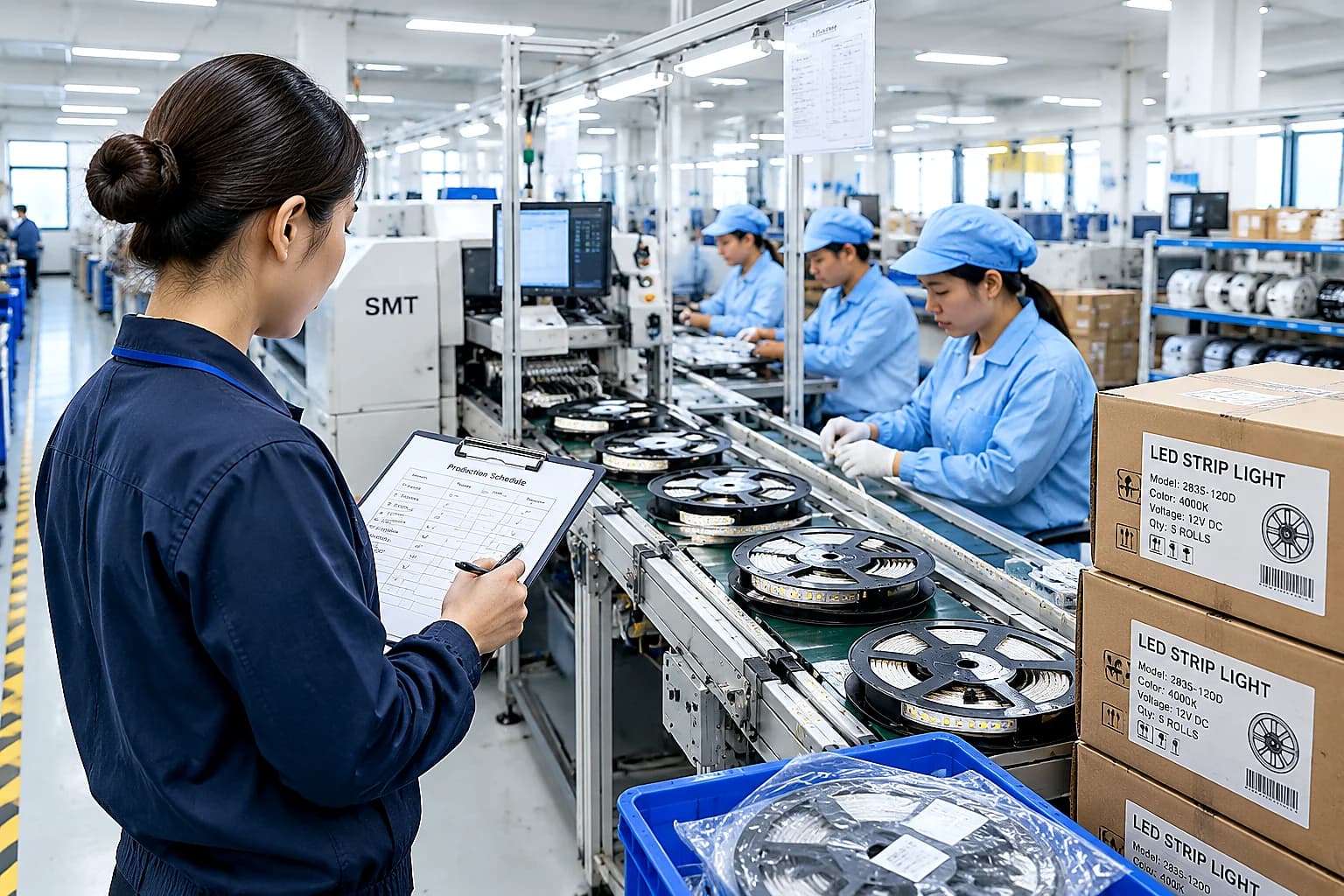
Key takeaways
- 'In production' means nothing until you agree on milestones — PCB assembly, SMT, assembly, burn-in, packing — and get evidence for each.
- Weekly progress updates with photos and quantities are the minimum; a factory that cannot show physical progress is usually behind.
- Material sourcing is where delays actually happen — confirm key components (LED chips, drivers, PCBs) are on site, not 'ordered'.
- Put production milestones and late penalties in the PO before you sign, not after the delay happens.
1. Why 'in production' is the emptiest phrase in LED sourcing
Every LED buyer has heard it: 'Your order is in production, no problem.' The phrase sounds reassuring and means almost nothing. Production is not one event — it is a chain of stages, and the factory will happily tell you the chain has started while only the first link exists.
A real production update tells you which stage the order is at, what quantity has passed that stage, and what comes next. Anything vaguer than that is a signal the factory is not tracking your order closely.
This checklist turns 'in production' into a measurable claim you can verify with photos, quantities and dates.
2. Agree the milestones before you place the order
You cannot track what was never defined. Before signing the PO, put a production schedule in writing with clear milestones:
1. Material confirmation — all key components (LED chips, drivers, PCBs, connectors) confirmed on site or in transit with dates.
2. PCB assembly / SMT — your specific boards loaded onto the line.
3. Assembly and soldering — the product physically put together.
4. Testing and burn-in — electrical tests, aging test started, with test records.
5. Final inspection (FQC) and packing — quantity verified, packing list issued.
Each milestone should have a target date, a responsible contact, and a deliverable (photo, record, or report). A schedule with dates but no deliverables is a wish, not a plan.
3. The weekly update routine that catches delays early
Agree a fixed update rhythm — weekly is the minimum for orders longer than three weeks. Each update should answer five questions:
1. What stage is the order at right now?
2. What quantity has passed that stage?
3. Any material shortages? Which components, and what is the resolution date?
4. Any quality issues found, and how many units were rejected?
5. Is the shipment date still on track, or has it moved — by how many days?
Ask for photos that show your order specifically: your reel labels, your logo on cartons, your color code on the line. A factory juggling multiple buyers will send the same generic photo to everyone. A photo of your batch with your order number on the label is hard to fake.
Log every update with the date. When the factory later claims 'we told you', your log is the ground truth.
4. The warning signs that your order is being deprioritized
Some patterns appear before the delay does. If you see two or more of these, escalate:
The factory stops volunteering photos and you have to chase every update.
Progress updates repeat the same stage for two weeks in a row.
The answer to 'what quantity is done' is 'almost done' or 'coming along'.
Material excuses change: chips delayed, then drivers, then something else — shifting excuses usually means the real bottleneck is that your order is low priority.
A newer, bigger customer's order 'rushed in and jumped the line' — this happens, and it is exactly why your milestone dates are in the PO.
When you see these signs, do not wait for the next weekly update. Ask for a dated production plan for the remaining stages and a new confirmed shipment date in writing.
5. How to verify progress without flying to the factory
You cannot be on site for every order, but you can verify remotely:
Ask for time-stamped photos or a short video of the current stage — a five-second video of your reels on the packing line is stronger evidence than ten photos.
Request batch records: SMT loading records, test data logs, and burn-in start/end times. A factory running real production can produce these in minutes.
If your order quantity is large enough to justify it, book a mid-production inspection (sometimes called 'during production inspection' or DPI). An inspector visits while the goods are still being made, not after they are packed, and reports real quantities against the schedule.
Live video calls into the workshop are increasingly common and cheap. If a factory refuses a short video call to show the line, that refusal is itself information.
6. What to do when the delay is real
First, get the new date in writing with the reason. A factory that gives you a revised date and a cause is still managing the problem; one that only repeats 'soon' is not.
Second, check whether partial shipment helps. If 60% of the order is ready, shipping it now and the rest later can save your downstream commitment (a store opening, a project deadline). Some buyers keep a partial-shipment clause in the PO precisely for this.
Third, document the cost of the delay: air freight to make up the schedule, idle installation crews, or a missed project slot. Send the calculation to the factory — it changes how seriously the delay is taken.
Fourth, decide whether this supplier stays in your pool. One delay with a clear cause and good communication is normal. Repeated delays with shifting excuses, on orders you tracked properly, is a pattern, not bad luck.
7. The clauses that belong in your PO
Add these to every LED order PO — they cost nothing and change behavior:
1. Production milestones with target dates (as in section 2).
2. A progress-report clause: weekly updates with photos and quantities on agreed days.
3. A delay-notification clause: factory must notify within 48 hours of knowing a milestone will slip.
4. A late-delivery clause: penalty (e.g. 0.5% of order value per week) or a confirmed partial-shipment option.
5. An inspection-rights clause: buyer may arrange mid-production inspection with 48 hours notice.
These clauses do not guarantee on-time delivery, but they make delay visible and costly, which is the only pressure a schedule responds to.
Frequently asked questions
Questions buyers ask
How often should I follow up on my LED order production?
Weekly for orders longer than three weeks, and more often (twice a week) during material sourcing and final packing, which are the stages where delays usually appear. Each follow-up should ask for the current stage, quantity done, and any material or quality issues — not just 'any update?'.
What should I do if the factory gives the same progress update twice?
Treat it as a warning sign. Ask for dated photos of your specific batch, request a video of the current stage, and ask for a revised milestone plan in writing. Same-stage updates two weeks in a row usually mean production has not moved.
Can I check production progress without visiting the factory?
Yes. Ask for time-stamped photos and short videos, request batch records (SMT logs, test data, burn-in records), or book a mid-production inspection through a third-party inspection company. A short video call into the workshop is also a strong and cheap verification tool.
What is a mid-production inspection (DPI)?
A DPI (during production inspection) is a check performed while goods are still being manufactured, typically at 30-60% completion. The inspector verifies actual quantities, materials, and workmanship against the order and reports early, so problems are caught before everything is packed and shipped.
Talk to the product team
Planning an OEM or commercial lighting order?
Send your application, specification and destination market. We will help narrow the product and sample options.
Discuss on WhatsApp