
Key takeaways
- Warranty and lifetime are two different documents. L70 is an LM-80/TM-21 prediction of output under stated conditions; the warranty is a conditional contract with exclusions, a notice window and a remedy. A 50,000-hour datasheet can sit next to a 3-year warranty without contradiction.
- Read the years against the conditions, not in isolation. Signify grades warranty by rated lifetime, Acuity's commercial line is 2 years, and Havit's 5-year term requires a licensed installer and caps continuous use. A short, unconditional warranty can outperform a long one full of qualifiers.
- Most claims are won or lost on the exclusions. Wrong voltage, an incompatible dimmer, no heatsink, over-driving, a missing serial label or normal in-spec dimming all sit outside the warranty. Match the driver, controls and thermal design to the product before you install.
- The remedy rarely covers the cost around it. Replacement is the default, but removal and reinstallation labor is almost always excluded, and freight and inspection can be charged back when the claim fails. Confirm who pays before a batch goes in.
- Put the terms in the purchase order: length and start date, covered failures and exclusions, remedy and lead time, freight and labor, the notice window and the claim process. A warranty that lives only on a webpage is rewritten the moment that page changes.
1. A warranty is a contract, not a lifespan number
Most buyers read "50,000 hours" and "5-year warranty" as the same promise. They are not. One is a prediction about how the LED will age; the other is an agreement about what the supplier will do if something fails, and the two are written by different people for different purposes.
The L70 lifetime is an engineering figure. After LM-80 testing of the LED package and TM-21 extrapolation at a stated junction temperature and drive current, it estimates when the source falls to 70% of initial output. Change the temperature or the current and the number changes with it. It describes expected performance under defined conditions.
A warranty is a commercial document. It has a start date, a scope, a list of exclusions, a window in which you must report, and a remedy the supplier agrees to provide. It is only as strong as the company standing behind it and the paperwork around the order. The datasheet number can be accurate while a claim is denied, because the warranty operates on conditions the lifetime figure never mentions.
2. Why the warranty years rarely match the rated life
Fifty thousand hours at eleven hours a day is a little over twelve years, yet the same product often carries a 3- or 5-year warranty. The gap is normal, not on its own a trap. Manufacturers price the warranty against the failures they will actually have to replace, and they account for the driver, which usually gives out before the LED package, and for field conditions they cannot control.
The terms vary by how a company segments its range. Signify ties the period to rated lifetime: an LED with lifetime at or above 25,000 hours gets three years, 15,000 to 25,000 gets two, and under 15,000 gets one. Acuity's Contractor Select commercial fixtures carry a two-year limited warranty from the date of sale. Havit Commercial offers a five-year replacement term but requires a licensed electrician and limits downlights to eight hours of continuous use with a rest period.
Treat the length as a signal rather than a score. A five-year warranty that requires short operating days and a licensed installer is a different promise from a three-year one with no usage cap, and the difference is exactly the kind of thing that decides a claim later.
| Source / tier | Warranty period | Conditions worth noting |
|---|---|---|
| Signify professional luminaires | 1-3 years, graded by lifetime | ≥25,000h = 3y; 15-25,000h = 2y; ≤15,000h = 1y |
| Acuity Contractor Select | 2 years | Commercial fixtures, from date of sale |
| Havit Commercial | 5 years replacement | Licensed electrician; downlights capped at 8h continuous |
| CHZ project tiers | 3 / 5 / 7 / 10 years | Coverage widens at each tier: driver, L70, L90, surge |
3. What a typical LED warranty actually covers
The covered list is shorter than buyers assume, and it is built around failures the factory can reasonably own. It starts with manufacturing defects - bad solder joints, incorrect assembly, components out of specification - and runs through the driver or power supply, which is the most common failure point and usually the heart of the claim.
Longer tiers add the failures that accumulate over time. Many commercial warranties cover lumen degradation once it passes the stated L70 threshold, and the longer ones add L90 and corrosion. Dimmable products may cover a control-side failure, but only where the fault is in the product rather than in an incompatible dimmer.
The CHZ tiers make the pattern visible. Three years covers manufacturing defects only; five adds driver failure and L70; seven adds L90 and corrosion; ten is full coverage including surge. The entry tier covers the cheap-to-honor items, and the longer tiers add the failures that actually show up after years in service.
- Defects in materials, soldering and assembly
- Driver and power-supply failure
- Lumen drop beyond the stated L70 / L90 threshold
- Product-side dimming failure on dimmable models
4. The exclusions that quietly narrow the promise
This is the section that decides most rejected claims, and it is the one buyers read last. Improper installation sits at the top - wrong voltage, an incompatible dimmer, faulty wiring - followed by physical damage from impact or from water that entered through a bad install. A strip that darkens because the profile could not shed heat is a thermal design failure, not a warranty failure.
Normal, in-spec lumen depreciation is excluded because gradual dimming is the expected behavior of an LED, not a defect. Over-driving the strip, sealing it into an enclosure, or running it beyond the rated ambient all move the failure outside the terms, and so does unauthorized modification or repair with third-party parts.
The serial label is its own trap. Many brands void the warranty outright if the label is removed, defaced or illegible, because without it the unit cannot be traced to a batch. Keep the label intact and photograph it before the product is installed.
- Wrong voltage, incompatible dimmer or faulty installation
- Impact, water from installation error or other physical damage
- Normal lumen depreciation within the rated threshold
- Over-driving, no heatsink or out-of-spec ambient
- Modified units, third-party parts or a missing serial label
| Typically covered | Typically excluded |
|---|---|
| Manufacturing defects (soldering, assembly) | Improper installation (wrong voltage, incompatible dimmer) |
| Driver / power-supply failure | Physical damage or impact |
| Lumen drop beyond the L70 / L90 threshold | Normal lumen depreciation within spec |
| Product-side dimming failure | Labor for removal and reinstallation |
| - | Over-driving, modification or a missing serial label |
5. When the clock starts, and how long you have to report
The start date is worth settling because the candidates - invoice date, delivery date, installation date - can be months apart on a project that warehouses the goods before fit-out. Most commercial terms start at invoice or delivery, which means stock held on a shelf before installation may already be burning warranty time. If you need the clock to start at commissioning, get it written into the order.
The notice window is separate from the warranty years and it is short. Signify, for example, requires a claim within thirty days of discovering the failure; hold it for a quarter and you can be outside the terms even with years of warranty left on paper.
Record three dates against every batch - purchase or invoice, delivery, and commissioning - and when a failure appears, note the day you first saw it. That is the date that starts the notice window, and it is the one suppliers will ask for.
6. Repair, replace or refund: what the remedy actually gives you
The remedy is what the warranty promises to do, and it almost always runs as a hierarchy: repair or replace first, with a refund or credit only where replacement is not practical. Replacement is the default, so read what it actually delivers - whether the unit is new or refurbished, whether it carries the remaining warranty or a fresh term, and whether it is the same model.
The model matters more than buyers expect. A substituted strip or panel can shift color, output and dimming against the rest of an install, and a discontinued product replaced by a current one rarely matches the original spec. Ask what happens if the model is no longer made.
None of this covers the cost of taking the old unit out and putting the new one in, which on a large installation can exceed the price of the product. Put the remedy in the order: replacement unit, lead time, who handles it, and the fallback if the exact model is gone.
7. Freight, labor and inspection: the costs that are usually yours
Labor for removal and reinstallation is almost universally excluded; Signify's standard terms state it directly, and most commercial warranties follow the same line. The electrician's time to swap a failed panel is the buyer's cost even when the panel itself is replaced free.
Freight turns on the outcome. Under Signify's Central America terms, when the claim is justified the supplier may cover freight, but when it is not, the customer can be charged for freight, testing and handling. That makes the initial diagnosis financially important - a speculative claim that fails can cost more than the product.
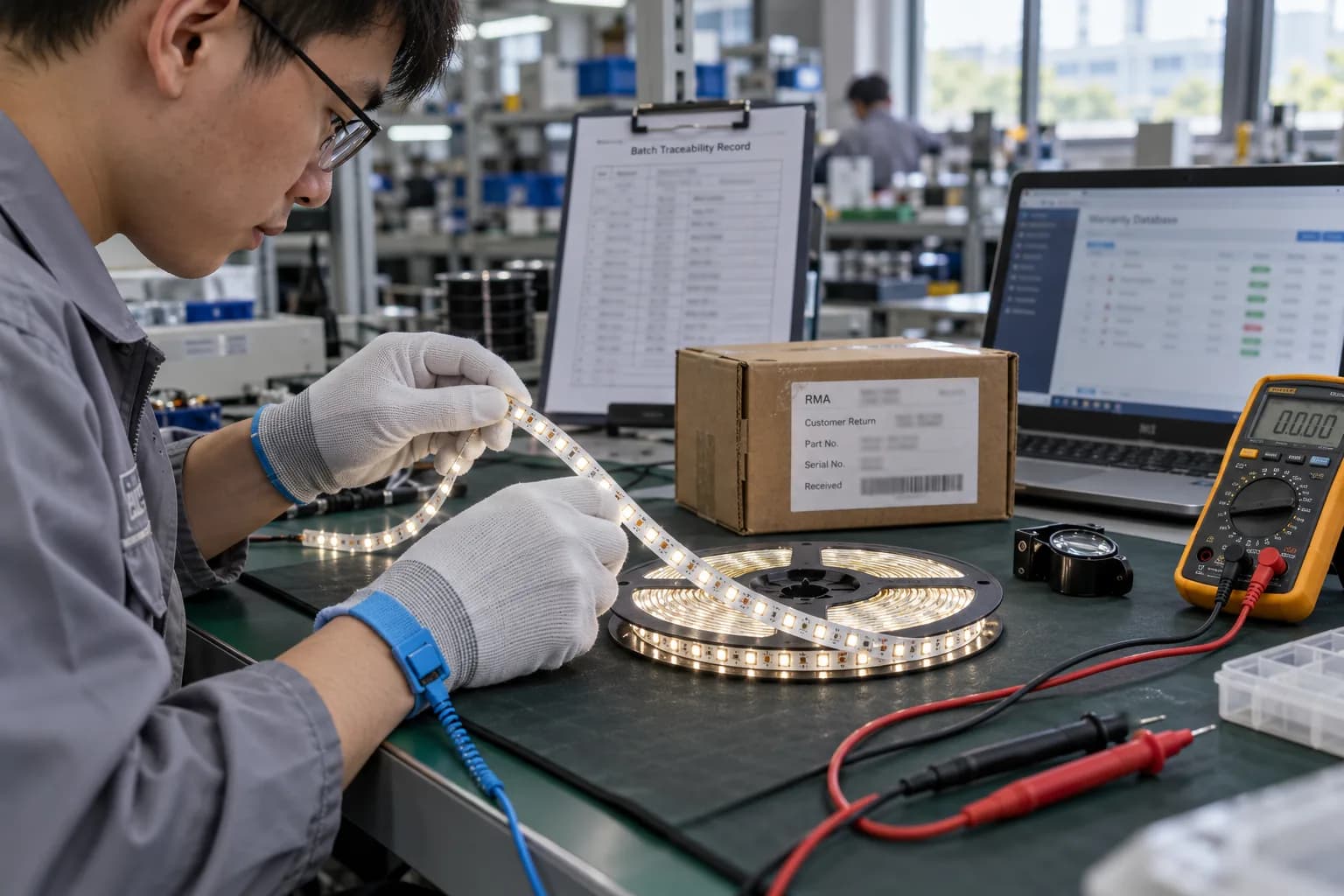
Suppliers commonly ask for the order number, model, a clear description and dated photos or video before approving anything, and they may require the failed unit returned for inspection. Keep the failed units and their packaging, document the symptom, and never ship anything back without a return authorization.
8. How to judge whether a warranty is credible
A warranty is only worth something if the company is reachable and trading when the claim arrives. A ten-year promise from a supplier that changes its name every two years cannot be enforced, regardless of how the number looks on the page.
The credible signs are practical: written terms with a defined scope and claim process; a supplier that has stayed reachable across repeat orders; lifetime claims backed by LM-80 and TM-21 rather than a round figure; and warranty language that stays consistent from one product to the next. A supplier that can show the test behind the number is usually one that will answer the phone later.
The warning signs are equally clear - every product stamped with the same long warranty regardless of construction, no written document, no claim process, and lifetime figures quoted with no test conditions. You are judging the chance the promise will be honored, not the size of the number, and an enforceable three-year term beats a marketing ten-year one.
9. Write the warranty terms into the PO before you order
The purchase order is where a datasheet promise becomes an enforceable term. A warranty that lives only on a webpage can be rewritten the moment that page changes; the version in the signed contract cannot.
Name the terms explicitly: the warranty length and its exact start date; the failures that are covered and the exclusions; the remedy and the replacement lead time; who carries freight, labor and inspection; the notice window and the claim procedure; and the documents that support the claim, including LM-80, TM-21 and any test reports or certificates.
Require the batch or serial traceability that makes a claim possible, and confirm the warranty runs for the agreed term even if the product is revised. If a failure has already occurred rather than being planned for, the claim checklist is the other half of this - the evidence, traceability and controlled return process.
- Warranty length and the exact start date
- Covered failures and exclusions
- Remedy and replacement lead time
- Freight, labor and inspection responsibility
- Notice window and claim procedure
- LM-80 / TM-21 and required documents
Related Lumseq products
Frequently asked questions
Questions buyers ask
Is a 5-year LED warranty automatically better than a 3-year one?
Not on the number alone. Read the conditions - usage caps, who must install it, what is covered at each tier and how to claim. A three-year warranty with few qualifiers can be more enforceable than a five-year term that requires licensed installation and limits operating hours.
Does a 50,000-hour rating guarantee the light for 50,000 hours?
No. The 50,000-hour L70 figure is an LM-80/TM-21 prediction under stated temperature and current conditions, while the warranty is a separate, conditional contract. The warranty period is usually shorter than the rated life.
Who pays to ship a failed LED back under warranty?
It depends on the result. Some terms have the supplier cover freight when the claim is justified, but charge the customer for freight, testing and handling when it is not. Confirm the freight terms in the purchase order before returning anything.
Does the warranty cover the electrician's labor to replace a failed panel?
Usually no. Removal and reinstallation labor is almost universally excluded from commercial LED warranties, even when the replacement product itself is supplied free. State labor responsibility in the contract.
What commonly voids an LED warranty?
Wrong voltage or incompatible dimmer, physical damage or installation-related water, over-driving or missing heatsink, out-of-spec ambient temperature, unauthorized modification or third-party parts, and a removed or illegible serial label.
When should the warranty start - invoice, delivery or installation?
Most terms start at invoice or delivery, which can be months before installation on a warehoused project. If you need the clock to start at commissioning, specify that in the purchase order rather than assuming it.
Can I get a refund instead of a replacement?
Warranties usually offer repair or replacement first, with a refund or credit only where replacement is not practical. If a refund matters to your project, add the order of remedies to the contract before ordering.
How long do I have to report a failed LED?
The notice window is separate from the warranty years and often short - some terms require a claim within 30 days of discovering the failure. Report the problem promptly and keep the date of first observation.
Sources and references
Signify standard warranty for professional luminairesAcuity Brands Contractor Select limited warrantyHavit Commercial warranty termsCHZ overseas project warranty and after-salesSunco product warrantyJCE Lighting warranty policyTalk to the product team
Planning an OEM or commercial lighting order?
Send your application, specification and destination market. We will help narrow the product and sample options.
Discuss on WhatsApp