
Key takeaways
- L70 means the LED has lost 30% of its initial light output — it is still working, just dimmer. '50,000-hour lifetime' usually means hours to L70, not hours to failure.
- Lumen depreciation is real: heat is the main driver, so lifetime at 60°C is much shorter than at 25°C.
- LM-80 is the chip manufacturer's test data, not a warranty. A warranty covers failure modes, not gradual dimming.
- Ask for lifetime at your actual operating temperature and for the test method (LM-80, TM-21) — if the supplier cannot name one, treat the number as marketing.
1. The 50,000-hour myth
Buyers see '50,000 hours' on a datasheet and assume the light will work for 50,000 hours and then stop. That is not how LED lifetime is defined. For most products, the rated lifetime is the time until the light output drops to 70% of its initial value — the L70 point.
The difference matters: at 50,000 hours the LED is usually still lighting, just noticeably dimmer. In many applications the dimming is acceptable; in others (display lighting, task lighting) it is a visible degradation you will notice long before the product fails.
So the first question to ask a supplier is not 'how many hours?' but 'hours to what?' — L70 at what temperature, and measured by which method.
2. What L70, L50 and B50 actually mean
Lifetime figures come in two parts. The 'L' number describes light output: L90 means 90% of initial output remains, L70 means 70% remains, L50 means half the light is gone.
The 'B' number describes how uniform that loss is across a population: B50 means 50% of the LEDs have reached the stated output, while B10 means only 10% have fallen to it. A B50 lifetime is the average; a B10 lifetime is a more conservative guarantee.
So a full lifetime statement looks like 'L70 at B50 = 50,000 hours at 25°C'. If the datasheet just says '50,000 hours' with no L/B/temperature, you are looking at a marketing number, not an engineering one.
LED strips and cheap modules often state lifetime without the test conditions. That is not necessarily a lie — it is just unverifiable, which is a different kind of risk.
3. Why heat eats lumen output
Lumen depreciation is driven mainly by junction temperature. Higher temperatures accelerate degradation of the phosphor and the chip, so the same LED rated 50,000 hours at 25°C may be rated 30,000 hours at 60°C or worse in a confined fixture.
This is why two products with identical chips can have very different real lifetimes: the one with a better heat path (thicker aluminum, better thermal paste, more surface area) keeps the junction cooler and dims slower.
For outdoor or 24/7 applications, always ask for lifetime at the actual ambient temperature of your installation, not the lab 25°C number. The difference between 25°C and 60°C is often a 30-40% lifetime cut.
4. LM-80 and TM-21: the documents behind the claim
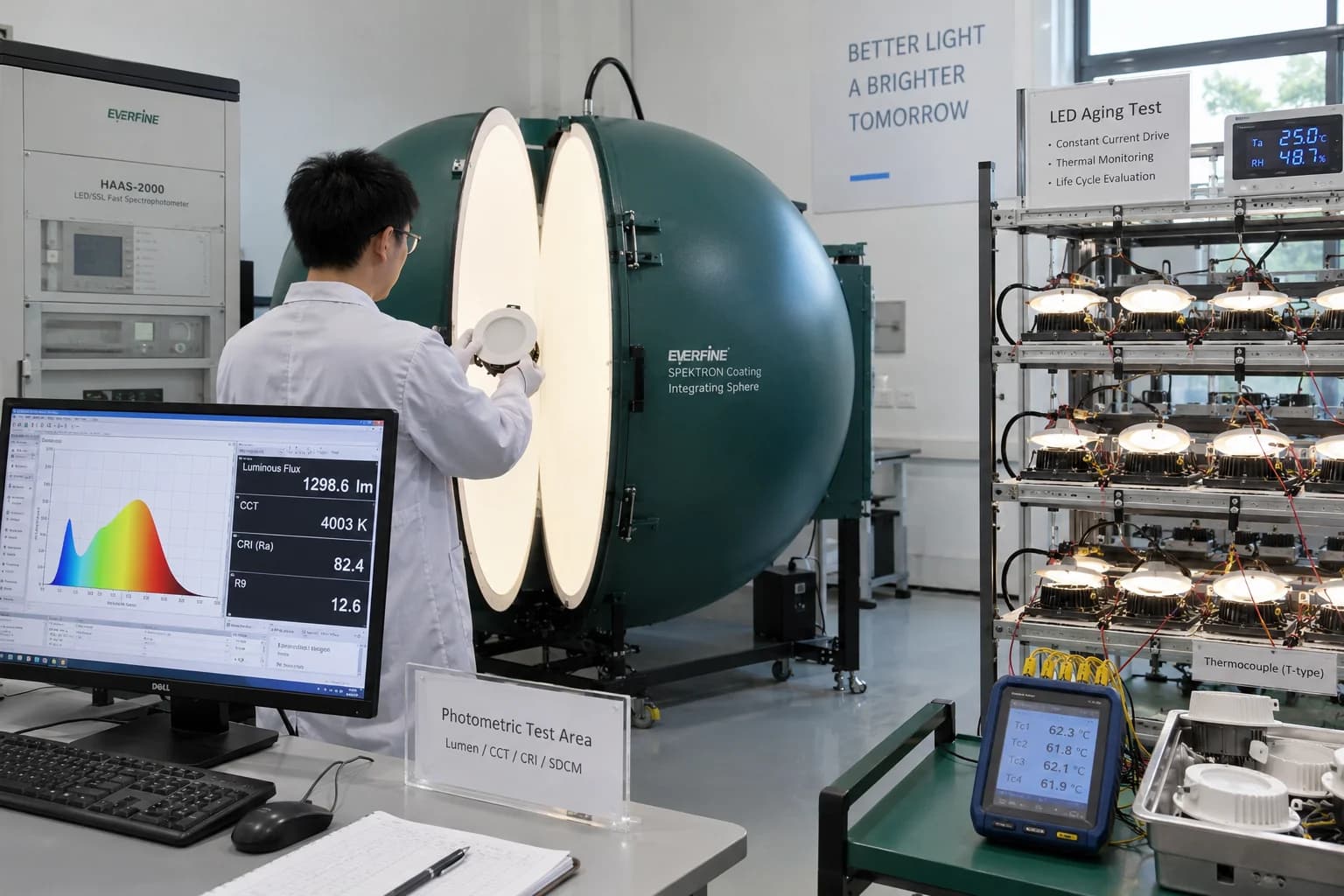
LM-80 is an IES test method for measuring lumen maintenance of LED packages under controlled current and temperature. The chip maker runs LEDs for thousands of hours and publishes the data. TM-21 is the calculation method that projects the LM-80 data forward to estimate L70.
For buyers, the practical points are simple:
1. LM-80 data comes from the chip brand (Samsung, Osram, etc.), not usually from the fixture maker. Ask which chip brand and whether LM-80 data exists for that exact chip.
2. The LM-80 report states temperature and current. A lifetime claim extrapolated from a lower temperature or current than your application is optimistic.
3. TM-21 projections are still projections. They are the best standard basis we have, but they assume the product's thermal design performs as designed — which is exactly what a cheap heatsink or poor assembly can undermine.
A supplier who can send the chip's LM-80 report and state the TM-21 projection at your operating temperature is doing real engineering. One who answers 'it's 50,000 hours, guaranteed' is not.
5. Warranty covers failure, not dimming
This is the most misunderstood boundary. A typical LED warranty covers premature failure: dead chips, failed drivers, color shift beyond specification, flicker — the things that make a product stop working correctly.
Gradual lumen depreciation is not a warranty event. If a fixture is at L75 after three years of a five-year warranty, that is normal aging, not a defect. Buyers who submit a warranty claim for 'lights got dimmer' are usually disappointed.
Read the warranty terms before ordering and ask three questions: what failure modes are covered, what is the driver coverage (drivers fail more often than chips, and some warranties cover the driver separately or for fewer years), and what the claim process requires (photos, returned samples, or a test report).
6. The buyer's checklist for lifetime claims
When you compare LED products from different suppliers, put these six questions to each:
1. What is the rated lifetime, stated as Lxx at Bxx (e.g. L70 at B50)?
2. At what ambient temperature is that lifetime rated, and what is it at my installation temperature?
3. Which chip brand is used, and can you share the LM-80 report for that exact chip?
4. What is the TM-21 projected L70 for our current and temperature?
5. What does the warranty cover — which failure modes, for how long, and does it include the driver?
6. Is the lumen maintenance tested on the finished luminaire, or only on the chip? (Chip data + poor assembly can still mean early dimming.)
Suppliers who answer all six with documents earn your trust. Suppliers who answer with 'trust us, it's high quality' are asking you to buy a number.
7. When lifetime is worth paying for
Not every application needs a premium lifetime rating. A retail display light that runs 8 hours a day for a seasonal window will reach L70 far later than the fixture is even on the shelf. Paying for 50,000 hours there is optional.
The applications where lifetime deserves real scrutiny: 24/7 installations (corridors, outdoor, signage), ceiling-recessed fixtures that are expensive to replace, and projects with long warranty commitments to your own customers.
For those, an extra few percent on the fixture price to get a verified lifetime claim — a known chip brand with LM-80 data and a proper heatsink — is cheap insurance compared with a relamping exercise halfway through a five-year project.
Frequently asked questions
Questions buyers ask
Does a 50,000-hour LED last 50,000 hours?
Usually yes, but it means hours to L70 (30% light loss), not hours to failure. The LED typically still works after 50,000 hours, just dimmer. Always check the L and B numbers and the rated temperature before comparing products.
What is the difference between L70 and L50 lifetime?
L70 is the time until the LED retains 70% of initial light output; L50 is the time until it retains 50%. L50 is almost always longer. Manufacturers usually quote L70 because it is the industry-standard end-of-life point for general lighting.
Can I claim warranty if my LED lights have become dimmer over time?
Generally no. Lumen depreciation is normal aging, not a defect, and most warranties cover failure modes like dead chips or failed drivers — not gradual dimming. Check your warranty terms for the exact coverage before ordering.
How do I verify a supplier's lifetime claim?
Ask for the chip brand and its LM-80 report, the TM-21 projected L70 at your operating current and temperature, and the rated ambient temperature of the claim. If the supplier cannot name a test method or provide documents, treat the lifetime number as marketing.
Talk to the product team
Planning an OEM or commercial lighting order?
Send your application, specification and destination market. We will help narrow the product and sample options.
Discuss on WhatsApp