
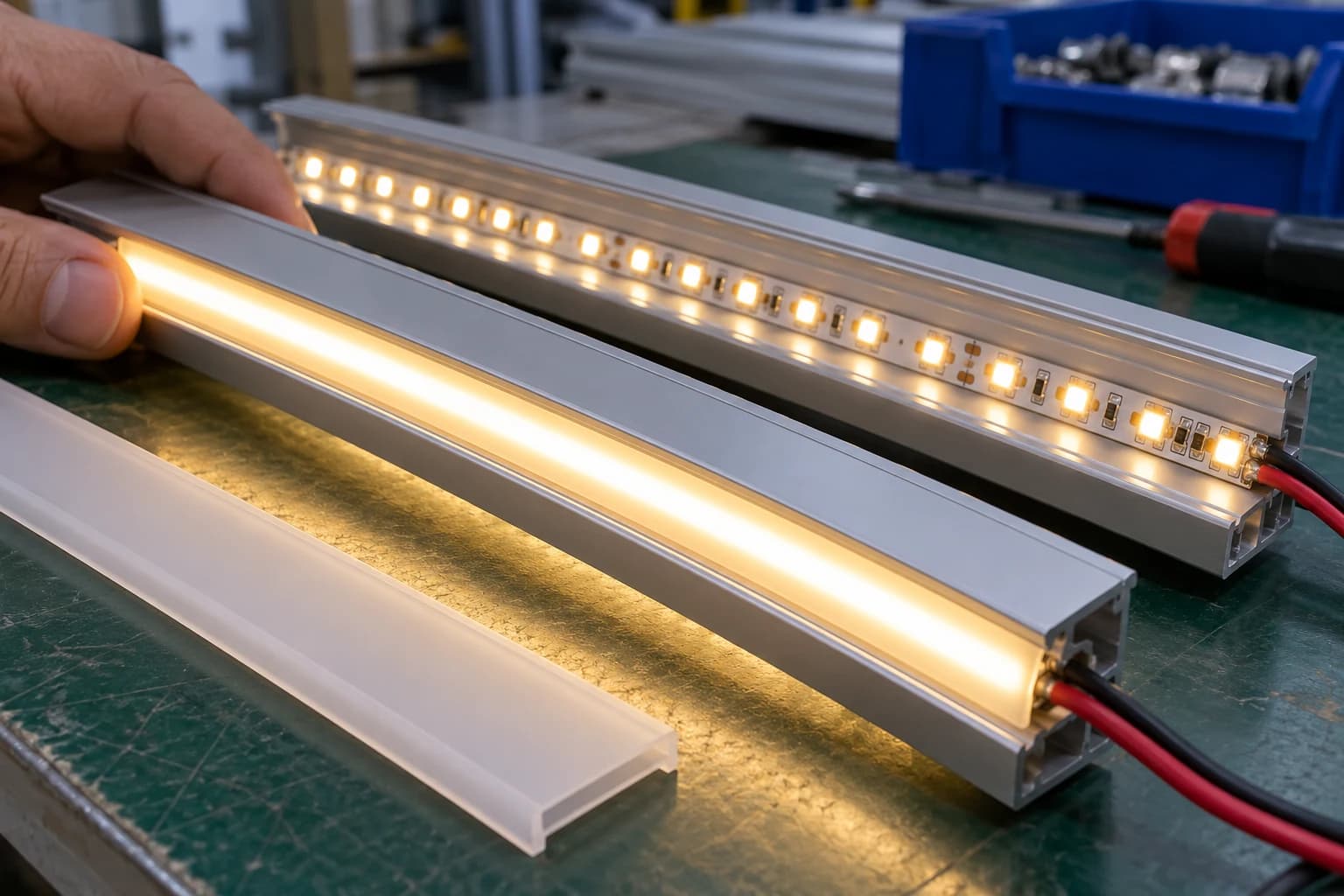
Key takeaways
- COB changes the construction, not just the count. On an SMD strip each LED is a finished packaged component - a lead frame, a plastic housing, sometimes a lens - soldered onto the PCB at a spacing, and the packages are what you see as dots. On a COB strip the bare flip chips are bonded directly onto the board in long strings and covered with one continuous layer of phosphor-loaded silicone, with no separate housing and no air gap between sources. Pushing an SMD strip to 240 or 288 LEDs per metre still leaves visible packages; COB reaches the dotless look by removing the package entirely.
- The construction guarantees a continuous-looking emitting surface and nothing else. COB is not automatically brighter, more efficient, cooler or longer-lived. Lumens per metre depend on the chips, current and phosphor conversion, and a well-driven SMD strip can out-output a COB strip at the same power; the dense phosphor layer can cost lumens per watt, and the tight layout concentrates heat rather than shedding it. Read a COB claim as a statement about appearance first, and compare the measured values on everything else.
- The real trade-off is concentrated heat. The chips sit in one continuous line with little board space to spread the load, so the thermal load is focused along that narrow band. COB belongs in a matched aluminium profile, which acts as the heatsink rather than as decoration; run open to air, trapped in a sealed channel or overdriven, and the phosphor carbonises and darkens, the silicone yellows, the light shifts toward blue and output drops in a slow, uneven decline.
- There are smaller limits that add up. COB chips are wired in series groups, so cut points fall where a group ends - often 40 to 100 mm apart, coarser than a comparable SMD strip. RGB and RGBW COB are harder to execute and less widely available, the CCT range is narrower, chip-level failures cannot be repaired in the field, the soft silicone surface holds dust and is harder to clean, and the strip usually carries a price premium over basic SMD.
- Specify and verify the way you would any strip, with the thermal side weighted more. Name chips/m, W/m, lumens/m, CRI and R9, CCT and SDCM, board width and copper weight, voltage, IP construction, cut interval and bend radius, then the profile and driver. Build a mock-up with the exact profile, diffuser and driver, inspect from the real viewing distance and reflected surface, let it run and measure the temperature, and sweep the full dimming range - the low end is where matched COB systems expose flicker and uneven light.
1. What COB actually changes in how the strip is built
On a conventional SMD strip, each LED is a finished component before it reaches the board. A chip sits inside a small package - a lead frame, a plastic housing, often a tiny lens - and these packages, the 2835s and 3528s, are soldered onto the PCB at a set spacing. The package is what you see as a dot, and the gap between packages is what shows up as the dotted line.
COB removes that package. Bare flip chips are bonded directly onto the PCB in long, closely spaced strings, and the entire row is covered with one continuous layer of phosphor-loaded silicone. There is no separate housing around each chip and no air gap between light sources. The phosphor layer is what you see, and it reads as a single band rather than a row of points.
This matters because COB is not simply a denser SMD strip. You can push an SMD strip to 240 or 288 LEDs per metre and still see individual packages up close. COB reaches the dotless look by changing the construction, not just by counting higher. Treating the two as the same technology at different densities is where a lot of bad specifications start.
2. Where the continuous line actually earns its cost
The benefit is real but specific. Every SMD strip needs a certain distance for the dots to blend into a line, and that distance is set by the spacing, the profile depth and the diffuser. In a shallow profile with a clear cover, or mounted close to a reflective surface, the dots never fully disappear no matter how long you stare.
COB starts on the other side of that problem. Because the phosphor surface is already continuous, it can hold a uniform line in a shallow profile, behind a lighter diffuser, or at a shorter viewing distance. For under-cabinet work, hospitality bars, shelf edges, retail displays and any installation where the fixture itself is visible, that is the difference between a finished look and a faintly pixelated one.
The same shows up in indirect and reflected light. A cove that washes a wall or ceiling reveals the source in the gradient; a dotted source produces a faintly scalloped wash, a continuous source produces a smooth one. This is the scenario where COB is hardest to argue with.
- Shallow or compact profiles where there is no room for deep blending
- Visible fixtures and exposed linear runs rather than hidden coves
- Light or clear diffusers chosen to maximise output
- Short viewing distances and reflective surfaces
- Indirect cove and wall-washing where smoothness is the goal
3. What COB does not automatically give you
Here is the part that gets glossed over in marketing. The construction guarantees one outcome - a continuous-looking emitting surface. It does not guarantee anything about the numbers buyers actually care about, and assuming otherwise is how people overpay.
A COB strip is not automatically brighter. Lumens per metre depend on the chips, the drive current and the phosphor conversion, and a well-driven SMD strip can out-output a COB strip at the same power. It is not automatically more efficient; the dense phosphor layer and tight layout can cost lumens per watt, and economy varies widely between manufacturers. It is not automatically cooler - it tends to run hotter - and it is not automatically longer-lived, because lifespan comes down to how that heat is managed.
So read a COB claim as a statement about appearance first. If a supplier leads with COB meaning brighter, better and longer life without a measurement, they are selling the brand of the technology rather than the product.
| Claim | What is actually true |
|---|---|
| COB is brighter | Only if the chips, current and phosphor deliver more lumens; not guaranteed |
| COB is more efficient | Dense COB can be lower in lm/W; compare measured values |
| COB runs cooler | It concentrates heat; cooling is the main design burden |
| COB lasts longer | Only with adequate heatsinking; otherwise it can degrade faster |
| COB is cheaper | It usually carries a price premium over basic SMD |
4. The real trade-off is concentrated heat
Pack the chips this tightly and the heat has nowhere to spread. On an SMD strip there is at least a little board space between packages; on a COB strip the heat sources sit in one continuous line, so the thermal load is concentrated along that narrow band rather than distributed.
This is why COB is sold in a profile more often than loose. The aluminium channel is not an aesthetic accessory; it is the heatsink. Run a high-density COB strip open to air, trapped in a sealed channel, or driven above its rated current, and the temperature at the phosphor layer climbs fast.
The failure modes are visible when it happens. Overheated phosphor darkens and carbonises, the silicone yellows or browns, and as conversion drops the light shifts toward blue and loses output. None of it is sudden; it is a slow, uneven decline that a cheap strip can reach well before its rated life.
- Always mount COB in a matched aluminium profile or on a thermally bonded surface
- Do not overdrive it; respect the rated W/m and current
- Avoid sealed, unventilated channels on high-density models
- Check the temperature after a sustained run, not just at switch-on
5. Other limits: cut points, colour, repairs and cleaning
Heat is the biggest cost, but it is not the only one. COB chips are wired in series groups, so the cut points fall where a group ends rather than at every LED. On many models that means a cut interval of 40 to 100 mm, coarser than a comparable SMD strip. For precise lengths, that spacing matters.
Colour options are narrower too. Single-white and tunable-white COB are common, but RGB and RGBW COB are harder to execute and less widely available, and the CCT range is not as broad as the SMD catalogue. If a project needs colour-changing or an unusual colour temperature, check that it exists before committing the design.
Then there is practical upkeep. The soft silicone surface attracts dust and is harder to wipe clean than a hard package, a chip failure cannot be repaired in the field the way a loose SMD can, and repeated peeling and re-sticking damages it. These are small points individually, but they decide whether COB fits a given job.
| Limit | Detail | What to check |
|---|---|---|
| Cut interval | Series groups set coarser cut points, often 40-100 mm | Confirm the cut spacing against your lengths |
| Colour range | RGB/RGBW and some CCTs are limited | Verify the exact variant is available |
| Repairability | Chip-level field repair is not practical | Plan for segment replacement |
| Cleaning | Silicone holds dust and is harder to clean | Consider the environment |
| Cost | Typically a premium over SMD | Weigh it against the visible benefit |
6. When COB is the right choice, and when SMD wins
The honest answer is the unsexy one: it depends on what the fixture looks like in the finished space. COB is the right call when the linear light is on show - a visible fixture, a shallow profile, a reflective or close surface, a high-end interior where seamlessness is the whole point.
SMD is the better call when the dots are already hidden. In a deep cove, behind a strong diffuser, at a long viewing distance, the eye cannot resolve individual LEDs anyway, so paying for continuous construction buys nothing. SMD also wins when the job needs tight cut lengths, colour-changing, a tight budget, or open installation where the spaced layout actually sheds heat.
A useful way to phrase the decision: if the client will ever look at the emitting surface directly, COB is likely worth it. If they will only ever see the light it throws onto something else, a well-specced SMD strip in a proper profile is the more rational purchase.
- Choose COB for visible, shallow, close-range and reflective linear lighting
- Choose SMD for hidden coves, deep profiles and long distances
- Choose SMD when you need fine cutting, RGB, or a tighter budget
- Decide on the finished viewing condition, not the loose strip
7. How to specify a COB strip so the word means something
COB on its own is barely a specification. It describes a construction method, not a performance level, and two strips that both call themselves COB can differ in every way that matters. Specify the values the way you would for any strip.
Name the chip count per metre, the power per metre, the lumens per metre, the CRI and the R9 value, the CCT and its binning tolerance (SDCM), the board width and copper weight, the operating voltage, the IP construction, the cut interval and the minimum bend radius. Then name the aluminium profile and the driver, because the strip cannot be judged without them.
For dimming, specify the method and the low end. COB strips are often asked to dim quite far, and a driver that is not matched can produce flicker, popping or uneven light at the bottom of the range. Ask for the dimming range and the flicker performance rather than assuming continuous construction means continuous dimming.
| Spec field | Why it matters |
|---|---|
| Chips/m and W/m | Define the density and the thermal load |
| Lumens/m and lm/W | The only real comparison of output and efficiency |
| CRI, R9 and SDCM | Colour quality and consistency |
| IP rating and cut interval | Where it can be used and how it is cut |
| Profile and driver | Cooling and dimming depend on them |
| Dim range and flicker | The low end often exposes problems |
8. How to verify before you commit the quantity
The verification is the same discipline as any strip, but the thermal side deserves more attention. Build a mock-up with the exact profile, diffuser and driver the project will use, not a loose strip on a bench. A COB strip open on the table is a different thermal and optical object from one closed in a channel.
Light it and inspect from the actual viewing distance and angle, including the reflected or washed surface. Then let it run. A strip that looks perfect cold can overheat and shift after an hour, so measure the profile temperature after a sustained run and check the light against the cold sample.
Run it through the dimming range as well, watching the low end for flicker or unevenness, and if batch consistency matters, compare more than one reel. Where the choice between COB and SMD is genuinely close, put both in the same profile and look at that, rather than comparing photographs or catalogue lines.
- Mock up the exact profile, diffuser and driver
- Inspect from the real viewing condition and reflected surface
- Sustain the run and measure the temperature
- Check the full dimming range for flicker and uneven light
- Compare COB and SMD in the same fixture when undecided
Related Lumseq products
Frequently asked questions
Questions buyers ask
Is COB LED strip better than SMD?
It is better at one specific thing - producing a continuous, dot-free emitting surface. It is not universally better across brightness, efficiency, heat or lifespan. COB is worth it for visible, shallow or close-range linear lighting; a well-specced SMD strip is the more rational choice in a deep profile, a hidden cove, or where budget and cutting flexibility matter.
Do COB LED strips run hotter?
They concentrate heat more. The chips are packed in a continuous line with little spreading space, so the thermal load sits along that narrow band. COB strips should be mounted in a matched aluminium profile and run at their rated current; open-air or sealed-channel use on high-density models can overheat the phosphor and accelerate decay.
Are COB LED strips brighter?
Not automatically. Brightness depends on the chips, current and phosphor conversion, and a good SMD strip can out-output a COB strip at the same power. Compare measured lumens per metre rather than assuming the COB label means more light.
Can you cut COB LED strips anywhere?
No. COB chips are wired in series groups, so cutting is only valid at the marked points where a group ends, which are often spaced 40 to 100 mm apart - coarser than many SMD strips. Cut elsewhere and you break the circuit. Confirm the cut interval against your required lengths before ordering.
When is COB worth the extra cost?
When the fixture or the emitting surface is directly visible - a shallow profile, an exposed run, a reflective surface, an under-cabinet or hospitality installation where seamlessness is the point. If the strip is hidden in a deep cove or behind a strong diffuser, the dots are already invisible and the premium buys nothing.
Sources and references
Lumseq product catalogueCOB LED strip productTalk to the product team
Planning an OEM or commercial lighting order?
Send your application, specification and destination market. We will help narrow the product and sample options.
Discuss on WhatsApp