
Key takeaways
- Start with the application and the mounting height, then size by lumens. Matching the old metal-halide wattage is a shortcut that leaves most retrofits either over-lit and glaring or dim at the edges.
- Type III is the safe default for a general building perimeter, but loading docks and wide aprons usually want the forward throw of Type IV, and walkways the narrower Type II.
- Specify a full-cutoff, zero-uplight fixture wherever a dark-sky or light-trespass rule could apply. In the BUG system that means a U value of zero, and it is easier to buy it now than retrofit shields later.
- A photocell should be treated as standard, and a motion sensor with bi-level dimming is where the real savings are: the fixture holds a low level overnight and jumps to full when someone approaches.
- For a 2026 project, confirm the exact model is listed under DLC SSL 6.0, not the older 5.1, and that it carries UL or ETL. The older listings lose rebate eligibility as the year closes.
1. What a wall pack is, and where it fits on a building
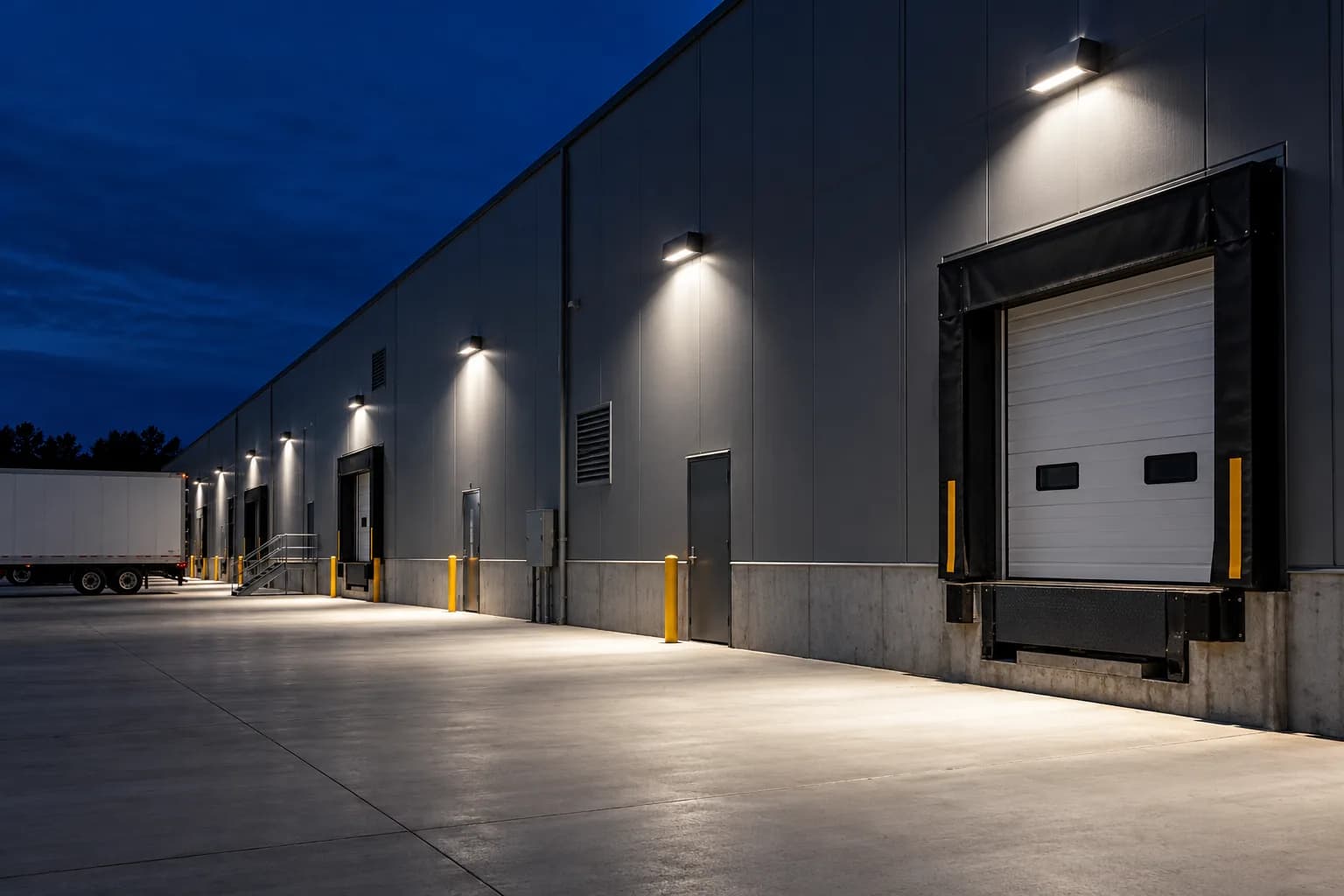
A wall pack is a compact, enclosed luminaire made to be mounted directly onto an exterior wall. Most are rectangular boxes between roughly 20 and 40 centimetres across, sealed against the weather, and aimed so the light spreads out from the wall and down onto the ground beside it. They sit on warehouse and factory perimeters, above service and loading doors, around hotel entrances, across retail facades and on the walls enclosing parking and service yards.
People sometimes lump them together with floodlights, but the jobs are different. A floodlight is usually a high-output head on a pole, a bracket or an eave, and it can be re-aimed anywhere. A wall pack is fixed to the wall and engineered around that position, with a controlled distribution that keeps the light close to the building rather than spraying it across the street. That control is the whole reason to use one: it puts light where people walk and work, and limits the spill that annoys neighbours and wastes energy.
The shift to LED matters here more than on almost any other outdoor fixture. The old metal-halide and high-pressure sodium packs took minutes to warm up, threw a yellow-orange light that aged badly, and drew a lot of power for a modest spread. A modern LED wall pack reaches full brightness the instant it switches on, holds most of its output for years, and typically cuts the energy for the same position by somewhere between half and four-fifths.
- Wall-mounted and fixed, not a pole head you re-aim
- Built for controlled light close to the building
- Common at doors, docks, perimeters, facades and service yards
- LED gives instant light, better colour and 50 to 80 percent lower energy use
2. Start from the application and the mounting height
The first thing to settle is not a model but the situation. A fixture above a low entrance where people stand and talk has to be comfortable on the face and free of glare. A pack on a loading dock has to throw light far enough out across the apron that a driver reversing a trailer can see the edge and the dock leveller. A perimeter security light is a different problem again, judged on whether there is anywhere a person can move without being clearly lit and picked up by a camera.
Mounting height drives almost everything that follows, because it sets how far the light has to fall and therefore how many lumens are needed. Low packs on walkways and small entrances commonly hang around 2.5 to 3.5 metres up. General building perimeters and entrances sit in the 3 to 4.5 metre band. Loading docks and warehouse walls run higher, often 4.5 to 6 metres, and tall industrial walls can go beyond that. The same 40-watt fixture that looks generous over a doorway will look thin and patchy bolted six metres up a warehouse wall.
Walk the site at night if you can, or at least look at photographs of the actual wall. Note what is underneath, how far the light needs to reach away from the building, and whether there are windows, a property line or an adjacent building that spill light would land on. Those notes decide the distribution, the cutoff and the lumen range before you open a single catalogue.
- Name the task: entrance, walkway, dock, facade or perimeter security
- Measure the real mounting height, not just the building height
- Decide how far out from the wall the light has to reach
- Mark windows, property lines and neighbours that limit spill light
3. Match lumens to the height, not the wattage
The habit that causes the most problems is buying by wattage. With metal-halide it was a rough guide, because two 150-watt lamps were broadly similar. LED fixtures break that relationship: two packs labelled 60 watts can differ by thousands of delivered lumens depending on the quality of the chips, the driver and the optics. The number that matters is the lumen output, and the wattage is mainly useful for checking the circuit and the energy bill.
As a planning range, a low walkway pack at 2.5 to 3 metres can work with about 1,500 to 3,000 lumens. Entrances and general perimeters in the 3 to 4.5 metre band usually call for 3,000 to 6,000. Loading docks and warehouse walls at 4.5 to 6 metres want 6,000 to 12,000, and tall walls or large aprons can need 12,000 to 20,000 or more. These are starting points for a layout, not a code to copy without checking the area.
Efficacy is the other half of the same decision. A fixture that turns one watt into more lumens costs less to run for the same light. A good commercial pack now sits comfortably above 120 lumens per watt, and the qualified, rebate-eligible models run higher again. If you are comparing two proposals with similar lumen totals, the one with the higher efficacy is the cheaper fixture over ten years even if it costs more on the invoice.
| Mounting height | Lumens per fixture | Typical LED power | Typical position |
|---|---|---|---|
| 8 to 10 ft (2.5 to 3 m) | 1,500 to 3,000 lm | 15 to 30 W | Walkways, small entrances |
| 10 to 15 ft (3 to 4.5 m) | 3,000 to 6,000 lm | 30 to 60 W | Entrances, general perimeters |
| 15 to 20 ft (4.5 to 6 m) | 6,000 to 12,000 lm | 60 to 100 W | Loading docks, warehouse walls |
| 20 ft and above (6 m +) | 12,000 to 20,000+ lm | 100 to 200 W | Tall industrial walls, wide aprons |
4. Replacing metal-halide and HPS: the retrofit numbers
When a wall pack is a like-for-like replacement, the temptation is to match the old lamp wattage. That almost always over-sizes the LED, because the old fixture wasted a large share of its power in the ballast and in light that never reached the ground. A 150-watt metal-halide pack, for example, drew more than that once the ballast was included, and by the middle of its life the lamp was producing well below its rated output as it depreciated.
The reliable way to retrofit is to match the light you actually need, expressed in lumens, rather than the power the old box consumed. A 70 to 100-watt metal-halide pack is generally replaced by a 15 to 25-watt LED in the 2,500 to 4,000 lumen range. A 150-watt MH comes down to roughly 30 to 50 watts and 4,500 to 7,500 lumens. The 250 to 300-watt class maps to 50 to 80 watts and 8,000 to 12,000 lumens, and a 400-watt MH is usually covered by 80 to 120 watts and 12,000 to 18,000 lumens.
One caution before you trust any single replacement chart. The old lamp's real output on the wall today is lower than the figure printed on the box, especially if it has been running for years. If the existing lighting was already too dim, do not size the new fixture to reproduce that dim result; size it to the target the site needs. A photometric layout settles the question, and it is worth having one for a building with many packs rather than guessing from a table.
| Legacy HID lamp | LED replacement | Typical lumens |
|---|---|---|
| 70 to 100 W MH / HPS | 15 to 25 W | 2,500 to 4,000 lm |
| 150 W MH | 30 to 50 W | 4,500 to 7,500 lm |
| 250 to 300 W MH | 50 to 80 W | 8,000 to 12,000 lm |
| 400 W MH | 80 to 120 W | 12,000 to 18,000 lm |
| 750 to 1,000 W MH | 150 to 200 W | 20,000 to 32,000 lm |
5. Distribution types and spacing: removing the dark gaps
Outdoor distributions are described by the IES Type system, which is really a description of the shape of the light on the ground. The type you choose decides whether the packs cover the area evenly or leave bright pools with dark gaps between them, and it is one of the details that cheap quotations tend to leave vague.
Type II concentrates the light to the sides in a relatively narrow, elongated spread, which suits walkways, narrow alleys and the edges of a building. Type III pushes more light forward and out to the sides and is the most common general-purpose distribution for building perimeters and medium parking areas. Type IV is a strong forward throw, built to push light away from the wall across a loading apron or a wide dock. Type V is the round, symmetric pattern used at corners and in open courtyards where light has to spread on both sides.
Spacing follows from the distribution and the mounting height. A useful rule of thumb is that a broad pack throws useful light roughly twice its mounting height away from the wall, but the spacing between fixtures is tighter, usually somewhere between one and 1.75 times the mounting height depending on type. Type II runs closest, Type IV widest. The point of getting this right is uniformity: packs spaced too far apart create hot spots directly underneath and dark zones between them, which is exactly the pattern a security layout is meant to avoid. For anything beyond a straight, simple wall, confirm the final spacing with a photometric model rather than a rule of thumb.
| Distribution | Shape of light | Spacing to height | Best position |
|---|---|---|---|
| Type II | Narrow, side-weighted | 1.0 to 1.25 | Walkways, alleys, narrow edges |
| Type III | Wide forward and sides | 1.25 to 1.5 | General perimeters, most facades |
| Type IV | Strong forward throw | 1.5 to 1.75 | Loading docks, wide aprons |
| Type V | Round, symmetric | By layout | Corners, open courtyards |
6. Color temperature and CRI for security and cameras
Correlated color temperature is the warm-to-cool scale measured in kelvins. Warm light around 3000K carries a soft, slightly amber tone and sits comfortably against residential and hospitality buildings. Neutral 4000K is the balanced default for most commercial perimeters, neither harsh nor muddy. Cool 5000K and above reads as crisp, daylight white and gives the highest contrast, which is why security-critical and industrial sites tend to favour it.
The catch is that the coolest light is not always the correct choice, and this is where local rules come in. A growing number of municipalities restrict the CCT of outdoor lighting, often to 3000K or lower, specifically to cut the blue-rich light that contributes to skyglow and affects wildlife. A fixture that is technically brighter but breaches the local CCT limit can fail an inspection regardless of its other qualities. Check the local ordinance before defaulting to 5000K.
Color rendering, measured by CRI, matters more than buyers expect once cameras are involved. A low-CRI light can make colours and vehicle details hard to read on footage. A CRI of 80 is a reasonable minimum for a commercial perimeter, and positions where surveillance footage is genuinely important are better specified at 85 to 90. High CRI does not make the light brighter, but it makes the detail under that light trustworthy, which is the actual point of a security installation.
- 3000K warm for hospitality and neighbour-sensitive walls
- 4000K neutral is the safe commercial default
- 5000K cool for high-contrast security and CCTV positions
- Check local CCT limits before choosing the coolest option
- CRI 80 minimum, 85 to 90 where camera detail matters
7. Full cutoff, BUG ratings and dark-sky compliance
A full-cutoff fixture is built so that the housing extends below the light source and no light escapes at or above the horizontal plane. Photometrically that means zero output at 90 degrees and above, so nothing is thrown up into the sky. It is the strictest of the common optical classifications and the one most dark-sky ordinances and responsible-lighting schemes are built around. A semi-cutoff or non-cutoff pack allows some light above horizontal and is increasingly difficult to justify on a new project.
The modern way this is described on a specification is the BUG rating, defined under the IES TM-15 standard. BUG stands for backlight, uplight and glare, and each component is scored from zero to five, with lower numbers meaning better control. A true full-cutoff pack carries a U value of zero, which is the figure to look for when a dark-sky or light-trespass rule applies. The B value tells you how much light is thrown back toward and through the wall, and the G value describes the glare a person sees looking toward the fixture.
The formal dark-sky approval programs go further than simply requiring zero uplight. The current guidelines cap the correlated color temperature at 3000K, require fixtures above a modest lumen level to be dimmable down to around 10 percent, and limit the uplight on commercial fixtures to a tiny fraction of the total output. They also restrict how far a fixture can be tilted upward, generally to no more than five degrees. Even where a dark-sky rule is not enforced today, specifying a full-cutoff, low-BUG fixture is a sensible hedge: the direction of regulation is clearly toward tighter control, and retrofitting shields or replacing packs later costs far more than buying the correct ones now.
| BUG component | What it measures | Target for a controlled site |
|---|---|---|
| B - Backlight | Light thrown back toward the wall and behind | Low, minimises light trespass |
| U - Uplight | Light at or above 90 degrees into the sky | U0 for full cutoff |
| G - Glare | Discomfort looking toward the fixture | Low, especially near eye level |
8. IP and IK ratings, housing, thermal and surge protection
Because a wall pack lives outside for years, the enclosure has to be judged separately from the light it produces. The IP rating describes how well it is sealed against dust and water. IP65, meaning dust-tight and protected against water jets, is the practical minimum for general outdoor use. IP66 adds protection against stronger jets and is worth specifying on coastal sites or anywhere packs are pressure-washed, and IP67 covers temporary immersion in flood-prone positions.
The IK rating covers impact. IK08 is the standard for an ordinary commercial wall, while IK10 is the vandal-resistant choice for ground-level packs, parking structures and anywhere the fixture is within easy reach. On coastal or industrial sites, also look at the housing material and its corrosion resistance; a powder-coated or properly treated aluminium housing and stainless fasteners hold up far better than untreated metal where salt or chemicals are in the air.
Two more details separate a fixture that lasts from one that fails early. The first is thermal management, which on a sealed pack comes down to the housing acting as a heat sink; a fixture that runs hot cooks the driver and the chips and depreciates fast. The second is surge protection, which matters because outdoor fixtures are exposed to lightning and grid surges. A built-in surge rating of at least 6 kilovolts is a reasonable baseline, and higher is justified in exposed locations. A cheap pack with no surge protection is a common failure point after a storm, and it usually takes the driver with it.
- IP65 minimum; IP66 for coastal and washdown sites; IP67 for flood risk
- IK08 standard, IK10 for vandal-prone and ground-level positions
- Check housing corrosion resistance and stainless fasteners
- Look for solid heat sinking and at least 6 kV surge protection
9. Controls, DLC 6.0 and the order-time checklist
Controls are where a wall pack installation stops being a row of boxes that burn all night and becomes something managed. A photocell is the baseline, switching the fixture on at dusk and off at dawn so it never runs in daylight; it is the cheapest energy measure available and should be treated as standard unless the packs are switched centrally. The next step up is a motion sensor with bi-level dimming, which holds the fixture at a low level overnight and raises it to full output when someone approaches. That combination can cut the energy by roughly half compared with full brightness all night, and the sudden step up in light is itself a deterrent.
For larger buildings, 0-10V dimming lets the packs connect to a building or networked lighting system, so they can be scheduled, dimmed on a curve and monitored rather than controlled one at a time. The incremental cost is modest on a controls-ready fixture and the flexibility is considerable on a site with many outdoor packs.
The certification point that matters most in 2026 is the version of the DLC listing. SSL 6.0 took effect at the start of the year, with the consortium accepting applications from January and the older 5.1 products being moved off the active qualified list during the year and finally delisted by mid-December. For wall-mounted area fixtures, the 6.0 minimum efficacy sits around 125 lumens per watt for Standard and 145 for Premium, alongside the required dimming. On top of that, every North American installation needs a UL or ETL safety mark. Before you commit an order, confirm the exact model number on the current DLC list and check the safety mark, the IP and IK ratings, the cutoff and BUG value, and the control options. A model that looks cheaper but is listed under the old standard can quietly lose the rebate that made the project stack up.
- Photocell as standard; motion with bi-level dimming for the bigger savings
- 0-10V dimming to connect into a building or networked system
- Confirm the model is DLC SSL 6.0 listed, not the older 5.1
- Require a UL or ETL mark and check IP, IK, cutoff and BUG
- Verify the exact model number on the current qualified-products list
Frequently asked questions
Questions buyers ask
How many lumens do I need for an outdoor wall pack?
It depends on the mounting height and the area. Walkways at 8 to 10 feet commonly work with 1,500 to 3,000 lumens, general entrances and perimeters at 10 to 15 feet use 3,000 to 6,000, and loading docks or warehouse walls at 15 to 20 feet need 6,000 to 12,000. Tall walls can require 12,000 or more. A photometric layout is the reliable way to confirm the count for a larger building.
What is the difference between full cutoff and semi cutoff wall packs?
A full-cutoff fixture produces no light at or above the horizontal plane, so it has zero uplight and carries a U0 BUG value. A semi-cutoff fixture allows some light to escape above horizontal. Full cutoff is required by most dark-sky rules and is the better default on a new project, since it limits skyglow and wasted light.
What LED wall pack replaces a 150 watt metal halide?
A 150-watt metal-halide pack is generally replaced by a 30 to 50-watt LED producing about 4,500 to 7,500 lumens. Matching the old wattage would over-size the LED, because the old fixture lost power in the ballast and the lamp depreciated over time. Size by the lumens the site needs rather than the old wattage.
What is a BUG rating?
BUG stands for backlight, uplight and glare, defined under the IES TM-15 standard. Each is scored from zero to five, with lower values meaning better control. For a dark-sky or light-trespass requirement, the key figure is a U value of zero, which confirms a true full-cutoff fixture with no upward light.
What color temperature should an outdoor wall pack be?
Neutral 4000K is the balanced default for most commercial perimeters. Warm 3000K suits hospitality and neighbour-sensitive walls and is often required by dark-sky rules, while cool 5000K gives the high contrast preferred for security and CCTV. Always check the local CCT limit before choosing the coolest option.
Do wall packs need a photocell?
A photocell is the practical baseline for outdoor packs, because it switches them on at dusk and off at dawn and prevents them wasting energy in daylight. A motion sensor with bi-level dimming goes further, holding a low level overnight and raising to full output when someone approaches, which can roughly halve the energy use.
What IP rating does an outdoor wall pack need?
IP65 is the practical minimum, meaning dust-tight and protected against water jets. IP66 is worth specifying on coastal sites or where packs are pressure-washed, and IP67 covers temporary immersion in flood-prone areas. For impact, IK08 is standard and IK10 is the vandal-resistant choice for ground-level fixtures.
Does the DLC 6.0 change affect wall packs?
Yes. SSL 6.0 took effect at the start of 2026, and the older 5.1 products are being moved off the qualified list and finally delisted by mid-December. For wall-mounted area fixtures, 6.0 sets a minimum efficacy around 125 lumens per watt for Standard and 145 for Premium, plus dimming requirements. Confirm the exact model is listed under 6.0 if a rebate is part of the project.
Sources and references
DarkSky International - Approved Luminaires Guidelines v3.1DesignLights Consortium - SSL V6.0 Technical Requirements (draft documentation)LED Light Expert - Full cutoff wall packs explainedHylele - LED wall pack buying guide, wattage and lumensBees Lighting - Wall pack cutoff and light trespassJCE Lighting - Selecting wall packs by BUG ratingTalk to the product team
Planning an OEM or commercial lighting order?
Send your application, specification and destination market. We will help narrow the product and sample options.
Discuss on WhatsApp