
Key takeaways
- These are four markets, not one. South Africa runs on 230V at 50Hz on Type M/N plugs, Kenya on 240V at 50Hz on Type G, Nigeria on 230V at 50Hz on Type D/G, and Morocco on 220V at 50Hz on Type C/E. All four sit at 50Hz, the same frequency as China, and inside the 100-240V window, so one wide-input driver covers them all. The language split is sharper than the voltage one: South Africa, Kenya and Nigeria work in English, Morocco in French, and the local word for the product changes - LED tape in South Africa, snake lights in Kenya, rope or neon in Nigeria, ruban LED in Morocco.
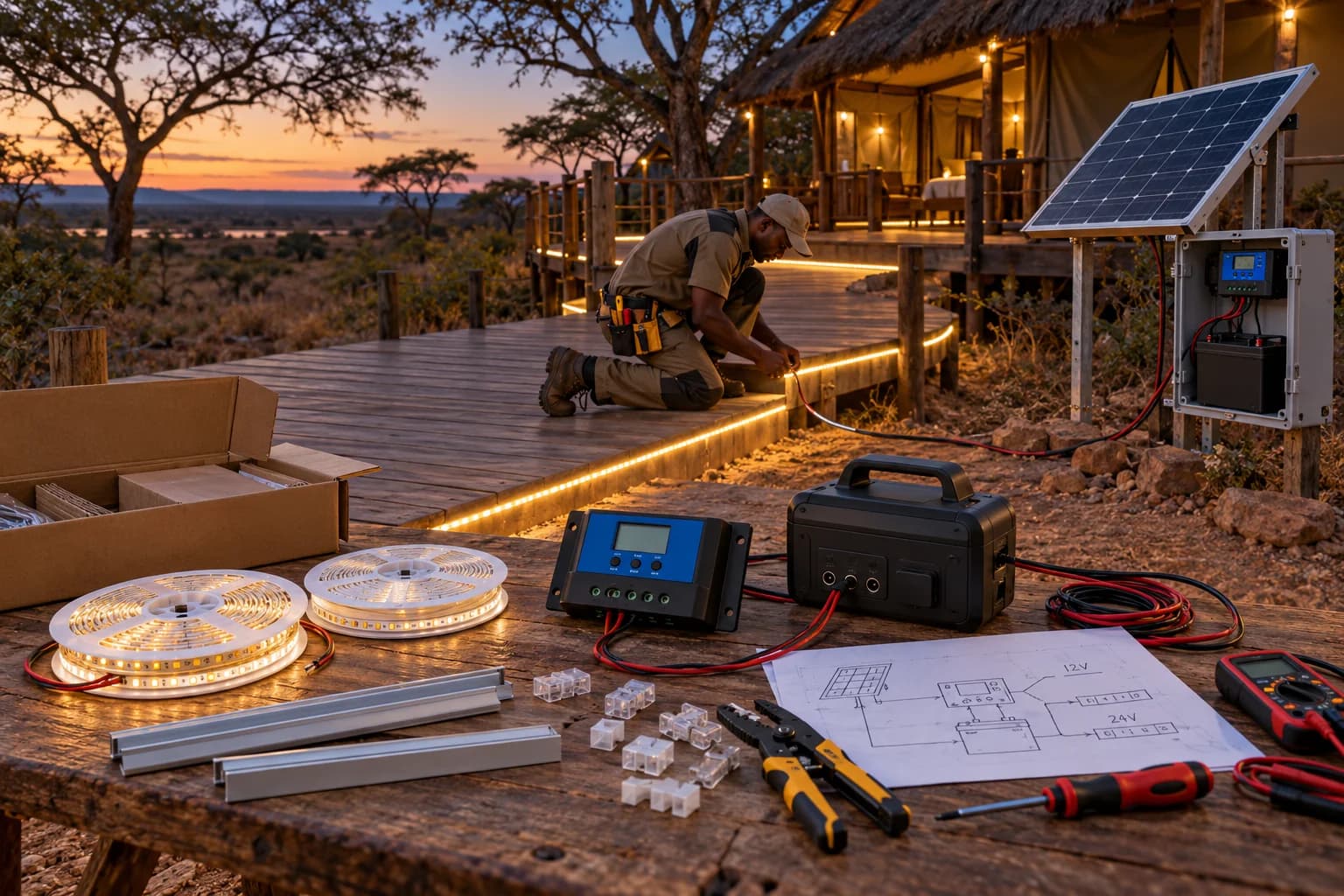
- The off-grid question is the Africa-specific one. A strip is a 12V or 24V DC component, which means it can run directly from a solar charge controller and battery with no inverter - exactly the setup lodges, game farms, rural sites and load-shedding homes need. South African search interest for battery-operated LED strip is up roughly 170 percent year on year, tracking Eskom load shedding. A high-voltage 220V reel cannot do this without an inverter; 12V/24V strip can, as long as the battery and panel are sized for the run and the night hours.
- Compliance is led by the importer, one model and one HS code at a time. South Africa requires an NRCS Letter of Authority (LOA) against SABS/SANS standards with SANS 164 plugs; Kenya runs KEBS PVoC, so a Certificate of Conformity is issued in the exporting country before shipment; Nigeria requires SONCAP, with a per-shipment SONCAP Certificate that is mandatory for clearance or the consignment is refused; Morocco applies the CMIM mark backed by an Arabic or French declaration of conformity and technical file. The factory supplies the test reports; the importer files and holds the certificate.
- The local counter and the factory sell different things. Retailers in Nairobi, Lagos, Casablanca and Johannesburg sell by the metre and the 50-metre reel, quote in shillings, naira, dirham and rand, take M-Pesa or WhatsApp orders, and promise delivery in days from local stock. A Chinese factory quotes in USD FOB or CIF, sells full reels and cartons against a fixed spec, supports OEM, and cannot honestly offer same-day stock or M-Pesa. Never compare a local kit price with a bare-reel FOB number without normalising the unit, accessories, tax and freight.
- Do not machine-translate your way into Morocco. A French buyer searches ruban LED, asks for a fiche technique and a devis, and buys profilé aluminium alongside the strip; a French page that is just an English title translated with no one able to answer the enquiry in French is worse than none. Serve the three English markets and project contractors in English first, and only open a French service once French-language quoting and documentation are genuinely supported.
1. Four markets, four names, two sourcing languages
A sign contractor in Johannesburg is pricing a restaurant front that has to stay lit when the Eskom schedule cuts the power. An importer in Nairobi is restocking what every electrician and hardware trader in the city calls snake lights, sold by the metre and paid for on M-Pesa. A decorator in Lagos needs 50-metre neon reels for weddings and POP ceilings, priced in naira. A shopfitter in Casablanca sends the enquiry in French: ruban LED, profilé aluminium, a fiche technique and a devis. They are buying the same physical product. They are not buying it in the same language, under the same rules, or from the same kind of seller.
The local vocabulary is not decoration - it is what buyers type and what the purchase order says. In South Africa the product is LED strip or LED tape, a genuine synonym the trade uses. In Kenya strip is often called snake lights alongside the English LED strip, and the top local search questions are practical ones like how to connect it. In Nigeria buyers mix LED strip, rope light and neon, with the long 220V neon reel dominant for decoration. Morocco is French: ruban LED is the category (bande LED is sometimes used), a supplier is a fournisseur, a quote is a devis, the datasheet is a fiche technique, and the aluminium channel is a profilé aluminium. Recent Google Trends data confirms the shape: LED strip lights is the steady high-volume term in South Africa, concentrated in Gauteng, KwaZulu-Natal and the Western Cape, with battery-operated LED strip up roughly 170 percent and warm LED strip up roughly 130 percent; Kenya and Nigeria are smaller, spikier markets centred on Nairobi and Lagos; Morocco searches ruban LED, including ruban LED 220v, around Casablanca and Rabat, while the B2B word fournisseur has little search volume but very clear intent.
Local retail and direct import answer different jobs. A South African lighting retailer, a Nairobi hardware counter, a Lagos electrical dealer and a Casablanca magasin sell by the metre and the reel, bundle drivers and controllers into kits, price in rand, shillings, naira or dirham with local tax included, take mobile money or WhatsApp orders, and hold stock so a customer can walk out with product the same day. That is the honest route for small jobs, repairs, and anyone who genuinely cannot wait for a vessel. The price carries the importing, warehousing, clearance and tax the dealer has already done.
Direct import is a different transaction. A factory sells full reels, cartons and project quantities against a fixed specification, keeps colour and width consistent across repeat orders, and supports OEM and project packaging. In return the buyer accepts a production lead time, a minimum order, and the freight, clearance and conformity work described in this guide. The dividing line is specificity and volume, not cheapness: a small, urgent, open-specification order belongs at the local counter; a fixed-specification chain, a distribution container or a project belongs at the factory.
We are a China-based LED strip and power-supply manufacturer. We quote and ship from China under the agreed Incoterm, support project and OEM orders, and provide model-matched documents before shipment. We do not hold stock in Johannesburg, Nairobi, Lagos or Casablanca, we do not take M-Pesa, and we do not promise two-day delivery in naira or dirham, because that is not how a factory ships. Same-day local stock is real, but it is held by local importers and distributors, not by us.
2. The electrical baseline: 220-240V at 50Hz, and the off-grid question
Latin America forces a buyer to juggle 110V, 127V and 220V. Africa is simpler on the mains and harder on the supply itself. South Africa is 230V at 50Hz on Type M (and the newer Type N) sockets under SANS 164. Kenya is 240V at 50Hz on Type G. Nigeria is nominally 230V at 50Hz, in practice across 220-240V, on Type D and G. Morocco is 220V at 50Hz on Type C and E. Every one of them is 50Hz, the same frequency as China and most of Europe, so there is no 50/60Hz mismatch to design around as there is across Latin America. All four voltages fall inside the 100-240V range of a normal switching driver, which means a single wide-input driver specification covers all four markets. That is a real simplification for anyone building a regional catalogue.
The strip itself never sees the wall voltage. A 12V or 24V strip is a low-voltage DC device; a driver converts the mains to DC, and that driver is the part that must match the destination. Three systems appear on African projects, and the first real engineering decision is deciding which one the application belongs to.
1. AC high-voltage strip (220V or 240V). The board carries rectifiers and connects straight to the mains, so one feed can cover a long storefront, sign or facade with fewer drivers and power points. This is the dominant product in Kenyan and Nigerian retail, where 220V 50-metre neon and strip reels are sold by the metre for signage and decoration. The board must be built for the local voltage, and a 50-metre reel is a packaging length, not a promise of 50 metres from one end with no voltage drop - long runs still need feed points and sealed connectors.
2. DC 12V or 24V low-voltage strip with an external driver. This is the interior workhorse for cove, retail shelving, hospitality, kitchens and dot-free high-density COB, and it is where the more specification-driven South African market sits, with 24V COB at IP65 common in premium projects. Pairing 12V/24V strip with a wide-input 100-240V driver is the most forgiving spec across all four countries because the same driver accepts 220V, 230V and 240V without a separate part number.
3. The off-grid and backup system - the part that is genuinely different in Africa. South Africa has lived with years of Eskom load shedding, and the market has answered with battery and solar lighting: South African sellers report that cordless and battery LED strip has grown specifically around blackouts, rental units and spaces with no wiring, and the roughly 170 percent rise in battery-operated strip searches matches that. Across East and West Africa, lodges, chalets and game farms, rural sites and security lighting are often beyond a reliable grid entirely, and solar street and area lighting runs independently of it. The reason 12V/24V strip matters here is electrical: solar panel to charge controller to battery to 12V/24V strip is a direct-DC chain with no inverter, so it loses less energy and has fewer points of failure. A 220V high-voltage strip cannot run from a battery without adding an inverter, which is the clean line between the two products for a backup or off-grid job.
The off-grid route is easy to undersell. The strip is cheap; the battery and panel are where the project is won or lost. They have to be sized from the wattage per metre, the total metres, the hours lit each night and the number of cloudy days the battery must ride through, not just from the strip price. Outdoor and exposed runs still want IP65 or IP67, sealed to the connectors and end caps, and warm white is the dominant residential backup choice. Treat a solar strip order as a small power system, not a lighting-only order.
3. LOA, PVoC, SONCAP and CMIM: what clearance actually asks for
Each country runs its own conformity regime, and the rule is the same in all four: the certificate is filed by the importer or a local representative in the destination, model by model, and a CE mark is not itself market access. A factory can carry the testing burden and supply the reports, but it cannot honestly claim every product on its website is already registered for every country.
South Africa is run by the NRCS, the National Regulator for Compulsory Specifications. Electrical and electronic products must carry a Letter of Authority (LOA) confirming they meet the compulsory safety and energy-efficiency specifications; luminaires are assessed against SABS/SANS standards built on the IEC 60598 family. The plug is a separate trap: South Africa uses the SANS 164 three-pin system, so a corded product finished with a foreign plug will not pass. The LOA is held by the South African importer or registered representative.
Kenya runs KEBS PVoC, the Pre-Export Verification of Conformity. Conformity is checked in the exporting country - in China, by a KEBS-appointed inspection partner - against Kenya Standards that adopt IEC, including the KS IEC 60598 family for luminaires and KS IEC 61347-2-13 for LED control gear. The inspection and testing produce a Certificate of Conformity (CoC) that is a pre-import condition; electrical and electronic products are within PVoC scope unless specifically exempted. Ordering the PVoC work before shipment is the entire point - arranging it after arrival is expensive and slow.
Nigeria uses SONCAP, the Standards Organisation of Nigeria Conformity Assessment Programme. A product is first covered by a Product Certificate, and each shipment then needs a SONCAP Certificate (SC). The SC is mandatory for customs clearance at Lagos, Tin Can and other entry points; a regulated consignment arriving without one is refused release and can be re-exported. Solar and electrical lighting destined for Nigeria is routinely shipped with SONCAP, so the fact that a product is solar-powered does not remove the requirement.
Morocco applies the CMIM (Cم) mark under Law 24-09 and its technical regulations, covering low-voltage electrical equipment (the decree covers AC 50-1000V equipment) and electromagnetic compatibility. The responsible party draws up a declaration of conformity in Arabic or French and a technical file - product description, circuit and design documents, component list and test reports - and an import Certificate of Conformity is presented at clearance through the port system. A CE test report is a useful starting point, but it does not replace the CMIM dossier.
The strip-versus-luminaire classification is where buyers should stay cautious. A bare 12V/24V strip on its own is a component in some classifications; the moment it is placed on the market with a driver as a finished luminaire, it falls squarely inside electrical-lighting regulation. Lighting fittings generally classify under HS heading 9405, but the exact ten-digit code and the conformity scope for bare strip, driver and finished kit differ by country and must be confirmed with the importer and the issuing body before production. We supply the model-matched reports and datasheets we actually hold; we do not promise blanket LOA, PVoC, SONCAP or CMIM coverage for every product online.
4. Currency, payment, and the unit that actually gets quoted
Four currencies sit behind four local retail systems: the South African rand (ZAR), the Kenyan shilling (KSh/KES), the Nigerian naira (NGN) and the Moroccan dirham (MAD/Dhs). Local retailers quote in those currencies with local tax included, and they take the payment methods their customers actually use - in Kenya that means M-Pesa, and across the region it means WhatsApp enquiries, cards and cash. A factory export order does none of this. It is quoted in US dollars, paid by telegraphic transfer against a deposit and balance, and moves on FOB or CIF terms. For Nigeria in particular, where the naira has moved sharply, a factory should quote USD and let the importer manage conversion rather than attempt to hold a naira price.
The tax stack is real and should be budgeted with a broker, not a one-line freight estimate. Standard VAT sits at 15 percent in South Africa, 16 percent in Kenya, 7.5 percent in Nigeria and 20 percent in Morocco, on top of import duty that varies with the HS classification and any port or inspection charges; Kenya and Nigeria also treat the PVoC CoC and SONCAP SC as clearance preconditions. These rates change, and the duty on bare strip, drivers and finished luminaires is not identical, so confirm the exact code, the destination port and the current rate with a local customs broker before the deposit.
The quote unit is the more common source of direct loss. Local buyers across the region think in metres, in 50-metre high-voltage reels (the Kenyan and Nigerian neon standard), in 5-metre low-voltage reels, and in kits that already contain a driver, controller and clips. A factory quote should state explicitly whether the price is per metre, per 5m reel, per 50m reel or per carton, how many metres that carton contains, whether the driver and controller are included, the MOQ, and the Incoterm. A local kit price with a driver and clips and a bare FOB reel price are not comparable, and buyers who put them side by side without normalising the unit end up believing the factory or the dealer is far cheaper than it really is.
A factory should not copy local retail promises it cannot meet. Same-day or two-day delivery, M-Pesa, local instalments and tax-included consumer pricing are built on a local entity and local inventory. A vendor in China advertising stock in Nairobi or Lagos, M-Pesa checkout and two-day delivery at factory prices is almost always a reseller or a middleman, not a factory. If local fulfilment is what a buyer needs, the honest answer is a local distributor, not a factory pretending to be one.
5. Matching the strip to the job: an Africa application short list
The same handful of applications repeats across the four markets. This is the short list we quote against; exact wattage and lumen figures are confirmed per model and per length on the final schedule.
South African interiors, retail and hospitality: high-density 24V COB at CRI 90 or above, 3000K or 4000K, in a diffused aluminium channel, with IP65 for bathrooms and sheltered outdoor use. This is the most specification-driven segment in the region and the closest match to a European-quality project.
Load-shedding and backup lighting: battery- or solar-powered 12V/24V strip for walkways, rental units, homes and small businesses, in warm white, with a charge controller and battery sized to the night hours. This is the fastest-rising South African use case and one a local retailer often cannot supply as a complete system.
Kenyan and Nigerian storefronts, events and decoration: 220V/240V long-run neon flex and rope light on 50-metre reels for POP ceilings, weddings, signage and retail fronts, with sealed connectors and IP65 where the run is exposed. This is what the local counters push, and it is the main direct-import volume for decoration distributors.
Moroccan residential and shopfitting: ruban LED fitted into profilé aluminium for ceilings, staircases, furniture and shop windows, with 12V/24V product indoors and 220V reels for long runs, presented in French with a proper fiche technique.
Off-grid and solar projects across the region: 12V/24V strip for lodges, chalets, game farms, rural sites, security lighting and solar street schemes, run directly from the battery side with no inverter, sized as a small power system. This is the opportunity that is genuinely distinctive to Africa and that local retail rarely serves at project scale.
Tenders, chains and projects: ports, retail chains and commercial jobs lead with the specification and the conformity documents. Confirm the LOA, PVoC, SONCAP or CMIM scope for the named models and the destination city before accepting a low FOB number; a container that cannot clear customs, or that cannot run off a solar battery it was sold for, cannot be saved by a cheap unit price.
6. What a project-ready RFQ from Africa should contain
A message that reads 'LED strip, Africa, best price' forces every factory to guess. A project-ready RFQ removes the guesswork and makes competing quotes like-for-like. Across four voltages, four compliance regimes and two languages, the destination detail is not optional.
1. Country and city - this sets the voltage, the plug, the compliance regime (LOA, PVoC, SONCAP or CMIM) and the port: Durban or Johannesburg, Mombasa or Nairobi, Lagos or Tin Can, Casablanca.
2. Language - English for South Africa, Kenya, Nigeria and project contractors; French for Morocco, where a fiche technique and a devis may be required.
3. Grid or off-grid - whether the strip runs from mains, from a solar battery, or as load-shedding backup. This decides the entire voltage system.
4. Voltage system - 220V/240V high-voltage direct, 12V/24V with wide-input drivers, or 12V/24V from a solar charge controller; plus the control protocol (non-dim, TRIAC, 0-10V) and colour (single-colour, tunable white, RGBW).
5. Optical and electrical spec - W/m, lm/m, COB or SMD density, CCT, CRI, board width, cut length, and the required IP rating.
6. Quantities and run geometry - total metres, number of reels or runs, the length of each run, the maximum distance from the driver, and whether the reel is 5m or 50m.
7. For solar or backup jobs - the hours lit each night, the number of cloudy days to cover, and the battery and panel capacity expected, so the system is sized rather than guessed.
8. Quote unit and accessories - price per metre, per reel or per carton, whether drivers, controllers, profiles, connectors and clips are included, and the MOQ and currency.
9. Compliance and commercial terms - which certificate is required, the HS code the importer plans to use, packaging and carton marking, lead time, Incoterm and port of entry.
A factory that returns a table against those fields is quoting the same product as its competitor. A factory that only sends a per-reel price is handing the engineering, the solar sizing, the tax calculation and the compliance risk back to the buyer.
7. Buying direct from China, and the honest answer on French
For a project or distribution order, the direct route runs the same way every time. A project-ready RFQ arrives, the factory confirms the specification against the destination city and the grid-or-solar question, and produces a schedule. A sample or small trial is approved for colour, CRI and thermal behaviour. The model-specific LOA, PVoC, SONCAP or CMIM work is settled on the importer's side using the factory's reports, production is released against a deposit, a pre-shipment inspection checks the batch against the approved sample, and the goods are packed and loaded for the agreed Incoterm. The importer then clears the consignment under the local regime and the correct HS code.
What a factory genuinely does is manufacture to the agreed spec, support OEM and project packaging, provide third-party test reports and the documentation conformity assessment builds on, accept inspection, and ship FOB or CIF. What it does not do is hold same-day local stock, take M-Pesa, price in naira or dirham with local instalments, or quietly hold an LOA or SONCAP certificate in the importer's name. Those obligations sit with the local partner, and a vendor who blurs that line is usually a reseller marking up someone else's strip.
The language question deserves a straight answer. South Africa, Kenya and Nigeria, plus most project contractors across the region, work in English, so English technical documentation is directly usable and that is the stable baseline we publish in. Morocco is a French market, and a French buyer expects ruban LED, a fiche technique, a devis and a distributor who can answer in French. A French landing page produced by machine-translating English titles, with no one able to answer the incoming French enquiry, is worse than none - it draws a lead that is then dropped. The honest sequence is to serve the English markets fully, offer French datasheets for the specific models where they are genuinely available, and open a French service only when French-language quoting and support are real. That is a capability project, not a translation one.
The same discipline applies to the claim that wins the region. The thing Africa needs that a local strip counter structurally cannot provide is a complete, correctly sized low-voltage system: matched 12V/24V strip, wide-input drivers for the grid, and controller-battery-panel kits for solar and backup, with model-matched compliance documents behind them. That is a factory's job, quoted properly, and it is where a direct order is more than a cheap reel.
If you are pricing an order for South Africa, Kenya, Nigeria or Morocco, send the country and city, the application, whether the job runs on the grid or solar, the run lengths and the quote unit you need, and we will return the matched strip, wide-input driver or solar-side specification with the documentation that actually applies to those models - and a clear answer on which items are already documented and which would be added for your order.
Frequently asked questions
Questions buyers ask
Can I import LED strips directly from China to South Africa, Kenya, Nigeria or Morocco?
Yes. Chinese factories ship FOB or CIF directly into all four markets for project, OEM and distribution orders at specifications a local counter does not stock. The local importer or agent handles clearance and the destination conformity - an NRCS LOA in South Africa, KEBS PVoC in Kenya, SONCAP in Nigeria and CMIM in Morocco - using the factory's test reports, and pays the local duties and VAT. Direct import is the more consistent route for fixed-specification project and distribution volumes; local retailers and hardware counters are the better choice for small, urgent, open-specification orders and replacements.
What voltage and frequency do LED strips use in South Africa, Kenya, Nigeria and Morocco?
The strip itself is a 12V or 24V DC low-voltage component, so the driver is what must match the wall supply. South Africa is 230V at 50Hz (Type M/N plugs), Kenya 240V at 50Hz (Type G), Nigeria 230V at 50Hz across a 220-240V range (Type D/G), and Morocco 220V at 50Hz (Type C/E). All four are 50Hz and within the 100-240V window, so 12V/24V strip paired with a wide-input driver covers all four with one part number. High-voltage 220V/240V strip must be ordered for the local voltage and runs directly from the mains; it cannot run from a battery without an inverter.
What certification is required for LED strips in each country?
South Africa requires an NRCS Letter of Authority (LOA) against SABS/SANS standards, with SANS 164 plugs on corded products. Kenya runs KEBS PVoC, where a Certificate of Conformity is issued by an appointed inspection partner in the exporting country before shipment. Nigeria requires SONCAP, including a per-shipment SONCAP Certificate that is mandatory for customs clearance; consignments without it can be refused or re-exported. Morocco requires the CMIM mark, supported by an Arabic or French declaration of conformity and a technical file. In all four the importer files and holds the certificate for the exact model and HS code, while the factory supplies the test reports; bare 12V/24V strip may be classified as a component, but a driver-equipped finished luminaire is regulated.
What do buyers in Africa call LED strips, and how do they pay?
South Africa uses LED strip or LED tape; Kenya often calls it snake lights alongside LED strip; Nigeria mixes LED strip, rope light and neon for long 220V decorative reels; Morocco uses the French ruban LED (with fournisseur, devis, fiche technique and profilé aluminium). Local retailers sell by the metre, the 5m or 50m reel and in kits, quote in rand, shillings, naira and dirham with tax included, and take M-Pesa, cards, cash or WhatsApp orders. A Chinese factory instead quotes in USD FOB or CIF, sells full reels and cartons, and requires a deposit and balance by bank transfer, with no local same-day stock.
Can 12V/24V LED strips run on solar or battery during load shedding?
Yes, and that is one of the strongest reasons to specify low-voltage strip in Africa. A 12V or 24V strip runs directly from a solar charge controller and battery with no inverter, forming an efficient direct-DC chain for lodges, game farms, rural sites, security lighting and South African load-shedding backup; search interest in battery-operated LED strip has risen sharply in South Africa alongside blackouts. The battery and panel must be sized from the W/m, total metres, hours of night-time use and cloudy-day reserve, and exposed runs should be IP65/IP67. A 220V high-voltage strip cannot do this without an inverter, so for backup or off-grid use, choose 12V/24V and treat the order as a small power system.
Talk to the product team
Planning an OEM or commercial lighting order?
Send your application, specification and destination market. We will help narrow the product and sample options.
Discuss on WhatsApp