
Key takeaways
- IP rating has two digits: the first is dust protection, the second is water protection. Do not evaluate them in isolation.
- IP65 protects against low-pressure water jets; IP67 survives temporary immersion in 1 m of water; IP68 handles continuous immersion at a pressure specified by the manufacturer.
- For most outdoor architectural and wet-location applications, IP65 is sufficient. Choose IP67 only if the strip may be splashed or briefly submerged. Specify IP68 only for genuine underwater or pressurized-wet use.
- Higher IP ratings add cost and reduce heat dissipation, which shortens LED life. Buying a higher rating than your application needs is a real downside, not a bargain.
- Silicone coating, potting and fully encapsulated construction each achieve different levels. Ask your supplier which construction method is used, not only which IP number is printed on the label.
- Require batch-level waterproof test records, not just a generic certificate. A single lab report does not prove every roll you receive passes.
1. What Is an IP Rating, and Why Does It Matter for LED Strips?
IP stands for Ingress Protection, defined by the IEC 60529 standard. An IP rating tells you how well an electrical enclosure resists two things: solid objects (dust, tools, fingers) and water. For LED strip lights, which are essentially flexible PCBs with exposed solder joints and surface-mount LEDs, the second digit — water protection — is usually the more critical one, because the PCB, copper traces and solder points corrode quickly when moisture gets in.
A strip sold as 'outdoor' but without a proper IP rating will typically fail within one or two seasons: the silicone coating cracks at the edges, water wicks along the copper traces, and the strip starts flickering or goes dark section by section. Choosing the right rating from the start prevents field failures, warranty claims and costly re-installation.
- IP = Ingress Protection, defined by IEC 60529
- Two digits: first = dust, second = water
- For LED strips, the second (water) digit is usually the limiting factor
- Water ingress corrodes copper traces, solder joints and LEDs from the inside out
- Under-spec rating causes field failures; over-spec rating costs money and hurts cooling
2. The First Digit: Dust Protection
For LED strip lights, dust protection is usually less of a concern than water, because the strip is either enclosed in an aluminum channel or coated with a protective layer. Still, the first digit affects how you specify the product and how it performs in dusty environments such as factories, kitchens or industrial sites.
Most outdoor or wet-rated LED strips are IP6X, meaning completely dust-tight. IP5X means dust-protected but not fully dust-tight — some dust may enter, though not enough to interfere with operation. For clean indoor decorative lighting, IP20 (touch-protected) is the standard and is perfectly adequate. The important point is that the first digit is only half the rating; a strip labeled 'IP65' is dust-tight and water-jet-protected, while a strip labeled 'IP54' is only dust-protected and splash-protected.
| First digit | Dust protection level | Typical use |
|---|---|---|
| IP20 | Protected against touch by fingers | Indoor, dry, enclosed fixtures |
| IP40 / IP44 | Protected against solid objects >1 mm | Indoor commercial, partially exposed |
| IP5X | Dust-protected (limited dust ingress allowed) | Dusty workshops, kitchens |
| IP6X | Dust-tight (no dust ingress at all) | Outdoor, dusty, wash-down areas |
3. The Second Digit: Water Protection, Explained
The second digit is where most buyer confusion happens. Numbers 1 through 6 describe protection against falling or sprayed water at increasing pressure and volume. Number 7 describes temporary immersion, and number 8 describes continuous immersion under pressure. Number 9K describes high-pressure, high-temperature steam cleaning, which is relevant for food and pharmaceutical environments but less common for architectural lighting.
The key conceptual distinction is between 'jets' (numbers 5 and 6) and 'immersion' (numbers 7 and 8). A strip that passes IP65 can resist being sprayed with a garden hose, but it is not designed to sit under water. A strip that passes IP67 can be dropped into a bucket of water for half an hour and survive, but it is not designed to be left there. A strip that passes IP68 is built to remain submerged for an extended period at a depth and pressure defined by the manufacturer.
| Second digit | Test condition | What it actually means |
|---|---|---|
| IPX4 | Splashed water from any direction | Resists incidental splashes, not direct spray |
| IPX5 | Water jets at 12.5 L/min, 6.3 mm nozzle, 3 m distance | Resists direct low-pressure spray from a hose |
| IPX6 | Powerful water jets at 100 L/min, 12.5 mm nozzle | Resists heavy seas or powerful wash-down spray |
| IPX7 | Immersion in 1 m of water for 30 minutes | Survives accidental short-term submersion |
| IPX8 | Continuous immersion at depth and pressure specified by manufacturer | Designed for long-term underwater use |
| IPX9K | High-pressure, 80°C steam jets at close range | Food/pharma wash-down environments |
4. IP65 vs IP67 vs IP68: What Each Rating Is Really Built For
Most LED strip buyers only ever need to choose between IP65, IP67 and IP68. They are not simply 'better' in order; they are designed for different physical situations. Choosing the wrong one — whether too low or too high — creates problems.
IP65 strips are usually silicone-coated (also called 'glue-coated' or 'conformal-coated') on a standard flex PCB. The coating seals the solder joints and components against water spray, but it is not intended for immersion. This is the workhorse rating for outdoor architectural lighting, under-eaves cove lighting, patio lighting, and any outdoor location where rain is the main exposure. It is the most common and most cost-effective outdoor rating.
IP67 strips are typically fully potted in a transparent or colored epoxy or silicone resin inside a flat silicone tube or PVC sleeve. The entire PCB is encapsulated in solid material, which prevents water from reaching the circuit even when the strip is briefly submerged. This rating is appropriate for locations where the strip may be splashed with high-pressure water, temporarily flooded, or installed in damp, partially exposed conditions such as fountains, steam rooms, or outdoor locations subject to occasional standing water.
IP68 strips are fully encapsulated — usually in a solid silicone or PVC profile with end caps sealed with adhesive — and designed to remain underwater for extended periods, such as in pools, water features, or permanently submerged architectural installations. The actual depth and duration must be specified by the manufacturer, because IPX8 does not have a single universal test condition in the way IPX7 does. A supplier saying 'IP68' without specifying depth and duration is not giving you enough information.
| Rating | Typical construction | Test condition | Best suited for | Relative cost |
|---|---|---|---|---|
| IP65 | Silicone conformal coating on flex PCB | Low-pressure water jets from any direction | Outdoor eaves, patios, building facades, rain-exposed coves | Lowest |
| IP67 | Fully potted in epoxy inside silicone tube | 1 m immersion for 30 minutes | Fountains, steam rooms, splash zones, occasional flooding | Medium |
| IP68 | Fully encapsulated with sealed end caps | Continuous immersion at manufacturer-specified depth/pressure | Pools, underwater features, permanently submerged installations | Highest |
5. Match the Rating to Your Actual Installation
The most common mistake buyers make is specifying IP68 for an outdoor facade lighting project, then paying a premium for a product that runs hotter because the encapsulation traps heat against the LEDs. Higher IP ratings reduce heat dissipation, and since LED lifespan is directly tied to junction temperature, over-specifying the rating can shorten the product's life rather than improve it.
Work backwards from the installation environment. Ask yourself: will the strip ever be touched by a direct hose or pressure washer? Will it ever sit in standing water? Is it installed indoors, under cover, or fully exposed to rain? For most architectural outdoor lighting — building facades, cove lighting, step lighting, landscape path lighting — IP65 is the correct and most cost-effective choice. For kitchens, bathrooms, or wash-down areas where the strip may be sprayed, IP65 is also the minimum; IP67 is not required unless the strip will be submerged.
Reserve IP67 for applications where temporary immersion is plausible: fountains that may overflow, steam rooms where condensation can pool at the bottom of a channel, or exterior locations subject to occasional standing water after heavy rain. Reserve IP68 for genuine underwater applications — pool lighting, underwater features, fully submerged architectural effects. If the strip is not going to be under water for more than 30 minutes at a time, you almost certainly do not need IP68.
- Start from the installation environment, not from a marketing label
- Most outdoor architectural lighting: IP65 is sufficient
- Wash-down, splash zones, occasional flooding: IP67
- Permanently underwater: IP68
- Higher IP = poorer heat dissipation = shorter LED life — do not over-specify
- Always specify depth and duration for any IP68 claim
6. How Suppliers Typically Misstate Waterproof Ratings
Waterproof claims are one of the easiest places for suppliers to exaggerate, because testing requires specialized equipment that most buyers do not have. The most common pattern is a strip that is only silicone-coated (genuinely IP65) being marketed as 'IP67' or 'IP68' without any immersion test. Because IP65 and IP67 strips look similar on a sample — both appear coated and sealed — the buyer has no way to tell until the product fails in the field.
Another common issue is end-to-end and connector waterproofing. The strip itself may be rated IP67, but if the end caps and solder joints between sections are not sealed, water enters through the weakest point. A strip is only as waterproof as its worst connection. Ask whether the connectors are included in the rating, and whether the end caps are factory-sealed or field-sealed. Field-sealed end caps — sealed with heat shrink or silicone on site — rarely achieve the same rating as factory-sealed ones.
A third issue is aging and UV exposure. A strip that passes an IP test on the day it is made may lose its seal after a year of UV exposure, ozone, and temperature cycling. Silicone coatings harden and crack at the edges; potted strips can delaminate from the PCB. Ask the supplier what accelerated aging or UV testing the product has undergone, and expect the rating to degrade over time in direct sunlight.
| Red flag | What it means | What to ask for |
|---|---|---|
| Coated strip labeled IP67/IP68 | Likely only IP65 construction | Ask for immersion test report, not just jet test |
| Rating excludes connectors | Weakest point will leak first | Confirm connectors are rated to the same IP |
| Field-sealed end caps | Seal quality depends on installer | Request factory-sealed ends if rating matters |
| No UV aging data | Seal may degrade in sun within 1–2 years | Ask for UV resistance data or accelerated aging report |
| 'IP68' with no depth/duration | IPX8 has no universal test condition | Specify required depth, duration and water temperature |
| Generic certificate, not batch test | Certificate covers a sample, not every roll | Request batch-level waterproof test records |
7. How to Verify a Waterproof Claim Before You Order
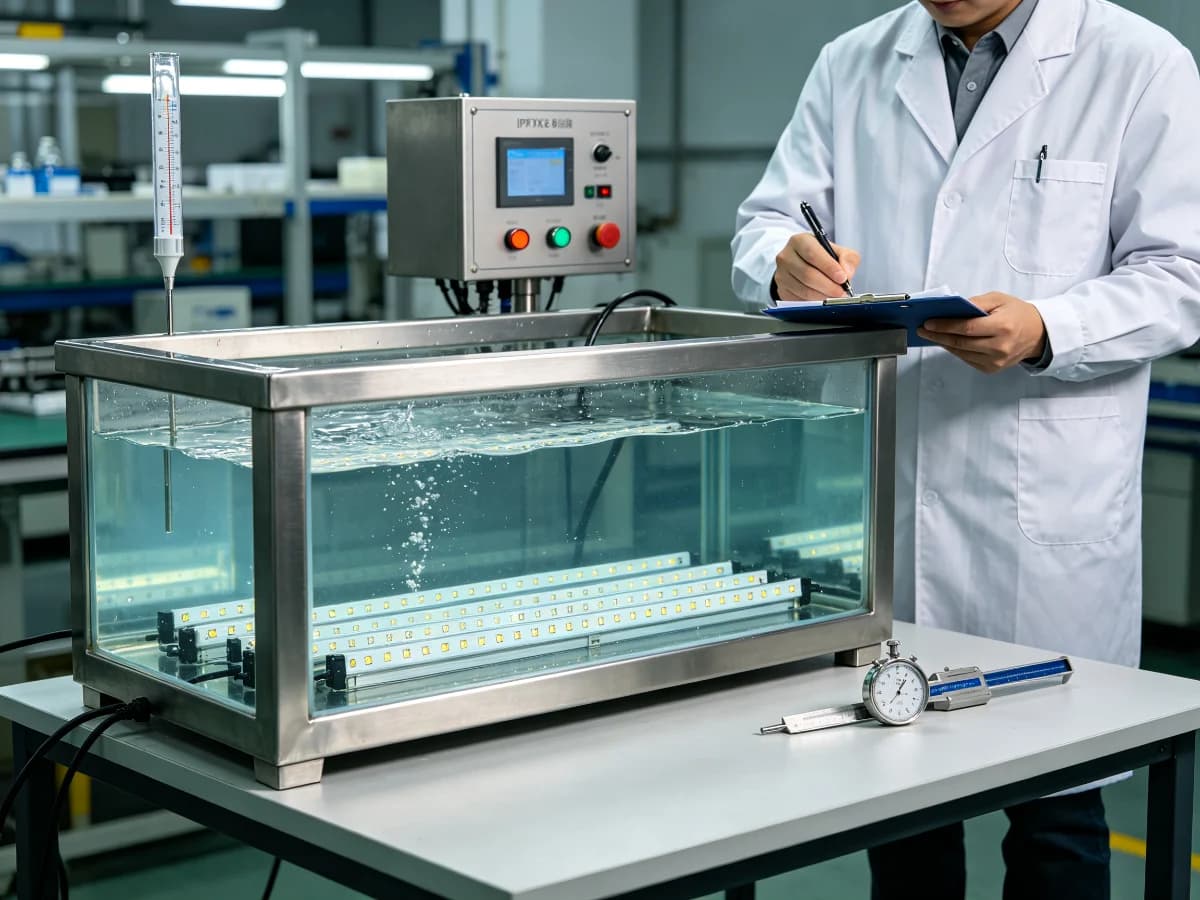
The most reliable verification is to test the product yourself before committing to a bulk order. For a small sample, a simple bowl of water can confirm an IP67 claim: submerge a 30 cm section (with end caps and one connector) in 1 m of water for 30 minutes, then power it on and inspect for dark spots or flickering. If it fails the bowl test, it will fail in the field.
For IP68 claims, ask the supplier for the actual test conditions: depth, duration, water temperature, and whether the test was performed with the strip powered on or off. Require a third-party test report from an accredited laboratory (TÜV, SGS, Intertek) rather than an in-house 'factory test.' In-house tests have their place as batch quality control, but they do not constitute independent certification.
For production orders, add a clause to the purchase order requiring random-sample immersion testing before shipment, with the test report attached to the packing list. The incremental cost of a pre-shipment water immersion test is tiny compared with the cost of a full container of failing strips. If the supplier resists batch-level testing, that resistance itself tells you something about how confident they are in the seal.
- Bowl test IP67: 30 cm sample, 1 m water, 30 minutes, then power on
- For IP68, require depth, duration and temperature specifications
- Prefer third-party lab reports (TÜV, SGS, Intertek) over factory-only reports
- Add pre-shipment random immersion testing to the purchase order
- Include the connector and end caps in every immersion test — they are the weak points
- Test with the strip powered on, not just unpowered
8. Summary: Pick the Right Rating for the Job
Choosing between IP65, IP67 and IP68 is not a matter of choosing the highest number you can afford. It is a matter of matching the rating to the actual water exposure the strip will face. Most outdoor architectural applications — facades, eaves, coves, landscape lighting — are well served by IP65 silicone-coated strips, and any money spent on IP67 or IP68 for these applications is wasted, or worse, spent on a product that runs hotter and fails sooner.
IP67 is the right choice when the strip may be splashed, briefly submerged, or installed in a damp environment where water can pool. IP68 is the right choice only when the strip will genuinely remain underwater for extended periods, and even then you must specify the depth and duration. For any rating above IP65, require evidence — not just a label on the product photo.
| Application | Recommended rating | Why |
|---|---|---|
| Indoor cove, display case | IP20 | No water exposure |
| Outdoor eave, facade, patio | IP65 | Rain exposure only, no immersion |
| Bathroom mirror light, kitchen backsplash | IP65 | Splashes from washing, no immersion |
| Fountain, steam room, splash zone | IP67 | May be splashed or briefly submerged |
| Pool lighting, underwater feature | IP68 | Continuous immersion at specified depth |
| Food/beverage wash-down area | IP69K (or IP67 minimum) | High-pressure hot water cleaning |
Frequently asked questions
Questions buyers ask
Is IP65 enough for outdoor LED strip lighting?
For most outdoor architectural installations — facades, eaves, cove lighting, patios and landscape features — IP65 is sufficient. It protects against rain and direct water spray from a hose. It is not designed for immersion. Choose IP67 or higher only if the strip may be submerged or exposed to heavy wash-down.
Can IP65 LED strips be used in a bathroom?
IP65 is acceptable for bathroom mirror lighting, toe-kick lighting and shower-adjacent applications where the strip is exposed to splashes but not direct water flow. In a shower enclosure itself, where water directly strikes the strip daily, IP67 or higher is recommended. Always confirm local electrical code requirements for wet and damp locations.
What is the difference between silicone-coated and potted LED strips?
Silicone-coated strips have a thin layer of conformal silicone over the PCB and LEDs, which typically achieves IP65. Potted strips are fully embedded in epoxy or silicone resin inside a tube, which typically achieves IP67 or IP68. Potted strips are bulkier, less flexible and run hotter, but they provide much better water protection. For most outdoor use, silicone-coated IP65 is the right balance.
Do LED strip connectors affect the IP rating?
Yes. The IP rating on the strip itself does not automatically apply to connectors, end caps or solder joints. Water always enters through the weakest point. Always confirm that connectors are rated to the same IP as the strip and that end caps are factory-sealed. A fully potted strip with unrated connectors is only as waterproof as its connectors.
How long will an IP65 LED strip last outdoors?
An IP65 LED strip installed in a ventilated aluminum channel away from direct UV exposure typically lasts 3 to 5 years. Direct sunlight and temperature cycling harden silicone coatings over time, which can crack at the edges and allow water ingress. UV-stabilized coatings and aluminum channels with thermal management extend life. IP-rated strips are not permanently waterproof; the seal degrades with age.
Can I make an IP20 strip waterproof by adding silicone myself?
Field-applied silicone or hot glue rarely achieves a reliable IP rating. A proper waterproof coating requires uniform coverage under controlled conditions, with attention to connectors and end caps. A home-sealed strip may appear water-resistant but will likely leak at the joints after a few months. Buy the rating you need from the factory rather than trying to upgrade it in the field.
Is IP68 always better than IP65 for outdoor use?
No. IP68 strips are fully encapsulated, which traps heat against the LEDs and reduces heat dissipation. Since LED lifespan is directly tied to junction temperature, an IP68 strip installed on a facade will run hotter and may have a shorter life than an IP65 strip in the same location. Match the rating to actual water exposure, and do not automatically buy the highest rating.
Talk to the product team
Planning an OEM or commercial lighting order?
Send your application, specification and destination market. We will help narrow the product and sample options.
Discuss on WhatsApp