
Key takeaways
- Vapor-tight, tri-proof and vapor-proof are regional and marketing terms, not ratings. Two fixtures with the same label can be built very differently, so compare the per-model IP, IK, housing and certification instead of the name.
- IP tells you how well the enclosure is sealed; IK tells you how hard it can be hit; NSF tells you whether the materials and construction are hygienic for food. These answer different questions, and a fixture can pass one without the others.
- Match the IP to the cleaning method: IP65 for dry areas and occasional cleaning, IP66 for routine hose-down, and IP69K only where high-temperature, high-pressure washdown is actually used.
- In food plants, work from the NSF/ANSI 2 zone (food, splash or non-food), not the room name. Use shatterproof polycarbonate with no exposed glass wherever product is open, and verify the NSF listing number in the database.
- For cold rooms, the deciding factors are the low-temperature driver rating, a defrost-cycle margin and a pressure-balancing vent that stops condensation. Sealing a fixture completely without a vent can make the moisture problem worse.
1. What actually kills a normal fixture in a wet or dusty space?
A standard indoor LED fixture is built around a ventilated or lightly sealed housing. That is fine for an office. Put it in a parking garage, a wash bay or a food processing line and it fails in predictable ways: dust settles on the driver and insulates it, water and grease creep in along the lens and cable entry, and the electrolytic capacitors cook or corrode. The lens clouds, the driver shorts, and the light starts flickering or simply switches off long before its L70 rating would suggest.
The mistake buyers make is treating this as a single waterproofing problem and reaching for the highest IP number on the page. A fixture that is hermetically sealed is not automatically the right one. Seal it completely with no way to equalize pressure, and warm air trapped inside during a defrost or washdown cycle condenses into water droplets on the lens. Use the wrong gasket material and it turns brittle after a few months of aggressive sanitizer. The fixture has to be sealed, ventilated in a controlled way, and chemically matched to how the room is cleaned.
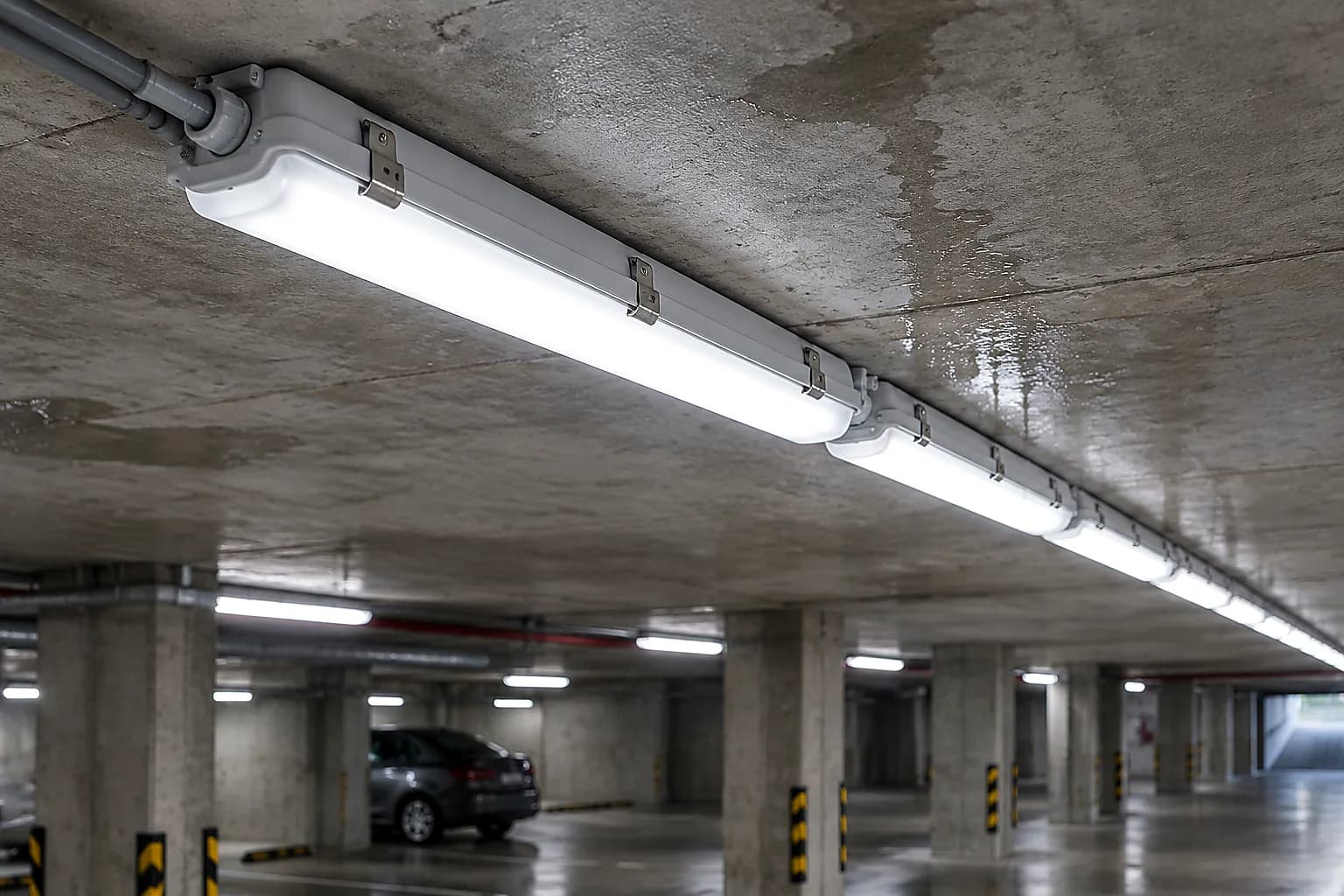
This is why the category exists. A vapor-tight or tri-proof light is a linear, fully gasketed luminaire with a polycarbonate lens and housing, clip or screw closures, and usually a single conduit entry. It is designed to keep water, dust, aerosols and, in the better versions, corrosive chemicals away from the electrical parts. The category is mature, but the specification details are where cheap and competent products separate.
2. Get the terminology straight before you compare products
The labels on these fixtures are not standardized, and that causes real confusion. Vapor-tight is the common North American term, tied to the UL world and focused on keeping atmospheric moisture, mist and splashes out of the housing. Tri-proof is the broader industrial term used in Europe and Asia, short for waterproof, dustproof and corrosion-resistant. Vapor-proof usually sits a step above, with a die-cast or heavier housing and a higher IP, although it is also applied loosely. Some manufacturers add weatherproof, watertight or corrosion-proof to the same product.
In practice, the same physical fixture can be sold as a vapor-tight in one market and a tri-proof in another. The name tells you the intent, not the performance. You will find fixtures labeled vapor-tight at IP65 and others at IP66, and tri-proof products spanning much of the same range. The only defensible way to compare is to open the datasheet for each model and read the IP, IK, housing material, gasket, input voltage and approvals side by side.
Be especially careful with the word vapor-proof. It is sometimes used for genuinely heavier, sealed industrial fixtures closer to IP66 or IP67, and sometimes just as a synonym on a retail listing. If a hazardous or fully immersed location is involved, the terminology matters a great deal and you need an explicitly rated product, which is outside the scope of an ordinary vapor-tight.
| Term | Typical emphasis | Where it is used | What to verify |
|---|---|---|---|
| Vapor-tight | Keeps moisture, mist and splashes out of the enclosure | North America, UL-oriented projects | Actual IP (often IP65), gasket and lens |
| Tri-proof | Waterproof, dustproof and corrosion-resistant | Europe, Asia and global industrial projects | IP, IK, housing material and corrosion resistance |
| Vapor-proof | Heavier, more completely sealed construction | Heavier industrial and washdown use | Whether it genuinely reaches IP66/IP67 or is just relabeled |
| Weatherproof / watertight | Loose descriptive labels | Retail and general listings | Treat as marketing; require a rated datasheet |
3. Choose the IP rating from the cleaning method, not the room
The IP code, defined by IEC 60529, is two digits. The first digit is protection against solids; in this category it is almost always 6, meaning fully dust-tight. The second digit is protection against water, and that is the number that actually changes with the application. The right way to pick it is to ask how the area is cleaned and what the fixture will be exposed to, rather than matching a label to a room name.
IP65 handles dust and low-pressure water jets from any direction. It is the workhorse for parking garages, covered loading bays, warehouses, basements, corridors and anywhere that gets occasional cleaning but is not hosed down daily. IP66 withstands stronger, higher-volume water spray and suits breweries, farms, light food processing and washdown corridors where routine hosing is normal. IP67 adds protection against temporary immersion, which is rarely the deciding factor for a ceiling-mounted linear fixture and is more relevant to ground-level or flood-prone installations.
IP69K is the top of the range and is specifically for high-temperature, high-pressure washdown, around 80 degrees Celsius and high pressure, used in clean-in-place and open-product zones. It is worth pausing before you specify it everywhere. IP69K fixtures and their gaskets are built for a cleaning regime that many areas never receive, and over-specifying adds cost where IP66 would do the job. The more common mistake is the reverse: using IP65 in a zone that is pressure-washed every shift, which is a guaranteed early failure.
| Rating | Protection | Typical locations | Cleaning regime |
|---|---|---|---|
| IP65 | Dust-tight, low-pressure water jets | Parking garages, warehouses, basements, corridors | Occasional cleaning, no routine hosing |
| IP66 | Dust-tight, stronger water spray | Breweries, farms, light food processing, washdown corridors | Routine hose-down |
| IP67 | Dust-tight, temporary immersion | Flood-prone or ground-level installations | Wet floors and standing water risk |
| IP69K | High-temperature, high-pressure washdown | Open-product and clean-in-place food zones | Daily hot, pressurized washdown |
4. IK ratings: how hard can the fixture be hit?
IP says nothing about physical impact, which is why the IK code exists under IEC 62262. In a parking garage, a loading dock, a transit area or a prison corridor, a light can be struck by a ladder, a pallet, a vehicle or a person. A thin lens that seals perfectly will still crack on impact, and a cracked lens ends the IP protection immediately. The two ratings work together.
Most linear vapor-tight fixtures land at IK08 or IK10. IK08 means the housing and lens survive a 5-joule impact, verified by a pendulum hammer test on the actual fixture. IK10 is the tougher end at 20 joules and is the standard choice for vandal-resistant and high-abuse locations. You will see IK10 paired with tamper-resistant Torx screws and captive or two-piece lens designs specifically so the fixture cannot be opened or smashed easily.
Do not assume a thick-looking plastic lens is IK10. The rating depends on the housing geometry, the lens material and how it is retained, not just wall thickness. For a food plant, the priority is usually the shatterproof and NSF requirements; for a parking garage or transit area, IK10 is often the more important number. If both impact and hygiene matter, specify both rather than choosing one rating and hoping it covers the other.
5. Food-grade lighting: NSF is not the same as IP
This is the single most common point of confusion in food projects. An IP rating documents how well the enclosure keeps water and dust out. NSF certification, under NSF/ANSI 2 for food equipment, documents that the materials and construction meet food-equipment sanitation standards: the surfaces are smooth and cleanable, the materials are non-toxic and non-absorbent, and the design does not harbor debris. A fixture can be perfectly sealed and still not NSF-listed, and an NSF listing does not by itself tell you the water pressure the housing can take. In open-product areas you genuinely need both.
NSF/ANSI 2 divides a plant into three zones, and the zone sets the requirement. The food zone covers surfaces and equipment that directly contact food, which for a luminaire generally means it must be built to the most stringent hygienic and shatter-resistant standard. The splash zone covers fixtures that will not touch product but will realistically receive spray, spillage or hose washdown. The non-food zone covers dry storage, corridors and packaging staging where product contact is not expected and nothing drips onto the fixture. NSF listings are often written as for splash zone and non-food zone, which tells you exactly where the manufacturer is approved to install it.
Wherever food is open, the diffuser must be shatterproof polycarbonate with no unprotected glass. If the lens is struck, it should not shed fragments into the product. The materials also have to match the sanitizers the plant actually uses; stainless steel clips and certain gasket compounds tolerate chlorine and acidic cleaners that cheaper plastics do not. Finally, always verify the listing number in the NSF database rather than trusting a logo on a spec sheet, the same way you would confirm a UL mark.
| NSF/ANSI 2 zone | What it covers | Typical lighting requirement | Minimum surface light |
|---|---|---|---|
| Food zone | Direct food contact and open product lines | NSF-listed, shatterproof PC, highest hygiene and washdown rating | Around 50 foot-candles at the working surface |
| Splash zone | Spray, spillage and hose washdown, no product contact | NSF-listed for splash zone, IP66 or IP69K as cleaned | Roughly 300-750 lux depending on the task |
| Non-food zone | Dry storage, corridors, packaging staging | NSF for non-food zone where listed; IP65 is often sufficient | Lower task levels, aligned with the room use |
6. Cold rooms and freezers: it is mostly a driver and condensation problem
Cold storage is counterintuitive. LEDs actually become more efficient at low temperatures, because the cold reduces thermal stress on the diode. The weak point is everything around it. The driver, and especially its electrolytic capacitors, has to start reliably at the lowest room temperature, and a standard fixture rated down to minus 20 degrees Celsius may not start in a deep freezer held at minus 30. The operating-temperature range has to cover the coldest the room reaches and include a margin for the defrost cycle, when the heater briefly warms the evaporator and the air around it.
The second issue is condensation and pressure. A cold room is held at negative pressure relative to the corridor, and the temperature swings between cooling and defrost. A fixture that is completely sealed traps a fixed volume of air; as the temperature cycles, the pressure difference pulls moist air in through any available path, and water condenses inside the lens. The better cold-room fixtures use a pressure-balancing breather, a membrane vent that lets air move while blocking liquid and dust, so the internal pressure follows the room without drawing in moisture. This is why a vent is not a leak in a cold-room fixture, and why sealing every opening can be the wrong move.
Specify the fixture by the actual room temperature and the defrost arrangement. Standard tri-proof battens commonly run from about minus 20 to plus 40 degrees Celsius, while purpose-built linear vapor-tight fixtures for walk-in coolers and freezers are rated from minus 40 to plus 50, with grey polycarbonate housings, stainless steel latch clips and a universal 120 to 277 volt input. Confirm the gasket stays flexible at the low end; a gasket that contracts and hardens during defrost opens a path for moisture.
- Rate the fixture to the lowest room temperature, with a defrost-cycle margin, not the average
- Require a low-temperature-rated driver and capacitors that start at the cold end
- Use a pressure-balancing membrane vent rather than sealing the housing completely
- Confirm the gasket remains flexible and does not contract at low temperature
- Account for the room's negative pressure when planning conduit and cable entry
7. Construction and sealing: the details that separate good fixtures
Once the environmental ratings are set, the construction decides how the fixture holds up. Look at the lens first: a frosted or opal polycarbonate diffuser gives even output and hides the individual diodes, and it should be retained so it keeps its seal after maintenance. The housing is usually polycarbonate or a polycarbonate base with an optional coated aluminum, and the clips that hold the lens closed are the part buyers most often overlook. Stainless steel latches resist corrosion and repeated opening; plastic clips are cheaper and are usually the first thing to break or relax.
The gasket matters more than it looks. Better fixtures use a poured-in-place polyurethane or a continuous silicone gasket rather than a loose foam strip, and the gasket chemistry has to tolerate the cleaning chemicals and the temperature range. A two-piece design with a captive lens and separate electrical and housing enclosures makes servicing safer and keeps the seal intact. In high-abuse or vandal-prone areas, tamper-resistant Torx screws replace or supplement the clips. Cable entry is the other classic leak point; a single conduit entry with a properly sealed gland is far more reliable than multiple knockouts that are left open or loosely plugged.
These are not exotic features, but they are easy to cut. A datasheet that lists a high IP while showing plastic clips, a strip gasket and multiple open cable entries is telling you where the cost was removed. Ask for the construction details in writing, especially for a washdown or freezer installation where the seals are doing the real work.
8. Mounting, voltage and dimming: plan the practical installation
Linear vapor-tight fixtures are flexible to mount, and the same model usually supports surface mounting on a wall or ceiling with standard brackets, plus suspension by chain or cable using a bail or mounting kit. Decide the method before ordering, because the brackets and hardware vary, and in a food plant the suspension hardware also has to be cleanable and corrosion-resistant. For walk-in coolers, confirm where the fixture sits relative to the evaporator and the door so it is not directly in the defrost airstream or blocked by shelving.
On the electrical side, North American fixtures almost universally use a 120 to 277 volt wide-range driver, which covers the common commercial and industrial voltages. Dimming is often 0-10 volt, typically down to about 10 percent, and should be specified up front rather than assumed. For projects that need rebates, a DLC listing, including DLC Premium where the efficiency and performance qualify, is often the deciding factor, and it should be confirmed against the current DLC qualified-products list using the exact model number.
Where several fixtures are daisy-chained, follow the manufacturer's wiring and conduit rules and do not exceed the rated through-wiring. In a cold room or washdown area, every added junction and unsealed opening is a potential failure point, so the cleaner design minimizes connections and keeps them inside the sealed fixture or a properly rated enclosure.
9. A verification checklist for the supplier
Before you release a purchase order, get the answers that actually determine whether the fixture will survive the space. The point is to tie every claim to the exact model and a verifiable listing, rather than accepting a family name and a logo.
Confirm the per-model IP and IK, the housing, lens, gasket and clip materials, and the operating-temperature range. For food, require the NSF listing and the exact zones it covers, then check the listing number in the NSF database. For cold rooms, add the low-temperature driver rating, the defrost margin and the pressure-balancing vent. For rebates, confirm the DLC listing on the live list. Finally, confirm the input voltage, dimming, mounting hardware and conduit entry, and keep a copy of the datasheet with the order for receiving and future repeat orders.
- Per-model IP and IK ratings, not the product family name
- Housing, lens, gasket and latch materials, with stainless clips where wet or corrosive
- NSF listing number and the exact food, splash or non-food zones covered
- Operating-temperature range with a defrost margin, plus a low-temperature driver for freezers
- Pressure-balancing vent where condensation is a risk
- DLC listing and rebate eligibility confirmed on the current list
- Input voltage, dimming range, mounting hardware and sealed conduit entry
- Datasheet and listing records filed with the purchase order
Frequently asked questions
Questions buyers ask
What is the difference between vapor-tight and tri-proof lights?
Vapor-tight is mainly a North American term for a gasketed fixture that keeps moisture and mist out; tri-proof is a broader industrial term meaning waterproof, dustproof and corrosion-resistant. They often describe the same physical fixture sold in different markets. The names are not ratings, so compare the per-model IP, IK, materials and approvals rather than choosing by the label.
Should I use IP65, IP66 or IP69K?
Choose by how the area is cleaned. IP65 suits dry areas and occasional cleaning like garages and warehouses; IP66 handles routine hose-down in places like breweries and washdown corridors; IP69K is for daily high-temperature, high-pressure washdown in open-product food zones. Specifying IP69K everywhere adds cost where it is not needed, while using IP65 in a pressure-washed zone guarantees early failure.
Is an NSF listing the same as a high IP rating?
No. IP measures how well the enclosure is sealed against water and dust; NSF measures whether the materials and construction meet food-equipment sanitation standards. A fixture can be well sealed without being NSF-listed. In open-product food areas you need both, and you should verify the NSF listing number in the database.
What are the food, splash and non-food zones in NSF/ANSI 2?
The food zone covers equipment that directly contacts food and needs the most stringent, shatterproof hygienic construction. The splash zone covers fixtures that receive spray, spillage or washdown but do not touch product. The non-food zone covers dry storage, corridors and packaging staging. The zone, not the room name, sets the lighting requirement.
Can I use a normal tri-proof light in a walk-in freezer?
Not always. LEDs work well in the cold, but the driver and capacitors must start at the lowest room temperature, and the fixture needs a margin for the defrost cycle. Standard tri-proof battens are often rated only to about minus 20 Celsius, while freezer-rated linear vapor-tight fixtures reach minus 40. Check the rated range and the low-temperature driver before installing one.
Why does water condense inside a sealed cold-room fixture?
A fully sealed fixture traps air, and temperature swings between cooling and defrost, together with the room's negative pressure, pull moist air in and condense it on the lens. The solution is a pressure-balancing membrane vent that lets air equalize while blocking liquid and dust, paired with a gasket that stays flexible at low temperature.
What does IK10 add compared with IK08?
IK08 survives a 5-joule impact, while IK10 handles 20 joules and is used in parking garages, loading docks and vandal-prone areas. IK ratings are tested with a pendulum hammer and are independent of IP; a lens that seals well can still crack on impact, so high-abuse locations need both a high IP and IK10.
Do these fixtures qualify for DLC rebates?
Many linear vapor-tight and tri-proof fixtures are DLC listed, and the more efficient ones qualify for DLC Premium. Eligibility is model-specific, so confirm the exact model number on the current DLC qualified-products list rather than relying on a general claim, and do this before ordering if a rebate is part of the project economics.
Sources and references
JCE Lighting - How to choose LED vapor tight lightsLumera Electric - Lighting for food processing plants (NSF/IP69K)Maes Lighting - What NSF-rated lighting actually certifiesHONNEX - Tri-proof lights for cold rooms and refrigerated areasLED Cooler Door Lights - Linear vapor-tight fixtures for cold storageAcuity Brands - Vapor tight LED strip light construction sheetTalk to the product team
Planning an OEM or commercial lighting order?
Send your application, specification and destination market. We will help narrow the product and sample options.
Discuss on WhatsApp